
2025 · Paper 1 · Chemistry
Question 4
The printed question, the official key, and each model’s JSON answer plus the reasoning it wrote.
Q04
Official B
Model answers
Claude Fable 5.1
Anthropic
B
Claude Fable 5.1 reasoning
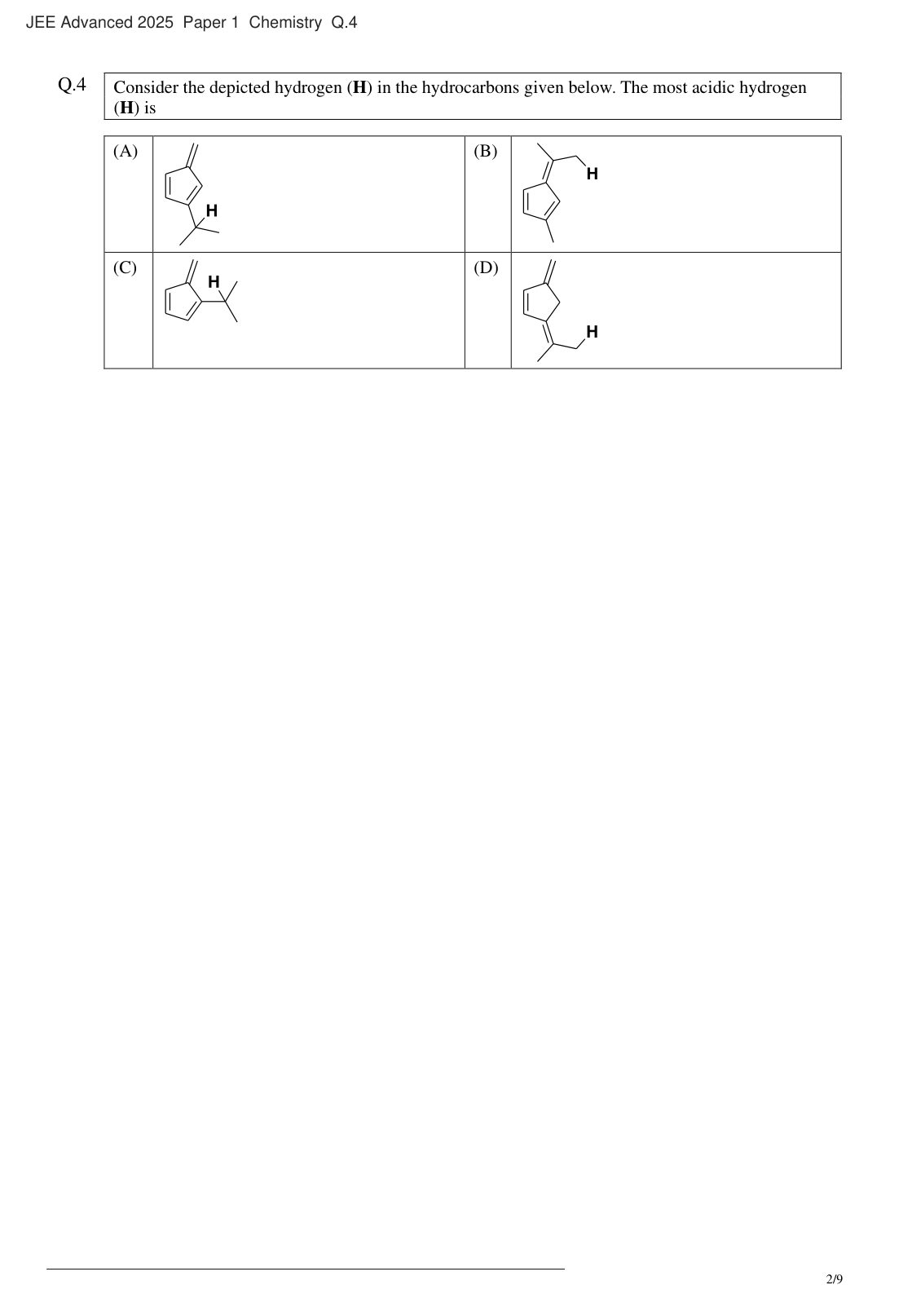
**Analysis:** Deprotonating the marked H in each case, we check whether the resulting carbanion can be delocalised into an aromatic cyclopentadienide ring. - **(A) and (C):** The H is on the isopropyl CH attached to a fulvene ring. The negative charge delocalises through the ring double bonds and ends up on the exocyclic CH₂ carbon, but at no stage does the five‑membered ring acquire 6 π‑electrons (the ring carbons are already fully sp² in fulvene, and exocyclic double bonds remain). No aromatic stabilisation. - **(D):** The ring contains an sp³ CH₂, an exocyclic =CH₂ and an exocyclic =C(CH₃)₂. Removing the marked methyl H gives an allylic-type anion that delocalises onto the ring carbon and further to the other exocyclic CH₂, but the ring never attains a cyclopentadienide (6 π) arrangement because of the sp³ carbon and exocyclic double bonds. - **(B):** The H is on a methyl group of the 6,6‑dimethylfulvene unit (C₅H₃(CH₃)=C(CH₃)₂). Loss of this H gives CH₂⁻–C(CH₃)=C(ring); resonance pushes the exocyclic C=C into CH₂=C(CH₃)– and places the negative charge on the ring carbon. That ring carbon, together with the two ring C=C bonds, forms an **aromatic cyclopentadienide anion (6 π electrons)**. This large aromatic stabilisation makes the marked H in (B) by far the most acidic (dimethylfulvene is indeed deprotonated at the methyl by bases like alkyllithium). **Answer: (B)**
GPT 6 Astra
OpenAI
B
GPT 6 Astra reasoning
No written reasoning was returned for this item.
GPT 5.6 Luna
OpenAI
B
GPT 5.6 Luna reasoning
No written reasoning was returned for this item.