
2025 · Paper 2 · Chemistry
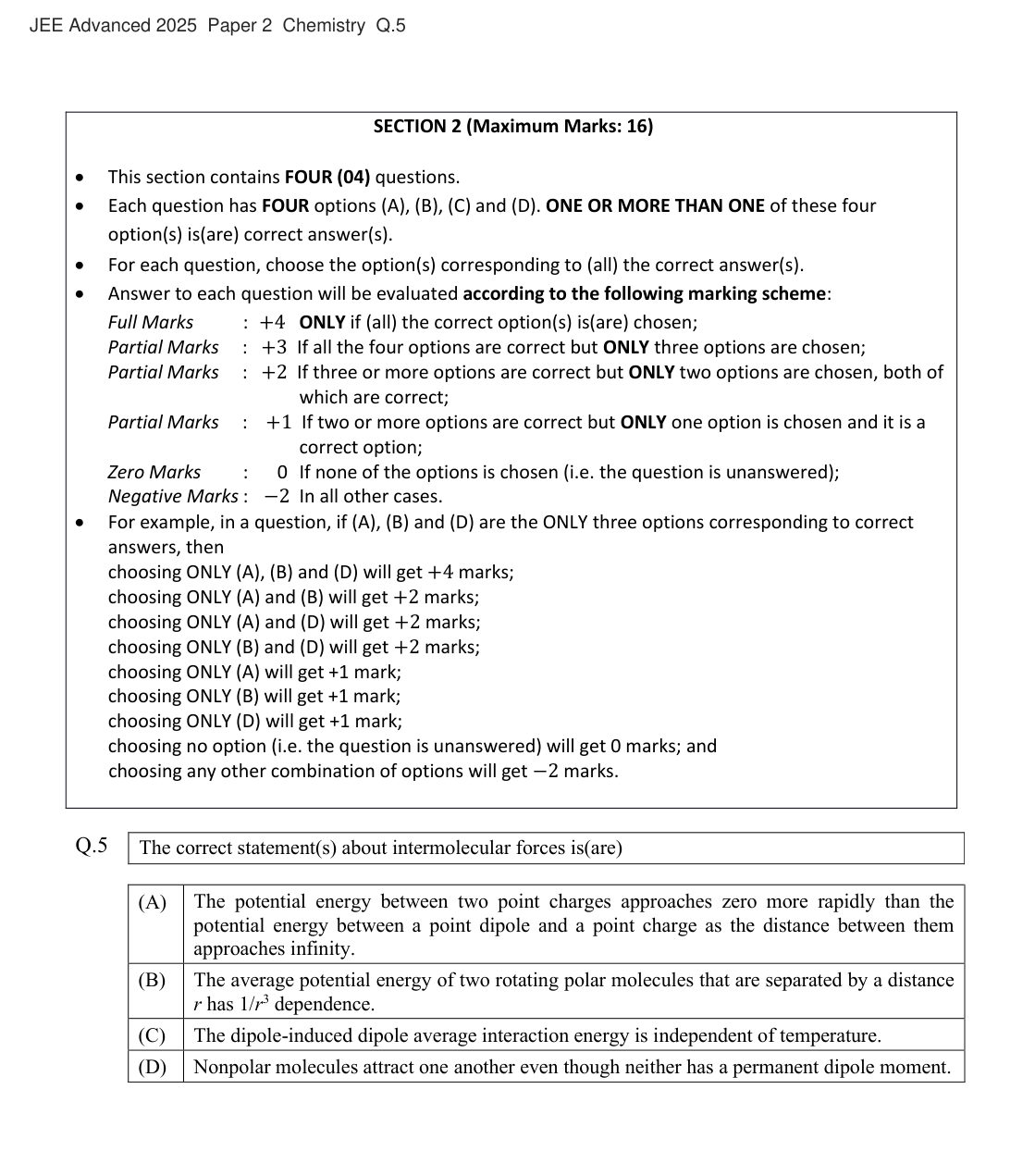
Question 5
The printed question, the official key, and each model’s JSON answer plus the reasoning it wrote.
Q05
Official C, D
Model answers
Claude Fable 5.1
Anthropic
C, D
Claude Fable 5.1 reasoning
Analyzing each statement: **(A)** Point charge–point charge potential energy: V ∝ 1/r. Point dipole–point charge: V ∝ 1/r². The dipole–charge interaction falls off faster, so the charge–charge energy approaches zero *less* rapidly. Statement (A) is **false**. **(B)** Two freely rotating polar molecules (Keesom interaction): the average energy is ⟨V⟩ = −2μ₁²μ₂²/(3(4πε₀)²kT r⁶), i.e. 1/r⁶ dependence, not 1/r³. (1/r³ applies to fixed-orientation dipole–dipole interactions.) Statement (B) is **false**. **(C)** Dipole–induced dipole interaction: V = −μ₁²α₂′/(4πε₀ r⁶). The induced dipole always follows the orientation of the permanent dipole, so the interaction is attractive for all orientations and averaging over rotation introduces no temperature dependence. Statement (C) is **true**. **(D)** Nonpolar molecules attract each other via London dispersion forces arising from instantaneous, fluctuating dipoles (e.g., liquefaction of noble gases). Statement (D) is **true**. Correct options: (C) and (D).
GPT 6 Astra
OpenAI
C, D
GPT 6 Astra reasoning
No written reasoning was returned for this item.
GPT 5.6 Luna
OpenAI
C, D
GPT 5.6 Luna reasoning
No written reasoning was returned for this item.