
2026 · Paper 1 · Mathematics
Question 5
The printed question, the official key, and each model’s JSON answer plus the reasoning it wrote.
Q05
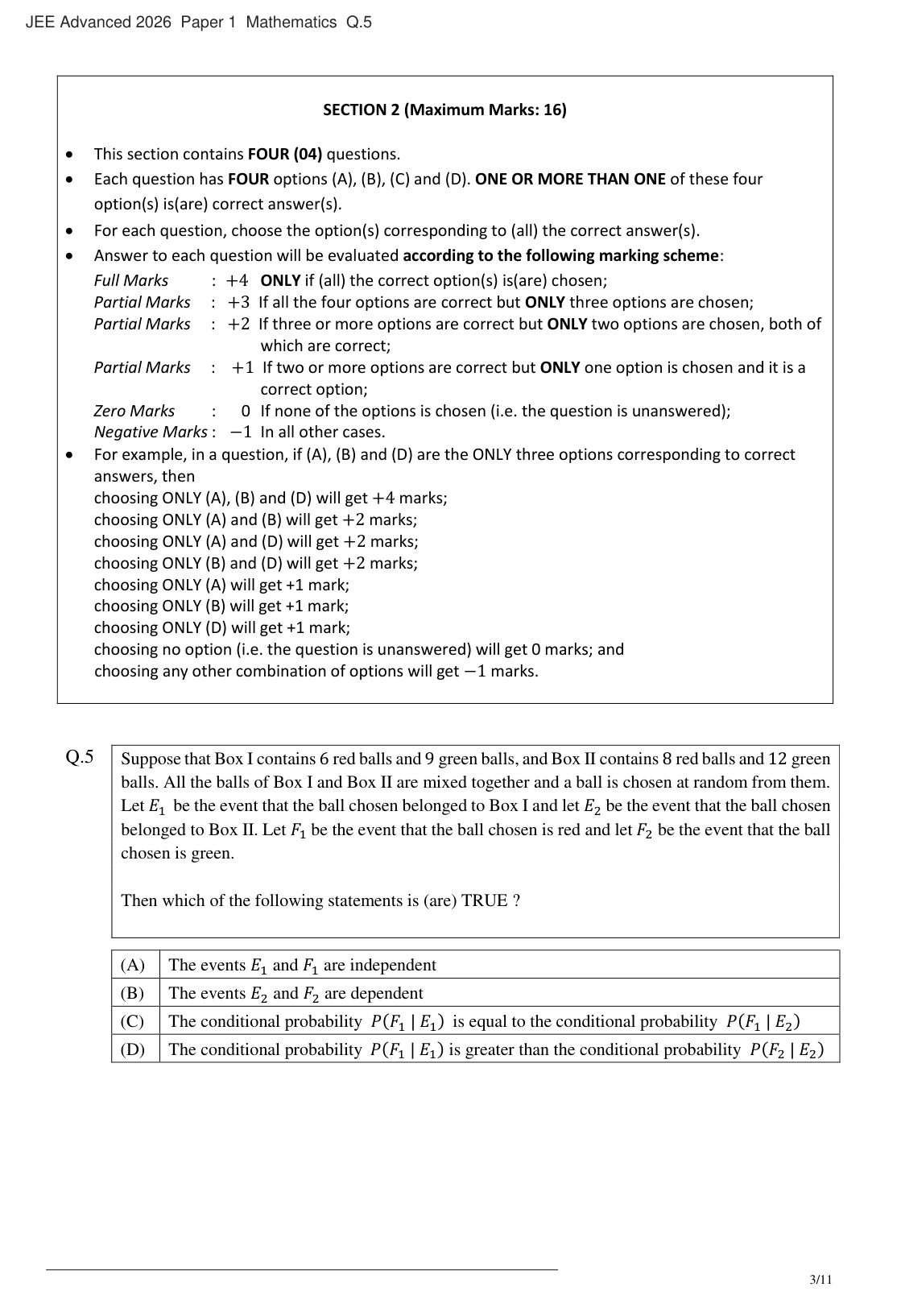
Official A, C
Model answers
Claude Fable 5.1
Anthropic
A, C
Claude Fable 5.1 reasoning
Box I: 6 red, 9 green (15 balls, red fraction 2/5). Box II: 8 red, 12 green (20 balls, red fraction 2/5). Total 35 balls: 14 red, 21 green. P(E1) = 15/35 = 3/7, P(F1) = 14/35 = 2/5, P(E1∩F1) = 6/35 = (3/7)(2/5). So E1, F1 independent → (A) true. P(E2) = 4/7, P(F2) = 3/5, P(E2∩F2) = 12/35 = (4/7)(3/5). Independent → (B) false. P(F1|E1) = 2/5 = P(F1|E2) → (C) true. P(F1|E1) = 2/5, P(F2|E2) = 3/5, so 2/5 < 3/5 → (D) false.
GPT 6 Astra
OpenAI
A, C
GPT 6 Astra reasoning
**Calculating ratios** I need to solve a straightforward ratio using .4 and .6. I'm thinking that a true C is essential here, which means the output should just be in JSON format. It seems like focusing on the final object would be the best approach. I'll make sure to structure it correctly to meet the requirements, as that's the goal. Let's get this done efficiently!
GPT 5.5
OpenAI
A, C
GPT 5.5 reasoning
No written reasoning was returned for this item.
Claude Sonnet 5
Anthropic
A, C
Claude Sonnet 5 reasoning
I'm computing the totals for both boxes and finding the probabilities of drawing each box and each color combination, then checking the conditional probability of picking box I given a red ball is drawn from each box — both come out equal at 2/5, meaning red drawn first doesn't help distinguish which box was chosen. Since P(F1|E1)=P(F1|E2)=2/5, this equals P(F1) itself, confirming E1 and F1 are independent, so A is true and C is true. Checking B, P(F2|E2)=3/5 equals P(F2), so E2 and F2 are also independent, making B false. For D, comparing 2/5 to 3/5 shows the inequality doesn't hold, so D is false — leaving A and C as the correct answers. Looking at this problem, I need to find probabilities based on the pooled sample space. **Setup:** - Box I: 6 red, 9 green (total 15) - Box II: 8 red, 12 green (total 20) - Combined: 14 red, 21 green (total 35) **Basic probabilities:** - P(E₁) = 15/35 = 3/7 - P(E₂) = 20/35 = 4/7 - P(F₁) = 14/35 = 2/5 - P(F₂) = 21/35 = 3/5 **Conditional probabilities:** - P(F₁|E₁) = 6/15 = 2/5 - P(F₁|E₂) = 8/20 = 2/5 - P(F₂|E₁) = 9/15 = 3/5 - P(F₂|E₂) = 12/20 = 3/5 **Checking (A):** E₁ and F₁ independent ⟺ P(F₁|E₁) = P(F₁) - P(F₁|E₁) = 2/5, P(F₁) = 2/5 ✓ **TRUE** **Checking (B):** E₂ and F₂ dependent ⟺ P(F₂|E₂) ≠ P(F₂) - P(F₂|E₂) = 3/5, P(F₂) = 3/5, these are equal, so E₂ and F₂ are **independent**, not dependent. - **FALSE** **Checking (C):** P(F₁|E₁) = P(F₁|E₂)? - Both equal 2/5 ✓ **TRUE** **Checking (D):** P(F₁|E₁) > P(F₂|E₂)? - 2/5 vs 3/5: 2/5 is NOT greater than 3/5 - **FALSE** ```json