
2026 · Paper 1 · Physics
Question 16
The printed question, the official key, and each model’s JSON answer plus the reasoning it wrote.
Q16
Official A
Model answers
Claude Fable 5.1
Anthropic
A
Claude Fable 5.1 reasoning
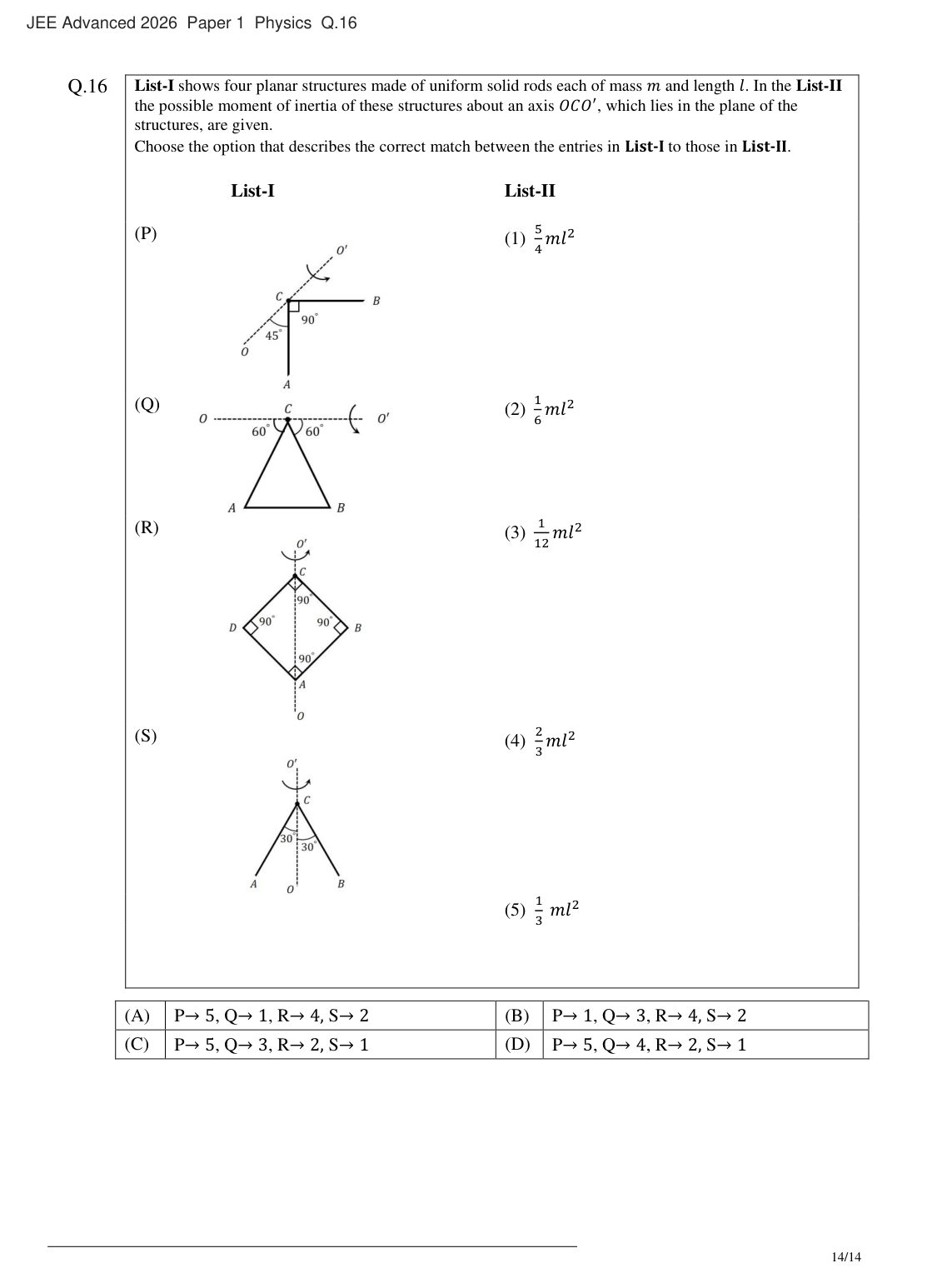
For (P), I calculate the moment of inertia using two rods meeting at 90° with the axis at 45° to each, giving (1/6)ml² per rod for a total of (1/3)ml², matching option 5. Now I'm moving to (Q), which involves an equilateral triangle. For (Q), each rod CA and CB makes 60° with an axis through vertex C parallel to base AB, giving (1/4)ml² each for the two rods, plus the base AB's contribution using its distance from the axis, totaling 5/4 ml², matching option 1. For (R), a diamond/square shape with the axis along a diagonal has each of the four rods at 45°, giving 2/3 ml² total, matching option 4. For (S), two rods each at 30° from the axis give 1/6 ml² total, matching option 2 — so the full mapping is P→5, Q→1, R→4, S→2, pointing to answer A. **Using** I of a rod about an axis through its end making angle θ with the rod: I = (1/3)ml² sin²θ. - **(P)**: Two rods each at 45° to axis → 2 × (1/3)ml²(1/2) = (1/3)ml² → (5) - **(Q)**: Rods CA, CB at 60° → 2 × (1/3)ml²(3/4) = (1/2)ml²; rod AB parallel at distance (√3/2)l → (3/4)ml². Total = (5/4)ml² → (1) - **(R)**: Four rods each at 45° → 4 × (1/6)ml² = (2/3)ml² → (4) - **(S)**: Two rods at 30° → 2 × (1/3)ml²(1/4) = (1/6)ml² → (2)
GPT 6 Astra
OpenAI
A
GPT 6 Astra reasoning
**Calculating dimensions** I'm looking at a calculation that seems straightforward. I need to calculate P as 2 ml^2/3 sin(45°)², which gives me 1/3 for item 5. For Q, it involves slants, so 1/4 plus the base of 3/4, totaling 5/4 for item 1. R includes four 1/6 amounts, which gives 2/3 for item 4. Finally, for S, I calculate 2/3 sin(30°)², equaling 1/6 for item 2. I’ll structure the final answer in JSON format!
GPT 5.5
OpenAI
A
GPT 5.5 reasoning
**Evaluating rod dynamics** I'm considering the moment for a rod about an axis through one end at angle θ. It appears to be calculated as (m l^2/3) sin^2 θ (in-plane). When I sum it up as 2 * (m l^2/3 * 1/2), I find it equals m l^2/3. So, the value seems to be 5, which corresponds to options A, C, and D. I wonder about the structure being an equilateral triangle with three uniform solid rods, each of length l and mass m. **Calculating mass distribution** I’m considering a situation where I have a mass distribution related to a system. It seems like I’m deriving a result from a formula using the moment of inertia, which leads to a total of 2/3 ml² when I calculate. I’ve noted that I'm looking at 4 sections, and I'm weighing options between A and B for further analysis. I need to streamline my approach here, so I’ll decide how to proceed based on what I find. **Analyzing geometry and angles** I'm checking the configuration, starting with an axis drawn from the bottom left to the top right. There's a horizontal rod from point C extending to the right, forming an acute angle of approximately 45 degrees with the axis. I’m confirming the angles, including a vertical rod pointing down and a base length l, which suggests an equilateral triangle with the base AB being horizontal. I’m working through all these angles and configurations to ensure clarity.
Claude Sonnet 5
Anthropic
A
Claude Sonnet 5 reasoning
I'm working through Structure P, trying to figure out the geometry - rod OA at 45° from vertical, rod CB horizontal, and the axis OCO' where O, C, O' appear to be colinear along the OC direction. I need to re-examine the figure to confirm how these rods and the axis relate to each other. Given the answer mapping, P mostly corresponds to 5/4 ml² except in option B. I'm trying to reconstruct the rod geometry from the figure: O at the bottom connecting at 45° to C, with a right angle at C between rods CA and CB, and the axis OO' passing through O and C. Actually looking closer, OA is a vertical dashed reference line, not a rod, with the 45° marked between the axis OC and this vertical at O. Since CA is also vertical and parallel to OA, that same 45° angle exists at C between the axis and rod CA. So this shape is an "L": two perpendicular rods CA (vertical) and CB (horizontal), both length l, joined at C, and the axis through C bisects the right angle between them, sitting at 45° to each rod. Now I need to compute the moment of inertia of each rod about this axis, using the fact that for a rod with one end at the axis point making angle θ with the axis, the perpendicular distance formula applies along its length. Working out each integral gives ml²/6 for rod CA and ml²/6 for rod CB, so the total comes to ml²/3 for shape P — but that seems to match option (5) rather than what I expected, so let me double-check against the list. Given the numbering: (1) 5/4 ml², (2) 1/6 ml², (3) 1/12 ml², (4) 2/3 ml², (5) 1/3 ml², my computed value of 1/3 ml² for P matches option (5), which aligns with the answer choices that have P→5. That's consistent, so now I move on to the next shape Q, an equilateral triangle with rods AB, BC, and CA each of length l, with C at top and A, B at the base. The axis OCO' is horizontal, passing through vertex C, with the rods CA and CB each making 60° angles with the axis on either side, since the triangle's apex angle at C is 60°. I still need to work out the moment of inertia of the base rod AB about this axis as well. Let me reconsider: maybe the axis doesn't bisect symmetrically, and I should work out the angle between the horizontal axis and CA using the actual geometry of the equilateral triangle with C at top, assuming angle ACB=60° stays fixed while the whole triangle is tilted relative to the axis. Good, angle ACB totals 60°, confirming the equilateral setup. Now computing moment of inertia about the x-axis for each rod: for CA, since the axis passes through endpoint C at 60°, I_CA = ml²/4, and by symmetry I_CB = ml²/4 as well. Now working out the contribution from rod AB. Since AB is parallel to the axis at constant perpendicular distance h = l√3/2, its contribution is simply I_AB = mh² = 3ml²/4. Summing all three gives I_Q = ml²/4 + ml²/4 + 3ml²/4 = 5ml²/4, matching option (1) — that's a nice consistency check. This means option A (P→5, Q→1) checks out so far. Now I should verify R and S: R involves a square-shaped arrangement of rods with axis through the vertical diagonal, and I need to work out the moment of inertia for each rod segment relative to that axis. Setting up coordinates with center at origin, C at top, A at bottom on the y-axis (the rotation axis), and B, D at horizontal distance l/√2 to the right and left respectively. Now I need to find the moment of inertia of each rod about this vertical axis using these coordinates. For rod CB, the distance from the axis varies linearly from 0 at C to l/√2 at B, so integrating x² dm along the rod gives ml²/6. By symmetry, rod CD contributes the same amount, ml²/6. By the same symmetric argument, rods BA and AD each also contribute ml²/6, giving a total I_R = 4 × ml²/6 = 2ml²/3, matching option 4, so R→4. Now moving to the S case: two rods forming a roof shape with A and B at the bottom, C at the apex, with 30° angles at the bottom. Unlike figure Q, which had a closed triangle with a base rod, figure S seems to consist only of two rods, CA and CB, meeting at apex C without a connecting base — just an open peak shape with the axis running through C. Each rod makes a 30° angle with the vertical axis, so I need to compute the moment of inertia I_S for these two rods individually, using the formula for a rod with one end on the axis at an angle θ. With θ=30°, each rod contributes ml²/12, so summing both gives I_S = ml²/6, matching option (2) — confirming S→2, which fits nicely alongside P→5, Q→1, R→4, all consistent with option A. Looking at this problem, I need to compute the moment of inertia for each structure about its given axis. **Structure P:** Two perpendicular rods (CA, CB) joined at C, with axis through C at 45° to each rod. Using I = (ml²/3)sin²θ for each rod (axis passes through rod's endpoint): I_P = 2 × (ml²/3)sin²45° = 2 × (ml²/3)(1/2) = **ml²/3** → matches (5) **Structure Q:** Equilateral triangle with axis through vertex C, horizontal, making 60° with rods CA, CB. - I_CA = I_CB = (ml²/3)sin²60° = ml²/4 each - Base AB (parallel to axis) at perpendicular distance h = l√3/2: I_AB = m·h² = 3ml²/4 Total: I_Q = ml²/4 + ml²/4 + 3ml²/4 = **5ml²/4** → matches (1) **Structure R:** Square (as diamond) with axis along vertical diagonal through A and C. Each side rod goes from a point on the axis to a point at perpendicular distance l/√2, with distance varying linearly (x = t·l/√2): I_each = m∫₀¹(t·l/√2)² dt = ml²/6 Total (4 rods): I_R = 4 × ml²/6 = **2ml²/3** → matches (4) **Structure S:** Two rods (CA, CB) meeting at apex C, axis vertical through C at 30° to each rod. I_each = (ml²/3)sin²30° = ml²/12 Total: I_S = 2 × ml²/12 = **ml²/6** → matches (2) **Summary:** P→5, Q→1, R→4, S→2, which corresponds to option (A). ```json