
2026 · Paper 2 · Chemistry
Question 1
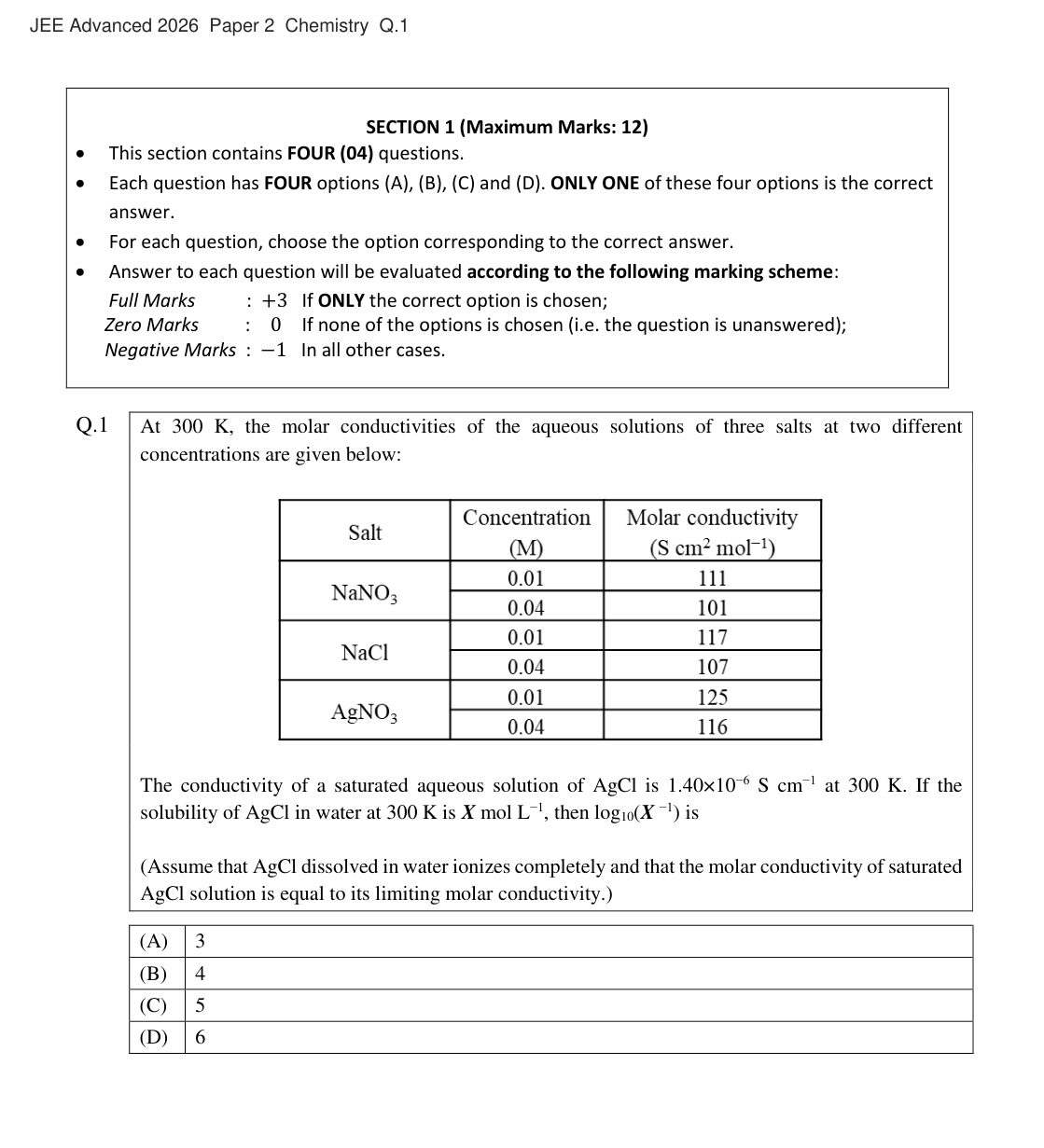
The printed question, the official key, and each model’s JSON answer plus the reasoning it wrote.
Q01
Official C
Model answers
Claude Fable 5.1
Anthropic
C
Claude Fable 5.1 reasoning
I'm applying Kohlrausch's law for NaNO3, solving the two equations to get A=100 and Λ°=121, then setting up the same approach for NaCl using its two concentration data points. Continuing, I find Λ°(NaCl)=127 and Λ°(AgNO3)=134 using similar equation pairs. Then applying the additivity relation, Λ°(AgCl) = Λ°(AgNO3) + Λ°(NaCl) − Λ°(NaNO3) = 140 S cm² mol⁻¹, and using the given conductivity κ=1.40×10⁻⁶ S cm⁻¹, I calculate solubility X = 10⁻⁵ mol/L, giving log(1/X) = 5, so the answer is C. Using Kohlrausch's law (Λm = Λ°m − A√c) with √0.01 = 0.1 and √0.04 = 0.2: - NaNO₃: Λ° = 121 - NaCl: Λ° = 127 - AgNO₃: Λ° = 134 Λ°(AgCl) = 134 + 127 − 121 = 140 S cm² mol⁻¹ X = κ × 1000 / Λ° = (1.40×10⁻⁶ × 1000)/140 = 10⁻⁵ mol L⁻¹ log₁₀(X⁻¹) = 5
GPT 6 Astra
OpenAI
C
GPT 6 Astra reasoning
No written reasoning was returned for this item.
GPT 5.5
OpenAI
C
GPT 5.5 reasoning
**Calculating concentration and pitfalls** I'm breaking down the formula, where C equals κ multiplied by 1000 over Λ. After calculating, it leads to C being 1.0×10^-5 mol/L. I’m not sure about the conductivity of pure water compared to the saturated solution, as small differences could affect results but seem negligible. They stated to assume the molar conductivity equals the limiting value, so I should finalize with only the JSON output. I’ll proceed with Option C!
Claude Sonnet 5
Anthropic
C
Claude Sonnet 5 reasoning
I'm applying Kohlrausch's law for strong electrolytes, using λ = λ° - k√c to extrapolate limiting molar conductivity from the two given concentrations for each salt. For NaNO3, I'm setting up the two data points with √c values of 0.1 and 0.2 to solve for λ° via linear extrapolation. Solving each pair yields λ°(NaNO3)=121, λ°(NaCl)=127, and λ°(AgNO3)=134. Then I'm combining these using the additivity relation to get λ°(AgCl) = 134+127-121 = 140, and using κ=1.40×10⁻⁶ S/cm to find c = κ/λ° = 10⁻⁸ mol/cm³, which converts to 10⁻⁵ mol/L — giving log(X⁻¹) = 5, matching answer choice C. Looking at this problem, I need to find the limiting molar conductivity of AgCl using Kohlrausch's law with the given data (strong electrolyte behavior, λ = λ° - k√c). **Step 1: Find λ° for each salt using two data points** For **NaNO₃**: √c₁=0.1, √c₂=0.2 - 111 = λ° - 0.1k - 101 = λ° - 0.2k - Solving: k = 100, λ°(NaNO₃) = 121 S cm² mol⁻¹ For **NaCl**: - 117 = λ° - 0.1k - 107 = λ° - 0.2k - Solving: k = 100, λ°(NaCl) = 127 S cm² mol⁻¹ For **AgNO₃**: - 125 = λ° - 0.1k - 116 = λ° - 0.2k - Solving: k = 90, λ°(AgNO₃) = 134 S cm² mol⁻¹ **Step 2: Apply Kohlrausch's law of independent migration** λ°(AgCl) = λ°(AgNO₃) + λ°(NaCl) − λ°(NaNO₃) λ°(AgCl) = 134 + 127 − 121 = 140 S cm² mol⁻¹ **Step 3: Calculate solubility X** Using κ = λ° × c (with c in mol/cm³): c = κ/λ° = (1.40×10⁻⁶ S/cm) / (140 S cm² mol⁻¹) = 1.0×10⁻⁸ mol/cm³ Convert to mol/L (×1000 cm³/L): X = 1.0×10⁻⁸ × 1000 = 1.0×10⁻⁵ mol/L **Step 4: Compute log₁₀(X⁻¹)** X⁻¹ = 10⁵ log₁₀(X⁻¹) = 5 ```json