
2026 · Paper 2 · Chemistry
Question 3
The printed question, the official key, and each model’s JSON answer plus the reasoning it wrote.
Q03
Official A
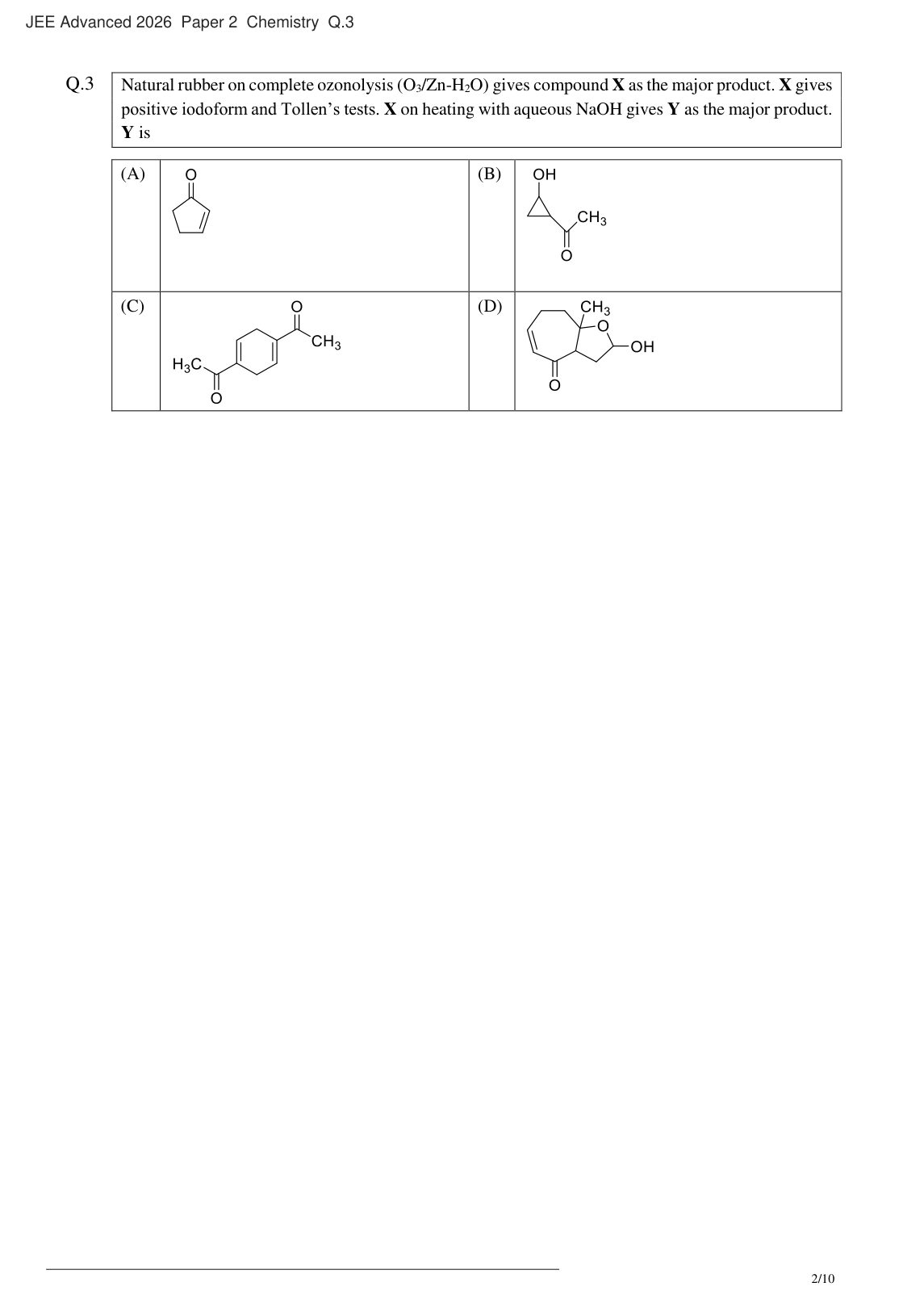
Model answers
Claude Fable 5.1
Anthropic
A
Claude Fable 5.1 reasoning
Natural rubber (cis-polyisoprene) on ozonolysis gives 4-oxopentanal (levulinaldehyde), CH₃CO–CH₂–CH₂–CHO, which has a methyl ketone (iodoform positive) and an aldehyde (Tollens' positive). Intramolecular aldol condensation with aqueous NaOH: the enolate at the methyl of the ketone attacks the aldehyde, forming a five-membered ring, followed by dehydration to give cyclopent-2-enone.
GPT 6 Astra
OpenAI
A
GPT 6 Astra reasoning
No written reasoning was returned for this item.
GPT 5.5
OpenAI
A
GPT 5.5 reasoning
**Analyzing chemical reaction** I'm working with the compound X, which is 4-oxopentanal, or levulinaldehyde. When heated with aqueous NaOH, I'm considering a potential intramolecular aldol condensation, so I need to figure out what Y could be. The options include cyclopent-2-en-1-one, 1-(2-hydroxycyclopropyl)ethanone, cyclohexene with two acetyl substituents, or a bicyclic hemiacetal. It’s crucial to analyze the reaction of CH3COCH2CH2CHO, given its aldehyde and methyl ketone structure. Maybe it could form a 5-membered ring, like 3-methylcyclobutanol? Let's investigate! **Analyzing ring structures** I’m thinking about different ring structures. First, the enolate at C3 attacks aldehyde at C1, creating a 3-membered β-hydroxy ketone with a cyclopropane structure. This results in option B. It seems like it’s an aldol addition product but under heat, dehydration could happen. Next, the enolate at C2 attacks the ketone at C4, which changes the product again. Lastly, the enolate at C5 attacks the aldehyde, leading to a larger structure. I need to figure out which enolate is the major product in this reaction. **Evaluating ozonolysis products** I'm exploring the dehydration process and wondering about the α,β-unsaturated ketone A. I should verify whether the ozonolysis product of natural rubber could differ. It might yield products like levulinaldehyde as major output. The role of heat and NaOH is intriguing too; it could lead to self-aldol reactions. I’m aiming to clarify the sequence of polymer cleavage for natural rubber, seeing how every double bond turns into something new during ozonolysis. **Understanding cleavage products** I'm analyzing the cleavage of double bonds in a molecule. The left carbon (C2) has a carbonyl ketone forming, while the right carbon (C3) gives an aldehyde. When I break down the segments, I see a pattern where connections and transformations happen post-cleavage. This includes ketones and aldehydes forming. Ultimately, I conclude that the molecule in question is indeed levulinaldehyde (4-oxopentanal). It's fascinating how these interactions shape the final product! **Assessing compound options** I need to determine which major option fits best. Options C and D might be related to dimerization products. Looking at Option C, it could be 1,4-diacetylcyclohexene with a cyclohexene ring and double bond. The formula seems to be C10H14O2, possibly from two molecules of X going through aldol reactions. For Option D, it might be a bicyclic hemiacetal. I should inspect these thoroughly and not jump to conclusions about their structure or reactions. **Analyzing chemical reactions** I'm looking at some chemical structures, considering B which has an OH and acetyl group. There’s a potential 3-ring structure involving an aldehyde and tertiary alcohol that isn’t visualized yet. If I use the C2 enolate, it might react with a ketone to form a 5-membered ring. The formation of a beta-hydroxy ketone from an aldehyde looks promising too. It’s worth noting that heating under aqueous NaOH might not be dilutive, and I wonder about aldol condensation opportunities for 1,5-dicarbonyl compounds. **Analyzing organic reactions** I'm looking at the natural rubber formula, which is C5H8. Each double bond undergoing ozonolysis creates a ketoaldehyde, specifically C5H8O2. I notice the question hints that X, which gives positive iodoform and Tollen's tests, contains CH3CO- and -CHO groups. When heating X with aqueous NaOH, it leads to Y, linking to levulinaldehyde forming cyclopentenone. I’ll make sure the final answer is formatted correctly in JSON, ensuring the answer letter is uppercase A, and there are no issues with formatting or trailing characters.
Claude Sonnet 5
Anthropic
A
Claude Sonnet 5 reasoning
Natural rubber is cis-1,4-polyisoprene, so ozonolysis of its backbone double bonds should cleave it into a keto-aldehyde repeat unit: 4-oxopentanal, with a methyl ketone group and an aldehyde group. This fits, since the methyl ketone gives a positive iodoform test and the aldehyde gives a positive Tollens test. Heating this compound with aqueous NaOH triggers an intramolecular aldol condensation - the enolate from the terminal methyl group attacks the aldehyde carbon, closing a five-membered ring, and subsequent dehydration forms a conjugated double bond. Working through the carbon connectivity, this produces cyclopent-2-enone as the final product. Attacking from the other alpha position would create an unfavorable three-membered ring, so this pathway is disfavored. This confirms the major product Y matches option A, the cyclopentenone structure. **Reasoning:** Natural rubber = cis-1,4-polyisoprene. Ozonolysis (O₃/Zn-H₂O) cleaves each internal C=C, generating a repeating keto-aldehyde unit: **X = CH₃-CO-CH₂-CH₂-CHO (4-oxopentanal, levulinaldehyde)** - Methyl ketone → positive iodoform test ✓ - Aldehyde group → positive Tollens' test ✓ On treatment with aqueous NaOH, **X undergoes intramolecular aldol condensation**: the enolate formed at the terminal methyl group (α to the ketone) attacks the aldehyde carbon, closing a 5-membered ring. Base-catalyzed dehydration (E1cb, favored due to conjugation with carbonyl) then gives the conjugated enone: **Y = 2-Cyclopentenone** This matches structure (A) — a cyclopentenone ring with the carbonyl and adjacent C=C double bond. ```json