
2026 · Paper 2 · Chemistry
Question 10
The printed question, the official key, and each model’s JSON answer plus the reasoning it wrote.
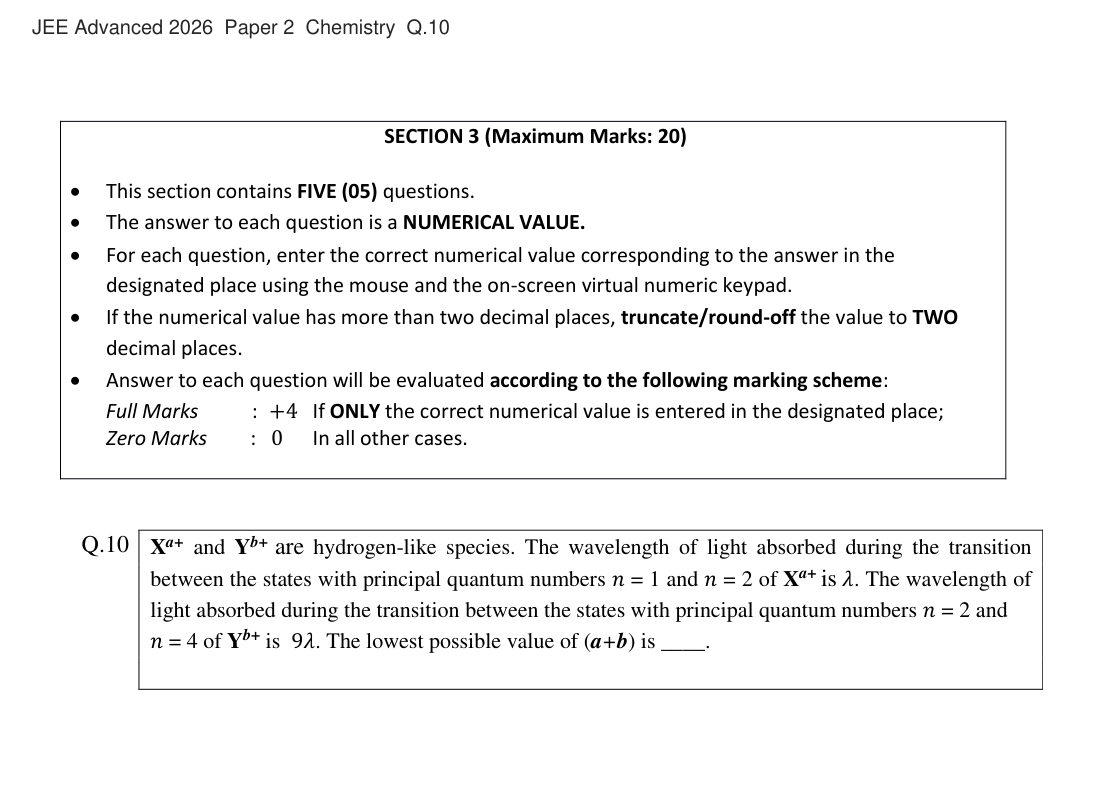
Q10
Official 3
Model answers
Claude Fable 5.1
Anthropic
3
Claude Fable 5.1 reasoning
Setting up the two Rydberg equations for the hydrogen-like ions X and Y, using their nuclear charges (a+1) and (b+1), then dividing them to relate Z_X and Z_Y through the ratio of wavelengths. This gives Z_Y = 2Z_X/3, so the smallest integer solution is Z_X = 3 and Z_Y = 2, meaning a = 2 and b = 1 — corresponding to Li²⁺ and He⁺. So a + b = 3. **Setting up:** For X^{a+} (Z_X = a+1): 1/λ = R Z_X²(1 − 1/4) = (3/4) R Z_X² For Y^{b+} (Z_Y = b+1): 1/(9λ) = R Z_Y²(1/4 − 1/16) = (3/16) R Z_Y² Dividing: 9 = 4Z_X²/Z_Y² ⟹ Z_Y = (2/3) Z_X Smallest integer solution: Z_X = 3 (Li²⁺, a = 2), Z_Y = 2 (He⁺, b = 1). Thus a + b = 3.
GPT 6 Astra
OpenAI
3
GPT 6 Astra reasoning
No written reasoning was returned for this item.
GPT 5.5
OpenAI
3
GPT 5.5 reasoning
**Analyzing parameters for the calculation** I'm figuring out the values for a and b in the equation a + b = 5k - 2, aiming for the lowest possible positive integers. For k=1, it leads to Z_X=3, Z_Y=2, and I'm getting final values as a=2, b=1. I've double-checked that they're positive. I should confirm if any tricks in the wording might affect atomic numbers, but it seems to align properly, leading me to the minimum sum of 3. Now, I'll present the final answer in JSON format.
Claude Sonnet 5
Anthropic
3
Claude Sonnet 5 reasoning
I'm setting up the Rydberg formulas for both transitions, using n=2→1 for X^a+ and n=4→3 for Y^b+, then solving for λ in each case so I can equate them and relate Z1 and Z2. **Answer: a+b = 3** Using the Rydberg formula for hydrogen-like species: For X^a+ (n=1→2): 1/λ = R Z₁² (1 – 1/4) = (3/4) R Z₁² For Y^b+ (n=2→4): 1/(9λ) = R Z₂² (1/4 – 1/16) = (3/16) R Z₂² Taking the ratio: 9 = [Z₂²(3/16)] / [Z₁²(3/4)] ⇒ 9 = (Z₂²/4)/(Z₁²) ... solving properly: λ = 4/(3RZ₁²) and 9λ = 16/(3RZ₂²) ⇒ λ = 16/(27RZ₂²) Equating: 4/(3Z₁²) = 16/(27Z₂²) ⇒ Z₁²/Z₂² = 9/4 ⇒ Z₁/Z₂ = 3/2 Smallest integer solution: Z₁ = 3, Z₂ = 2 → a = Z₁–1 = 2, b = Z₂–1 = 1 **a + b = 3** ```json