
2026 · Paper 2 · Mathematics
Question 18
The printed question, the official key, and each model’s JSON answer plus the reasoning it wrote.
Q18
Official 0.74 – 0.76
Model answers
Claude Fable 5.1
Anthropic
0.75
Claude Fable 5.1 reasoning
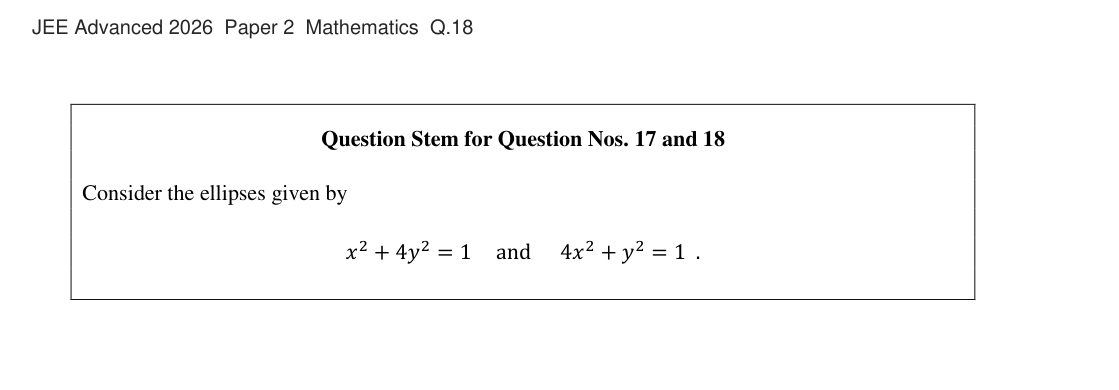
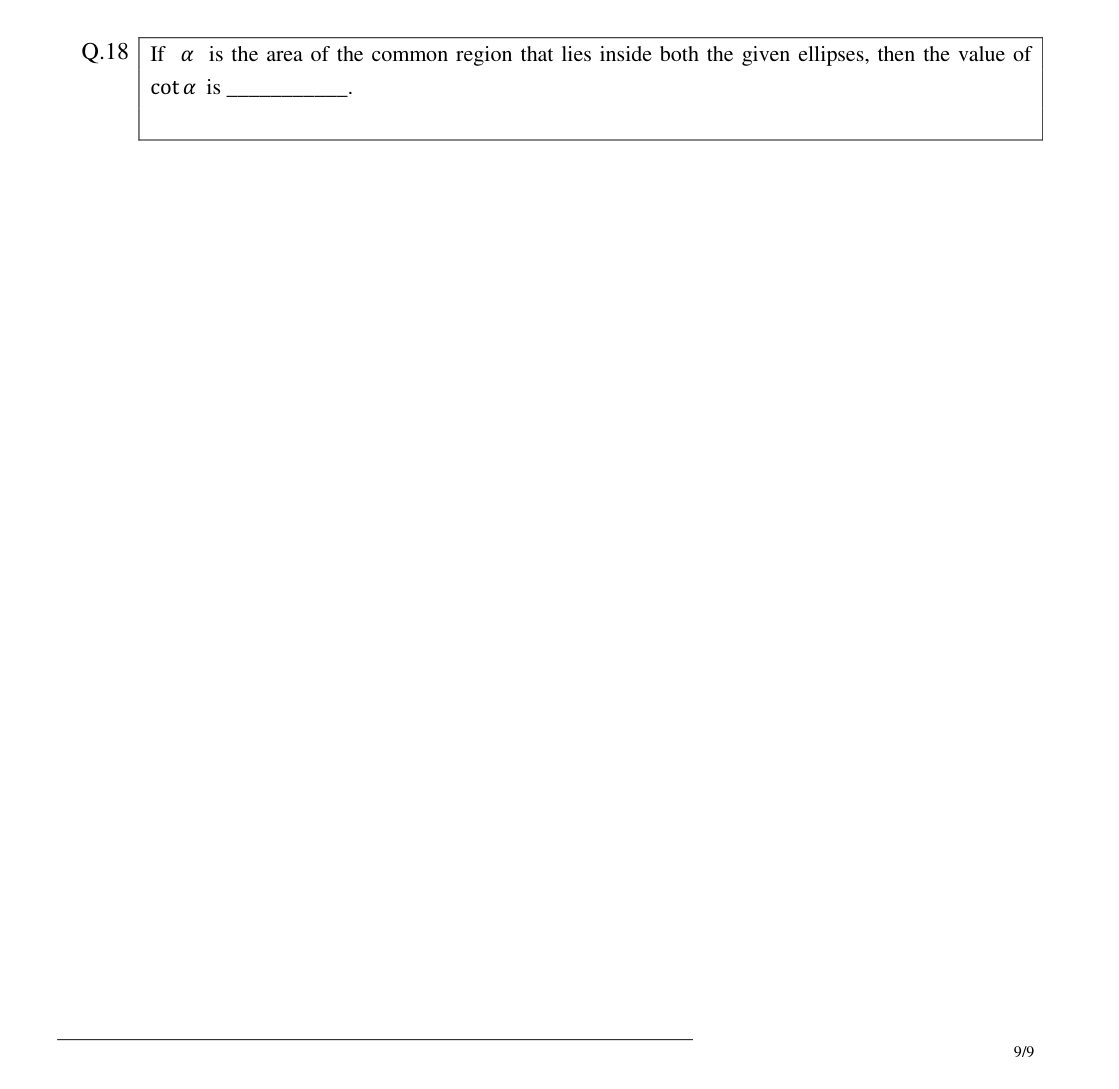
I have two ellipses, x²+4y²=1 and 4x²+y²=1, intersecting where x=y=1/√5. By symmetry the common region's area should be eight times the area of the piece within the first octant-like sector between 0 and π/4. Since 4x²+y²=1 is the inner ellipse in that sector, I compute its polar area integral there, getting (1/4)arctan(1/2) for that slice, so the total common area α = 2 arctan(1/2). Then using the double-angle tangent formula with tan t = 1/2, I find tan α = 4/3, so cot α = 3/4. **Setting up** The ellipses $x^2+4y^2=1$ and $4x^2+y^2=1$ intersect where $x^2=y^2$, giving $5x^2=1$, i.e. $P=\left(\tfrac{1}{\sqrt5},\tfrac{1}{\sqrt5}\right)$ (on the line $y=x$). **Common region by symmetry** The common region is symmetric about both axes and the lines $y=\pm x$, so $$\alpha = 8\times(\text{area in the sector } 0\le\theta\le\pi/4 \text{ inside both}).$$ For $0\le\theta\le\pi/4$, the inner ellipse is $4x^2+y^2=1$ (it reaches only $x=\tfrac12$ along the $x$-axis). In polar form: $r^2=\dfrac{1}{4\cos^2\theta+\sin^2\theta}$. $$\text{Sector area}=\frac12\int_0^{\pi/4}\frac{d\theta}{4\cos^2\theta+\sin^2\theta} =\frac12\int_0^{\pi/4}\frac{\sec^2\theta\,d\theta}{4+\tan^2\theta} =\frac12\cdot\frac12\left[\tan^{-1}\frac{\tan\theta}{2}\right]_0^{\pi/4} =\frac14\tan^{-1}\frac12 .$$ Hence $$\alpha = 8\cdot\frac14\tan^{-1}\frac12 = 2\tan^{-1}\frac12 .$$ **Computing $\cot\alpha$** With $\tan t=\tfrac12$: $\tan\alpha=\tan 2t=\dfrac{2\cdot\frac12}{1-\frac14}=\dfrac{4}{3}$. $$\cot\alpha=\frac34=0.75$$
GPT 6 Astra
OpenAI
0.75
GPT 6 Astra reasoning
No written reasoning was returned for this item.
GPT 5.5
OpenAI
0.75
GPT 5.5 reasoning
**Calculating area under curves** I'm working to find the area of the first quadrant through two integrals. The first integral goes from 0 to 1/√5, while the second runs from 1/√5 to 1/2. I’m using some formulas that involve arcsin and the square root. The goal is to compute these values, so I'm double-checking each integral. I'll want to ensure that my calculations are accurate, especially with those constants. It’s a detailed process, but let's keep it organized! **Calculating area and values** I'm working through some calculations involving the area and using arctan functions. I've found the total area for the specified quadrant and have cotangent values. It looks like I've arrived at something useful with my final JSON format needed, where my answer is marked as 0.75 and indicating that there's no unanswered aspect in this case. Now I just need to make sure it's presented correctly without any extra formatting like code fences.
Claude Sonnet 5
Anthropic
0.75
Claude Sonnet 5 reasoning
I need to find the area common to both ellipses x²+4y²=1 and 4x²+y²=1. By symmetry these intersect where x=y, giving 5x²=1 so x=1/√5, and I can use the 8-fold symmetry (swapping x,y and sign changes) to compute the area over one symmetric wedge and multiply. Checking the axis points: at y=0, the constraint 4x²+y²≤1 requires x≤1/2, tighter than x²+4y²≤1's x≤1. So near the x-axis (where x>y), the boundary is 4x²+y²=1, while near the y-axis (where y>x) the boundary is x²+4y²=1 — the smaller ellipse governs each region. I'm setting up to compute the total area as 4 times the first-quadrant portion, split at the diagonal y=x into these two governing curves. So the first quadrant area splits into two integrals, one for each curve segment. I notice these two integrals should be equal by the x↔y symmetry of the whole figure — the region under the first ellipse from 0 to 1/√5 mirrors the region under the second ellipse from 1/√5 to 1/2. I'll just compute both directly: I1 = (1/2)∫_0^{1/√5} √(1-x²) dx, and I2 = ∫_{1/√5}^{1/2} √(1-4x²) dx, using a substitution u=2x for the second one. Applying the standard antiderivative formula for √(1-x²), I'm evaluating I1 = (1/2)F(1/√5) where F(x) = (x/2)√(1-x²) + (1/2)arcsin(x). At x=1/√5, this simplifies nicely since √(1-1/5) = 2/√5, giving I1 = 1/10 + (1/4)arcsin(1/√5). Now I'm setting up I2 = ∫√(1-4x²)dx over [1/√5, 1/2] using the substitution x = (1/2)sinθ. Computing F(2/√5) gives 1/5 + (1/2)arcsin(2/√5), so I2 simplifies to π/8 - 1/10 - (1/4)arcsin(2/√5). I notice arcsin(2/√5) and arcsin(1/√5) are complementary angles since their sines' squares sum to 1, which might let me combine terms with the earlier integral. So the total area α = 2 arcsin(1/√5). Setting θ = arcsin(1/√5) with sinθ=1/√5, cosθ=2/√5, tanθ=1/2, I use the double angle formula for cotangent: cot(2θ) = (1-tan²θ)/(2tanθ) = (3/4)/1 = 3/4, so cot α = 3/4. I double-check via cos2θ=3/5 and sin2θ=4/5, giving cot2θ=3/4 — confirmed, so the answer is 0.75. Looking at this problem, I need to find the area common to both ellipses $x^2+4y^2=1$ and $4x^2+y^2=1$. **Finding intersection points:** By symmetry, setting $x=y$ gives $5x^2=1$, so intersections occur at $x=y=\pm\frac{1}{\sqrt5}$ (and sign variations), giving 4-fold symmetry. **Setting up the area (first quadrant):** For fixed $x$, the region requires $y \le \min\left(\sqrt{\tfrac{1-x^2}{4}},\ \sqrt{1-4x^2}\right)$. - For $0\le x\le \tfrac{1}{\sqrt5}$: bound is $y_1=\sqrt{(1-x^2)/4}$ (from $x^2+4y^2=1$) - For $\tfrac{1}{\sqrt5}\le x\le \tfrac12$: bound is $y_2=\sqrt{1-4x^2}$ (from $4x^2+y^2=1$) **Computing the integrals** using $F(x)=\int_0^x\sqrt{1-t^2}\,dt = \tfrac{x}{2}\sqrt{1-x^2}+\tfrac12\arcsin x$: $$I_1=\int_0^{1/\sqrt5} \sqrt{\tfrac{1-x^2}{4}}\,dx = \tfrac12 F(1/\sqrt5) = \frac{1}{10}+\frac14\arcsin\frac{1}{\sqrt5}$$ $$I_2=\int_{1/\sqrt5}^{1/2}\sqrt{1-4x^2}\,dx = \tfrac12\big[F(1)-F(2/\sqrt5)\big]$$ Computing $F(1)=\pi/4$ and $F(2/\sqrt5)=\tfrac15+\tfrac12\arcsin(2/\sqrt5)$, and using $\arcsin(2/\sqrt5)=\pi/2-\arcsin(1/\sqrt5)$ (since $(1/\sqrt5)^2+(2/\sqrt5)^2=1$): $$I_2 = -\frac{1}{10}+\frac14\arcsin\frac{1}{\sqrt5}$$ **Total area:** $$I_1+I_2 = \frac12\arcsin\frac{1}{\sqrt5}$$ This is the area in one quadrant; multiplying by 4 for full symmetry: $$\alpha = 2\arcsin\frac{1}{\sqrt5}$$ **Computing $\cot\alpha$:** Let $\theta=\arcsin(1/\sqrt5)$, so $\sin\theta=1/\sqrt5$, $\cos\theta=2/\sqrt5$. $$\sin 2\theta = 2\sin\theta\cos\theta = \frac{4}{5}, \qquad \cos2\theta = 1-2\sin^2\theta = \frac{3}{5}$$ $$\cot\alpha = \cot(2\theta) = \frac{3/5}{4/5} = \frac{3}{4}$$ ```json