2026 · Paper 2 · Physics
Question 1
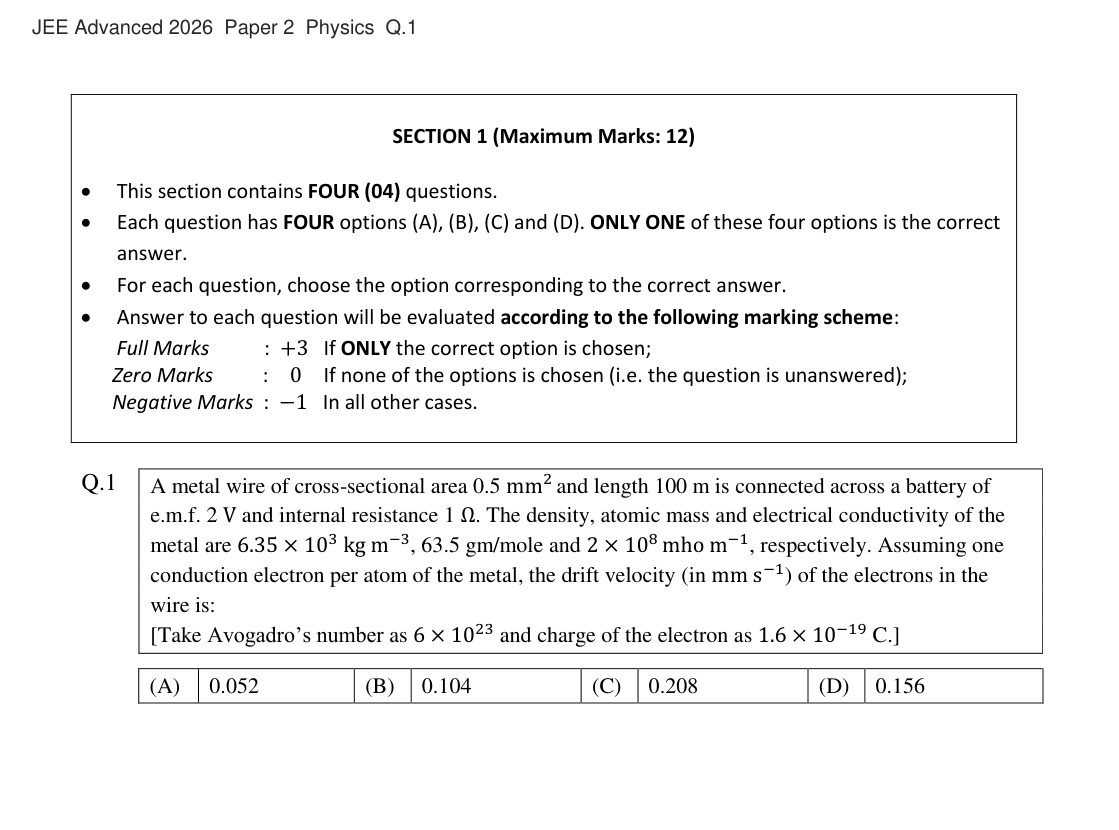
The printed question, the official key, and each model’s JSON answer plus the reasoning it wrote.
Q01
Official C
Model answers
Claude Fable 5.1
Anthropic
C
Claude Fable 5.1 reasoning
Resistance of wire: R = L/(σA) = 100/(2×10⁸ × 0.5×10⁻⁶) = 100/100 = 1 Ω. Current: I = 2/(1+1) = 1 A. Electron density: n = (ρ/M)·N_A = (6.35×10³ / 0.0635) × 6×10²³ = 10⁵ × 6×10²³ = 6×10²⁸ m⁻³. Drift velocity: v_d = I/(n e A) = 1/(6×10²⁸ × 1.6×10⁻¹⁹ × 0.5×10⁻⁶) = 1/(4.8×10³) ≈ 2.08×10⁻⁴ m/s = 0.208 mm/s.
GPT 6 Astra
OpenAI
C
GPT 6 Astra reasoning
No written reasoning was returned for this item.
GPT 5.5
OpenAI
C
GPT 5.5 reasoning
**Calculating drift velocity** I need to compute the drift velocity for a metal wire with specified properties. The wire's parameters include a cross-sectional area of 0.5 mm², a length of 100 m, and an EMF of 2V with an internal resistance of 1Ω. After calculating the current and charge density, along with the number of conduction electrons per atom, I find the drift velocity to be 0.2083 mm/s. Therefore, the correct answer is option C. **Ensuring final output accuracy** I need to finalize the JSON output, but first, I want to double-check the details to avoid any hidden traps. Specifically, I'm considering the battery terminal voltage and whether to factor in the internal resistance. If I ignore the internal resistance, I'd end up with a current of 2A, resulting in a voltage of 0.416, which isn't an available option. I also need to confirm that conductivity is indeed expressed in "mho m^-1."
Claude Sonnet 5
Anthropic
C
Claude Sonnet 5 reasoning
I compute the wire's resistance from its length, conductivity, and cross-sectional area, getting 1 Ω, then add the internal resistance to get 2 Ω total, giving a current of 1 A from the 2V source. Now I'm finding the free electron density using the copper's mass density, molar mass, and Avogadro's number. Then I use v_d = I/(neA), working through the arithmetic to get a drift velocity of about 2.08×10⁻⁴ m/s, or 0.208 mm/s, matching answer C.