
2026 · Paper 1 · Chemistry
Question 4
The printed question, the official key, and each model’s JSON answer plus the reasoning it wrote.
Q04
Official C
Model answers
Claude Fable 5.1
Anthropic
C
Claude Fable 5.1 reasoning
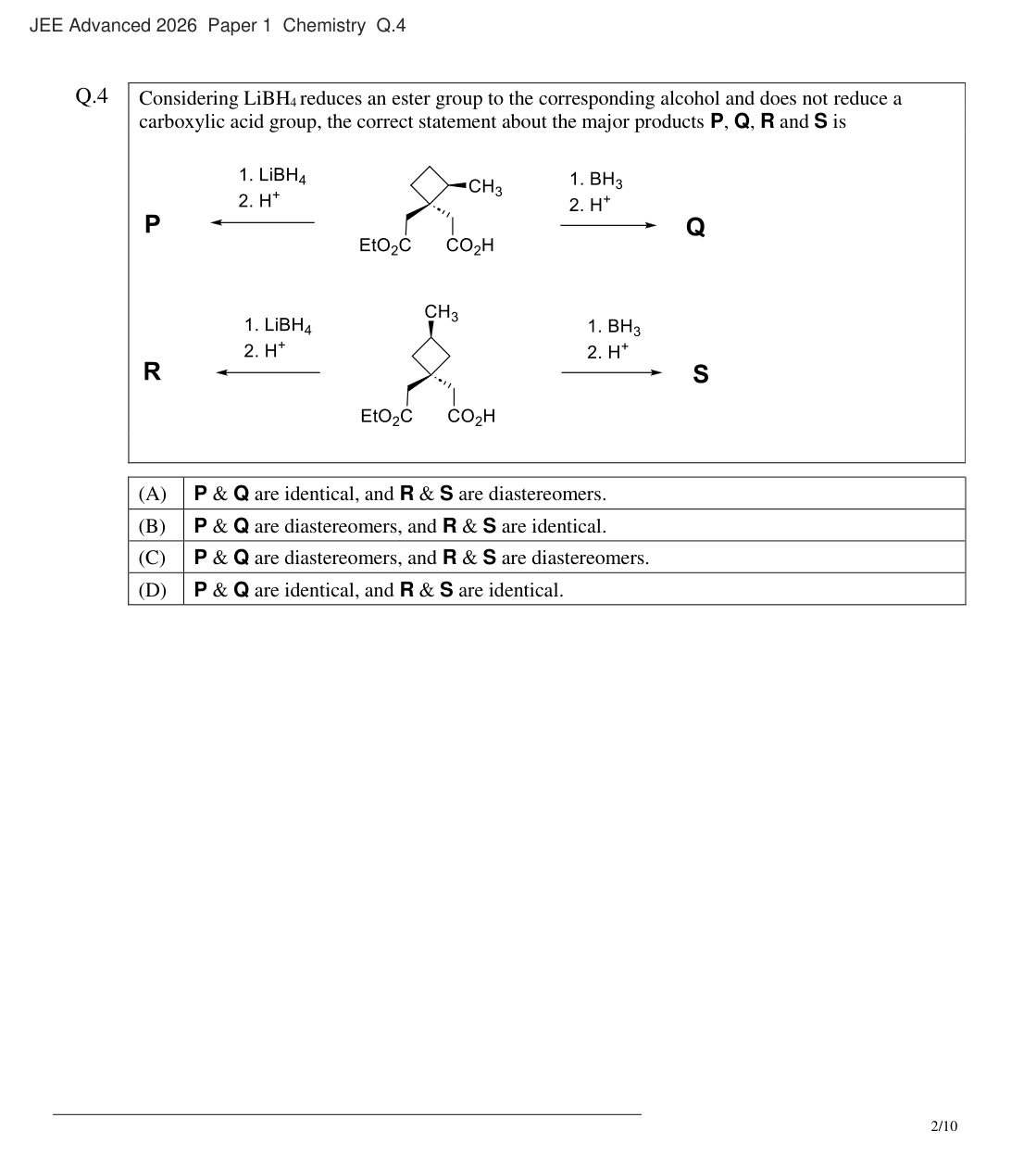
I'm working out the cyclobutane ring geometry, trying to place the quaternary carbon with its CH2CO2Et and CO2H substituents relative to the methyl group on the ring, figuring out which vertex is which in the square projection. Now I'm tracing what happens under each set of conditions: LiBH4 selectively reduces the ester to give a primary alcohol, leaving the acid intact, and acidic workup would drive lactonization between the new CH2CH2OH chain and the adjacent COOH to form a spiro γ-lactone. With BH3, the acid gets reduced instead, giving CH2OH next to the untouched ester, and acid-catalyzed lactonization again closes a five-membered ring—so both routes converge on the same spiro γ-butyrolactone skeleton, just built from different sides, meaning I need to compare exactly how the ring atoms connect in each case to see if the stereochemical outcome truly matches. I'm reconsidering: LiBH4 selectively reduces the ester group to give an alcohol, which then lactonizes with the acid to place the spiro carbon alpha to the carbonyl, while BH3 selectively reduces the acid, and that lactonizes with the ester to place the spiro carbon beta instead. So P and Q end up being constitutional isomers, not the same compound. Comparing P and Q's ring structures, the carbonyl sits adjacent to the spiro carbon in one but separated by a CH2 in the other, making them constitutional isomers rather than something distinguishable by simple symmetry arguments. That makes me question whether lactonization is even the right path here, since the reagent logic about which reduces acid versus ester needs to align with getting P and Q as the actual products. I'm working through whether the CH3-at-C3 substitution pattern gives the ring a mirror symmetry through C1 and C3, which would make substituents on C1 that are cis versus trans to the methyl group actually equivalent by that internal mirror plane — potentially making P and Q achiral or identical rather than diastereomers, unlike the C2-adjacent case where the two faces stay distinct. Actually, checking the 3-methyl case more carefully: C1 might be a pseudo-asymmetric center relative to C3, giving cis/trans relationships between the carbonyl and methyl group. If the maker conflates the two lactone constitutions from LiBH4 versus BH3, then the cis/trans placement of the carbonyl relative to CH3 would distinguish P and Q as diastereomers rather than identical structures. I'm trying different reduction pathways—LiBH4 versus BH3 on the ester versus acid, followed by lactonization—to see if P and Q could end up as the same lactone rather than diastereomers, but none of these scenarios seem to force that outcome given the stereocenter at C1. Let me reconsider whether both substituents attached to the ring are actually CH2 groups rather than direct attachments—so C1 connects via CH2 to CO2Et on one side and via CH2 to CO2H on the other, which changes how I should interpret the wedge and hash bonds in the structure. For P, combining CH2CH2OH with CH2CO2H forms a spiro six-membered δ-lactone, and for Q the same lactone skeleton emerges but with the carbonyl positioned on the opposite face, so the constitutions align once I account for this. Now I need to work out how the stereocenter behaves in the case with an adjacent methyl group. For the 2-methyl case, P has the carbonyl arm on the hash side and Q has it on the wedge side relative to the same ring, so these come out as diastereomers rather than identical structures. For the 3-methyl case, the ring possesses a mirror plane through C1 and C3, but whether the carbonyl arm sits cis or trans to the methyl group determines whether R and S are actually the same compound or distinct diastereomers, and I'm now checking whether the cis/trans relationship makes them different. Testing the 180° rotation about the C1–C3 axis: it flips CH3 to down but leaves the lactone arm assignments mismatched with S, so that's not a symmetry match. Checking reflections through the perpendicular plane or the ring plane also fails to superimpose R onto S, confirming they're diastereomers rather than identical structures — so this is a cis/trans relationship, not the same compound. **Analysis** Both arms on the quaternary ring carbon are CH₂ groups: CH₂CO₂Et (wedge) and CH₂CO₂H (hash). - **LiBH₄** reduces only the ester: CH₂CO₂Et → CH₂CH₂OH; then H⁺ lactonizes with the CH₂CO₂H to give a spiro δ‑lactone in which the carbonyl‑side CH₂ is on the *hash* face. - **BH₃** reduces only the acid: CH₂CO₂H → CH₂CH₂OH; H⁺ lactonizes with the ester to give the same spiro δ‑lactone skeleton, but now the carbonyl‑side CH₂ is on the *wedge* face. So P and Q (and likewise R and S) have identical constitutions and differ only in which face of the cyclobutane the carbonyl arm occupies. - **2‑Methyl case (P, Q):** the methyl on the adjacent carbon fixes the faces; swapping the arms changes the relative configuration → P and Q are **diastereomers**. - **3‑Methyl case (R, S):** the methyl at C‑3 is cis to one arm and trans to the other. In R the carbonyl arm is trans to CH₃; in S it is cis. No symmetry operation (flipping the ring or reflection) interconverts them → R and S are also **diastereomers** (cis/trans, both achiral).
GPT 6 Astra
OpenAI
C
GPT 6 Astra reasoning
**Evaluating product comparison** I'm considering that the spiro product is still A/B distinct, which suggests it's diastereomeric. I wonder why some might conclude that methyl is nonchiral, making them seem identical. There's the possibility that both could be diastereomers. I think I should test this with a known example, like 4-methylcyclohexanone compared to a ketone spiroketal. While 4-methylcyclohexanone's ethylene ketal has no stereochemistry, I wonder what happens with the propylene ketal. **Evaluating reflection transformations** I'm reflecting on how the reflection plane yz maps different components. The methyl group remains unchanged in the z+ direction, but cyclobutane is swapped. It seems like a wedge where x<0 and z+ becomes x>0 and z+, which isn't the desired outcome. A dash appears at z-, and I'm not sure if that's correct either. I need to be careful in considering how these changes affect the overall structure. **Investigating spiro compounds** I’m diving into whether the lower C3 stereogenic wedge actually leads to geometric isomers when dealing with asymmetrical spiro rings and symmetrical cyclobutane substitutions. I'm noting that there are IUPAC stereoisomers in spiranes that aren't optically active if they're nonplanar. Looking into disubstitution on opposite sides raises some questions, especially regarding compounds like spiro[3.3]heptane and how their substituents relate when rotating around their axes. It seems there's complexity in their chirality and geometric orientation! **Exploring spiro and lactone configurations** I'm considering how the central carbon is effectively tetrahedral and how simultaneous rotations might be necessary. The symmetry can possibly swap C2 and C4, but the two lactone branches aren't identical, suggesting there could be isomers present. For example, I’m looking at cyclobutane with an unsymmetrical spiro lactone and a C3 methyl group, which adds another layer of complexity to their configurations and potential isomerism. There’s a lot to unpack here!
GPT 5.5
OpenAI
C
GPT 5.5 reasoning
**Identifying stereochemistry** I'm looking at right ring carbon (CH3), which has a stereocenter. The top substrate presents adjacent stereocenters at C1 with CH3 and C2 with CO2Et or CO2H. Let's explore how these configurations interact and influence the overall molecular structure. It's interesting to see how the presence of multiple stereocenters can affect the reactivity and properties of the compound! I need to clarify any assumptions I have about stereochemistry here as I go. **Questioning ester hydrolysis** I’m thinking about whether the ester group will hydrolyze without an acid work-up. If I have H+, will that change anything? I’m not so sure about that. Maybe it just won’t hydrolyze without that step. This whole hydrolysis process can be confusing, and I'm trying to make sense of it. It's important to clarify these chemical reactions, so I want to get this right. Let me explore more about this reaction! **Exploring lactone formation** I’m considering how to make identical or diastereomer lactones. The major products might be lactones, but the scheme doesn’t clarify the outcomes — it only mentions relationships. With reagents like LiBH4 and H+/BH3, both might lead to lactone formation through reduction and acid-induced lactonization. So, in focusing on the substrate with a geminal ester and acid, selective reduction could yield hydroxy acid or hydroxy ester, both of which might cyclize under acidic conditions. The stereochemistry will depend on which substituent was reduced. **Analyzing stereochemistry and lactone formation** I'm thinking about the central stereocenter where the substituent changes, but there’s no bond breaking at the chiral center. Then, during lactonization, the -CH2OH connects to the carbonyl of the other substituent, which may create a spiro structure. Visualizing it, I see the ring carbon bearing -CH2OH and -C(=O)OH/Et, leading to a β-lactone. The stereochemistry of the lactone depends on the arrangement of substituents, and these could be identical or diastereomers based on the molecule's symmetry. The prompt emphasizes how LiBH4 reduces the ester to an alcohol, which could help clarify the reducing group. **Understanding lactonization and transesterification** I'm considering how P hydroxy acids can lactonize by losing water, which results in a lactone with the formula C...O2. On the other hand, Q hydroxy esters can undergo transesterification, losing ethanol and producing the same lactone formula. It's interesting that both processes lead to similar outcomes, and it's fun to explore how chemical reactions transform compounds! **Analyzing molecular positions** I'm noticing that the ring positions on the left and right stay the same, but CH2 and the carbonyl groups swap places, which is a type of inversion at C0. This is interesting, as it seems the methyl stereocenter, if present, has the same configuration. It's a neat little detail in molecular structure that can have a big impact on overall behavior. I wonder how this might influence reactions! **Analyzing cyclobutane configurations** I’m figuring out the positions in cyclobutane. C1 is a quaternary carbon, and I think C2 might have a methyl group. C3 is opposite C1, while C4 is on the adjacent side. If methyl is on C2, cyclobutane pathways from C1 to C2 or C4 differ; one leads to the methyl quickly, the other takes a longer route. I need to confirm if C2 and C3 are sterically different, making both C1 and C2 stereogenic. **Exploring stereoisomerism** I’m thinking about how if I invert C1 only and keep C2 the same, I might create diastereomers. This suggests that the top configuration could represent P/Q diastereomers. It’s intriguing to consider how small changes in the structure can lead to these distinct stereoisomers. I'll need to keep track of how they relate to each other and confirm if these are indeed diastereomers as I proceed. **Analyzing stereochemistry** I'm delving into whether a compound might not be stereogenic due to a pseudoasymmetric spiro center. If there’s a methyl group at C3, it could also be a stereocenter. The orientations at C1 could make paths through C2 and C4 enantiotopic. I think about the symmetry in the compound, especially with the methyl at C3. The upper and lower structures might yield diastereomers, but I need to verify that using wedge/dash representations carefully. **Verifying stereochemical relationships** I’m exploring whether one pair of products is identical while the other is a diastereomer. I really need to be sure of my answer, so I’m re-reading the prompt about LiBH4, which reduces an ester to an alcohol without affecting carboxylic acids. They didn’t mention BH3 selectivity, but that could be a known factor. If I assume no lactonization occurs, that could change the pair relationships they expect. I’ll conduct a detailed stereochemical analysis, especially looking at the methyl positions in the top and bottom drawings. **Examining substituent connections** I'm analyzing the connections for the CH3 group, which comes from the right vertex and has a solid wedge extending towards it. The geminal substituents seem to have one bond from the bottom. The solid wedge leading to the EtO2C looks like it starts around the coordinates (456,221) and extends down-left to (438,236). Meanwhile, the dashed wedge associated with CO2H seems to start at (476,213). I just need to ensure I'm interpreting these coordinates correctly! **Analyzing stereochemistry** I'm currently figuring out how the CH3 wedge attaches to the top vertex and carboxyl groups to the bottom vertices. This means I need to formalize things using 3D coordinates and local spatial vectors for both the ring and substituents. My focus is on determining if P and Q are identical or diastereomers rather than enantiomers. I’m noting that there might be some complexities with the methyl stereocenter, which could lead to enantiomeric pairs. Let's get those products and compare them! **Exploring lactonization details** I'm examining the lactonization reaction details. The substrate has a carbon bearing groups E, which is directed toward the hydroxymethyl group, and A, an acid, which is directed away. When treated with LiBH4, E is converted into a hydroxymethyl group. I need to clarify whether this hydroxymethyl group stays attached to the carbonyl carbon. This detail is important for understanding the reaction outcome and ensuring everything aligns properly with my calculations. **Considering chirality in compounds** The arrangement of c and d in a wedge/dash format doesn't mean a and b are nonidentical. I'm contemplating chirality and how it could be influenced by a spiro compound. Actually, spiro compounds can indeed be chiral even without a stereogenic carbon, especially if the two perpendicular rings are asymmetrical. I see that C0 connects to four atoms within those two rings, which is interesting and worth exploring further! **Analyzing stereochemistry** I'm trying to figure out the stereochemical relationship between enantiomers P and Q. If they are indeed enantiomers, then the statement about diastereomers must be false since diastereomers require at least one fixed stereocenter that's the same. If P and Q only differ at C0 while C2 remains consistent, they could be diastereomers. However, I need to verify if there are any changes in stereochemical descriptors due to CIP priority. I'll take a closer look at the configuration before concluding the answer as B, but must ensure not to overlook any aspects that might suggest A. **Considering cyclobutane conformation** I'm analyzing a cyclobutane structure with a methyl substituent at C3 that's out of the plane. Since the ring isn't planar, it could be puckered, which adds complexity to the rigidity of the structure. To determine if the two paths from C0 to C3 are equivalent, the CH3 must lie in a plane that allows for some swapping of those paths. I'll take these factors into account while further evaluating the ring's conformation. **Evaluating paths in C3** I'm considering C3, which has two paths through C2 and C4 leading to C0. I wonder if these paths become enantiotopic or diastereotopic due to the B/C orientation at C0. It seems interesting how the entire ring could become chiral, even with methyl groups that are opposite. There's a lot of detail here about chirality and how different configurations might influence it. It feels like an area rich with possibilities! **Analyzing chirality in molecules** It seems the molecule is achiral, which means there shouldn't be any stereoisomers. But can Br and CH3 display cis or trans configurations? For cyclobutane with 1,3-disubstitution, the orientation really matters. If I rotate 180° around the C1-C3 axis, do I swap positions of C2 and C4 while flipping the orientation? For example, if CH3 at C3 goes down while Br, at C1, also goes down, it shows they map correctly but not always to the same structures. **Exploring stereoisomers in cyclobutane** It seems that the plane of the ring doesn’t actually swap Br and Cl. When I map everything, it shows that the substituents might indicate an enantiomer rather than an identical molecule. I wonder if stereoisomers could exist depending on the arrangement of substituents at C1 and C3, especially when they're distinct? I’m checking the nomenclature for 1,3-disubstituted cyclobutane and considering how geminal disubstitution could influence the stereocenters due to the ring structure being non-identical. The tetrahedral arrangement at C3 adds to the complexity, possibly distinguishing paths. **Examining lactone structures** I’m considering the structure involving a lactone ring at C1 where substituents at B/C are bonded. It looks like at C1, there’s a CH2 group pointing up and a carbonyl pointing down, while at C3, CH3 points up. They seem analogous to B's different orientations, perhaps indicating they’re diastereomers. I need to settle whether options C or A apply and explore symmetry in the structures. I'll analyze a spiro lactone to see if a 180° rotation yields identical structures. **Exploring gem-B/C connections** In the acyclic gem-B/C example, I'm realizing that B up/M up versus C up/M up are different configurations since B and C are not connected. However, if B and C are connected to form a small ring, I wonder if the ring could be reflected through the C1-C3 plane, effectively exchanging B and C. Yet, since B and C are different atoms—like CH2 versus C=O—there’s no internal symmetry to consider here. So I'm curious about the implications of that! **Exploring spiro compounds and chirality** I’m looking into spiro compounds and how their chirality relates to cyclobutane and a methyl group. The identity of these compounds can change based on the orientation of the rings. According to spiro chirality theory, if one ring is symmetrical, then the compound is achiral. With cyclobutane and a 3-methyl substituent, I consider the paths and their equivalency. I wonder how the methyl position influences symmetry and the overall stereochemistry of the spiro system. Let's compare these ring orientations! **Analyzing spiro compounds** When considering spiro compounds, I'm thinking about how the symmetry of one ring might influence whether the molecule is achiral, especially regarding the "clockwise" and "counterclockwise" arrangements. It seems that spiro atoms could connect two rings in perpendicular planes, which complicates things a bit. If I model spiro[cyclobutane-β-lactone] with a methyl group opposite, the orientation of the methyl relative to the lactone ring becomes crucial. I wonder if transformations could help clarify whether P and Q are actually mirror images. Let's work on gathering those coordinates! **Modeling tetrahedral spiro compounds** I'm thinking about how to model the spiro compound as tetrahedral at the spiro carbon C1. To start with, I'll set the coordinates for C1 at the origin. The cyclobutane ring's bonds to C2 and C4 should lie roughly in the xy-plane. I can place C2 at (+1, 0, 0) and C4 at (-1, 0, 0), or possibly explore diagonal placements to create a better structure. Let’s see how this works out in practice! **Evaluating rotation and identity** I’m considering that we can’t insist on CH3 z+ in our fixed frame if Q has z+ because Q might also be rotated before comparison. To test identity, I should find a proper rotation R where R(P coordinates) equals Q coordinates with Q fixed. I thought about using R=180 degrees around the y-axis which swaps B and C, but it moves M downward, not aligning with Q in this orientation. **Evaluating lactonization products** I’m considering if an acid and an ethyl ester can interconvert under H+. It seems the major product could likely be a lactone. I want to establish final drawings for each starting structure, using stereochemical nomenclature for comparison. I’m thinking of representing the final molecules as "fused/spiro bicyclic β-lactones" with a methyl substituent. I need to differentiate the orientations of the lactone ring at the spiro center and compare stereochemical configurations. **Analyzing lactone orientation** I'm breaking down the relationships between the lactone atoms and the methyl groups. For pairs P and R, I have X up and Y down, while in Q and S, X is down and Y is up. It seems like the relationship can be interpreted as simply swapping which lactone atom is positioned up relative to the methyl group. For the top structure, the methyl is at adjacent carbon C2, while for the bottom structure, it's at opposite carbon C3. **Analyzing chirality and symmetry** I'm considering the implications of having X/Y differences along with ring paths. It tells me that the structure isn't chiral, as there are no distinct local R/S configurations. I’m also thinking about how for C3 ring paths, if C2/C4 align symmetrically with C1's X/Y arrangements with respect to a vertical plane, there might be symmetry involved in those configurations. It's fascinating to dissect this conceptual framework. **Exploring stereochemistry in dimethylcyclobutane** I’m considering whether C1 and C3 are stereocenters in cis/trans-1,3-dimethylcyclobutane. In monosubstituted cyclobutane, the symmetry means paths through C2/C4 lead to C3 methyl, so it's not chiral despite the presence of cis/trans isomers. The cis and trans forms are diastereomers, with trans potentially being chiral. Their geometric nature comes from ring structure rather than stereocenters. So, I see that the different arrangements around carbon lead to distinct isomers! **Examining stereochemistry options** I'm looking at the possibility that option B gives an identical R&S when considering reducing acid versus ester, followed by lactonization for a symmetric structure. But hold on, the starting symmetry has an ester and an acid at C1 and a methyl at C3. It seems chiral since the substituents differ. If both the acid and ester are different, C1 and C3 could indeed be stereogenic. I'll explore the different isomeric forms based on their arrangement. **Creating a model for diastereomers** I'm thinking about how these structures are likely diastereomers. It seems that the lactone ring could potentially interchange cis relationships through a ring flip. So, I’ll check this by making a physical model of a planar cyclobutane. In my model, I’ll position C1 at the bottom and C3 at the top, with X and M up and Y and H down for the R configuration. For S, I’ll flip Y and M to be up, with X and H down. **Evaluating compound reduction** The user may ask for a correct statement about major products of P, Q, R, and S after reducing unsymmetrically substituted cyclobutane-1,1-dicarboxylic acid monoester. I wonder if the question pertains to the top and bottom two isomeric starting materials, similar to cis/trans arrangements. It seems that in one arrangement, reducing the ester and acid yields the same lactone, while in the other, it could give a diastereomer. I need to derive this accurately! **Analyzing β-lactone formation** I’m trying to discern whether β-lactone could be a major product here. It seems like a four-membered lactone could form due to the Thorpe-Ingold effect in cyclobutane. But I might have misinterpreted the structure; the carboxyl groups might not be adjacent. If they're on different carbons, reducing the ester versus the acid could yield hydroxy acid or ester with the same formula. I need to troubleshoot this, as the drawing may actually represent a 1,2-dicarboxylate cyclobutane instead of a geminal setup. **Examining cyclobutane structure** I’m analyzing the image where the cyclobutane ring is depicted as a rhombus, but I think the bottom edge might actually represent a horizontal edge connecting two bottom vertices. If I reconsider it as a tilted square, I see four corners. The substituents show CH3 at the right corner and the ester attached to the bottom-left. There's a solid wedge to EtO2C from the lower-left and a dashed wedge to CO2H from the lower-right, indicating they’re on adjacent carbons, not geminal! This could mean the products have the same formula. **Exploring lactone formation** I'm considering the ester and acid groups. If the ester is at one position and the acid at another, they aren't the same formula unless lactonization occurs. That’s when a lactone is formed between an alcohol on one carbon and an acid or ester on an adjacent carbon, leading to a five-membered ring. Actually, if the substituents are adjacent on cyclobutane, they yield a fused lactone ring. Both paths might create the same fused lactone, but they could have different stereochemical relationships. It’s worth noting! **Analyzing coordinate positions** Okay, I’m using coordinates from the image. For the top ring, I'm considering vertices at (464,180) for the top left, (485,201) for the top right, (464,223) for the bottom right, and (443,200) for the bottom left. It seems to form a diamond shape. The CH3 wedge attaches to the right vertex. The EtO2C wedge appears below/right of the left vertex, possibly starting at (464,223) and fanning left. I’ll need to clarify the positions of the solid and dashed wedges based on these vertices. **Clarifying molecular structure** It looks like I see labels: "EtO2C" under the left side of the ring and "CO2H" under the right. A bold triangle wedge is drawn from the ring atom at the lower-left, possibly at (443,228) — not part of the diamond shape. Meanwhile, a dashed wedge seems to come from the lower-right ring atom at (474,221). I’m considering a central bottom edge connecting those two carbons. The ring might actually be a trapezoid, and the bottom substrate could represent a cyclobutane depicted as a square in perspective. **Parsing molecular structure** I’m looking closely at the methyl wedge from the right vertex at (483,200) towards CH3. I realize that it doesn’t connect to the same carbon. There’s a wedge going to the ester that may start from the bottom vertex. I want to clarify the lower substituents: it looks like the solid wedge starts at (463,222) and points down-left, while the dashed one seems to begin at (476,213). But I'm feeling a bit uncertain about that. **Analyzing molecular structures** I'm looking at the drawing of "EtO2C" and "CO2H" and thinking they’re likely on adjacent carbons. The solid and dashed wedges seem to align with a lower edge, rather than being on geminal carbons. The lower substrate shows the ester wedge at the lower-left ring carbon and the acid dashed at the lower-right ring carbon. I’m considering that the structure might be more like a parallelogram than a diamond, with different groups on various vertices. Time to re-evaluate! **Examining ring structure** I’m thinking about the ester wedge connecting to the bottom-left from the left lower carbon, and the acid dash connecting to the bottom-right from the right lower carbon. If this structure is a cyclobutane, it means I have four carbons arranged in a square, but tilted by about 45°. This layout makes sense for the orientation of the groups, and I need to keep this in mind as I analyze the overall structure! **Visualizing molecular structure** I’m analyzing a molecular structure where the top has a carbon with CH3 and the bottom edge has two substituted adjacent carbons. It seems impossible if diamond has just one bottom vertex. Maybe it’s drawn as a cyclobutane in a "puckered" perspective? A rhombus shape could function with front and back edges having different carbons. The bottom edge is likely between left and right. I see it more like a tilted square with specific vertices—one having an ester and another an acid. **Examining molecular labels** I’m trying to analyze the labels "EtO2C" and "CO2H" attached to two different lower vertices in a molecular structure. In the top structure, there's a CH3 on the right, an ester at lower-left, and an acid at lower-right. In the bottom structure, CH3 sits at the top carbon while the positions of the ester and acid remain the same. I’m wondering if the methyl carbon and acid carbon are actually the same, but it doesn’t seem like they are. The original image shows that EtO2C is attached in a specific way that might not align as expected. **Analyzing ester and acid positioning** I’m considering that the ester and acid might be on adjacent ring carbons, C1 and C2, both on the lower face. So, is the ester's wedge facing up or down? And is the dashed acid on the same carbon? I feel like I need more evidence to confirm this. If a carbon has both an ester and an acid substituent, those wedge and dash bonds should originate from the same point in the structure. That makes me think about how they’re visually represented. **Analyzing cyclobutane stereochemistry** I’m considering that the CO2H groups don’t share the same origin since the solid wedge's narrow end is at the lower-left and the dashed wedge's narrow end is at the lower-right ring corner. There’s a normal bond line potentially hidden by substituents, indicating they are vicinal. The ring seems to slant down from the ester carbon to the acid carbon. I’m thinking about how this relates to the substitution on cyclobutane-1,2-dicarboxylates and potential stereoisomers. **Clarifying cyclobutane structure** I’m analyzing the structure and thinking that the top CH3 is attached to a ring carbon adjacent to both carboxyl-bearing carbons. In a cyclobutane with vicinal carboxyls at the bottom two carbons, the top two should have clear distinctions based on their positions. I realize the CH3 on the top isn't at the top-right but rather on the right-side carbon. I want a consistent ring, so I’m picturing the cyclobutane as a diamond shape and determining where the ester and acid groups are positioned. **Reevaluating cyclobutane positions** I'm considering the placements again: maybe the ester is at C and the acid is also at C, but that seems redundant. If I place the ester at the left vertex (D) and the acid at the bottom (C), then they’re adjacent. The methyl on the right (B at the top) would also be adjacent to the acid and opposite the ester. However, I’m realizing that the positions of the methyl groups might be causing confusion. I need to double-check my layout! **Analyzing regioisomer relationship** I’m thinking about the relationship between the starting compounds at D and C, focusing on the methyl group at B that’s adjacent to either the acid or the ester. Since acids and esters are different, they lead to regioisomers rather than stereoisomers. I’m also considering the products P, Q, R, and S. They may be affected by the methyl’s position when comparing reductions of the ester and acid, particularly regarding lactonization. It seems I need to clarify the exact connectivity in the reactions. **Examining reduction problem** I’m focusing on the problem statement regarding LiBH4, which reduces esters to alcoho [truncated]
Claude Sonnet 5
Anthropic
—
Claude Sonnet 5 reasoning
No written reasoning was returned for this item.