
2026 · Paper 1 · Chemistry
Question 5
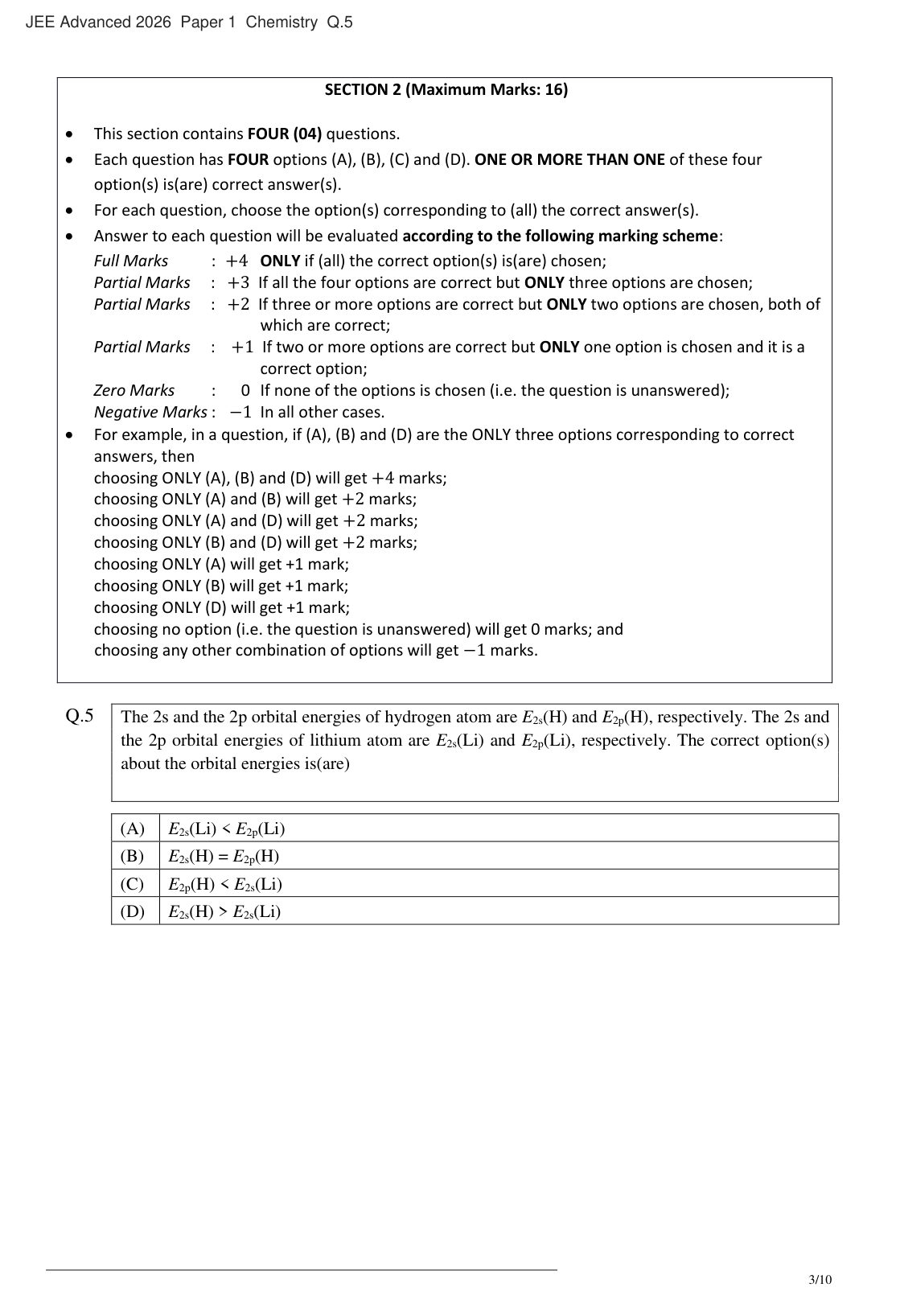
The printed question, the official key, and each model’s JSON answer plus the reasoning it wrote.
Q05
Official A, B, D
Model answers
Claude Fable 5.1
Anthropic
A, B, D
Claude Fable 5.1 reasoning
For hydrogen, both 2s and 2p sit at -3.4 eV since energy depends only on n, confirming (B). For lithium, penetration effects push 2s below 2p in energy, so (A) holds too. Checking (D), lithium's 2s energy roughly matches its ionization energy of -5.39 eV, which is lower than hydrogen's -3.4 eV, so I need to verify whether E2s(H) actually exceeds E2s(Li). Comparing (C), hydrogen's 2p at -3.4 eV isn't below lithium's 2s at -5.39 eV, so that option fails. Estimating lithium's Zeff using Slater's rules gives roughly -5.75 eV, reinforcing that lithium's 2s sits well below hydrogen's levels. So the correct answers are A, B, and D. **Analysis** - **Hydrogen (one-electron atom):** Orbital energy depends only on *n*. Hence E₂ₛ(H) = E₂ₚ(H) = −13.6/4 = −3.4 eV → **(B) correct**. - **Lithium (multi-electron atom):** Because of penetration/shielding effects, energy depends on both *n* and *l*; 2s penetrates more than 2p and is lower in energy → E₂ₛ(Li) < E₂ₚ(Li) → **(A) correct**. - **Comparing H and Li:** The 2s electron in Li feels an effective nuclear charge Z_eff ≈ 1.3 (>1), so its energy is E ≈ −13.6 × (1.3)²/4 ≈ −5.7 eV (experimentally IE of Li ≈ 5.39 eV, i.e., E₂ₛ(Li) ≈ −5.4 eV). This is lower (more negative) than E₂ₛ(H) = −3.4 eV. - E₂ₛ(H) > E₂ₛ(Li) → **(D) correct**. - E₂ₚ(H) = −3.4 eV is *not* less than E₂ₛ(Li) ≈ −5.4 eV → **(C) incorrect**.
GPT 6 Astra
OpenAI
A, B, D
GPT 6 Astra reasoning
No written reasoning was returned for this item.
GPT 5.5
OpenAI
A, B, D
GPT 5.5 reasoning
**Analyzing atomic orbital energies** I need to figure out the atomic orbital energies for hydrogen (H) and lithium (Li). The question outlines the energies E_2s and E_2p for both atoms and presents options to consider. I recognize that hydrogen, being a one-electron atom, has degenerate 2s and 2p states, whereas lithium, a multi-electron atom, has a lower energy for the 2s orbital compared to the 2p due to penetration effects. From my calculations, I can check if the given inequalities hold true. **Evaluating orbital energy comparisons** I just found that E2s for lithium is -5.39 eV, which is less than E2p for hydrogen at -3.4 eV. So, the claim that E2p(H) is less than E2s(Li) is false! However, I’m wondering if this might change based on the effective nuclear charge, considering unoccupied orbitals in Li. Option D is true since E2s(H) is indeed greater than E2s(Li). As for option C, it seems incorrect when I compare H's 2p to Li's 2s. I should double-check to ensure everything adds up correctly.
Claude Sonnet 5
Anthropic
A, B, D
Claude Sonnet 5 reasoning
For hydrogen, orbital energy depends only on n, so E2s(H)=E2p(H) confirms option B. For lithium, penetration effects mean 2s sits lower than 2p, confirming option A. Now I'm comparing E2p(H) with E2s(Li), since lithium's effective nuclear charge on the 2s electron pulls it lower than hydrogen's 2s/2p level at -3.4 eV. Using Li's ionization energy (5.39 eV), its 2s orbital energy is about -5.4 eV versus hydrogen's -3.4 eV, so E2p(H) is actually greater than E2s(Li), making option C false since it claims the opposite inequality. For D, comparing E2s(H)=-3.4 eV to E2s(Li)=-5.4 eV confirms E2s(H)>E2s(Li), so D holds true, giving A, B, D as the correct answers. Looking at this problem: **For Hydrogen atom:** In a hydrogen-like (one-electron) system, orbital energy depends only on the principal quantum number n, not on l. Therefore, all orbitals with n=2 (i.e., 2s and 2p) are degenerate. - E₂ₛ(H) = E₂ₚ(H) = -13.6/4 eV ≈ -3.4 eV - **(B) is correct** **For Lithium atom:** Due to penetration effects, the 2s orbital penetrates closer to the nucleus than 2p, experiencing less shielding and greater effective nuclear charge. This leads to: - E₂ₛ(Li) < E₂ₚ(Li) (2s is lower/more stable than 2p) - **(A) is correct** **Comparing energies quantitatively:** - E₂ₚ(H) = E₂ₛ(H) ≈ -3.4 eV (from Bohr model, Z=1, n=2) - E₂ₛ(Li) ≈ -5.4 eV (this corresponds to the first ionization energy of Li, ≈ 5.39 eV, since the valence electron in Li is in 2s orbital) **Checking (D):** E₂ₛ(H) > E₂ₛ(Li)? - -3.4 eV > -5.4 eV → **True**, since Li's higher nuclear charge (Z=3) pulls the 2s electron much closer/tighter compared to H's nucleus (Z=1), making E₂ₛ(Li) much more negative. - **(D) is correct** **Checking (C):** E₂ₚ(H) < E₂ₛ(Li)? - -3.4 eV < -5.4 eV → **False** (since -3.4 is actually greater than -5.4) - The 2s orbital in Li is significantly more stabilized due to increased nuclear charge and penetration, making it much lower in energy than the 2p orbital in H. - **(C) is incorrect** **Conclusion:** The correct options are (A), (B), and (D). ```json