
2026 · Paper 1 · Chemistry
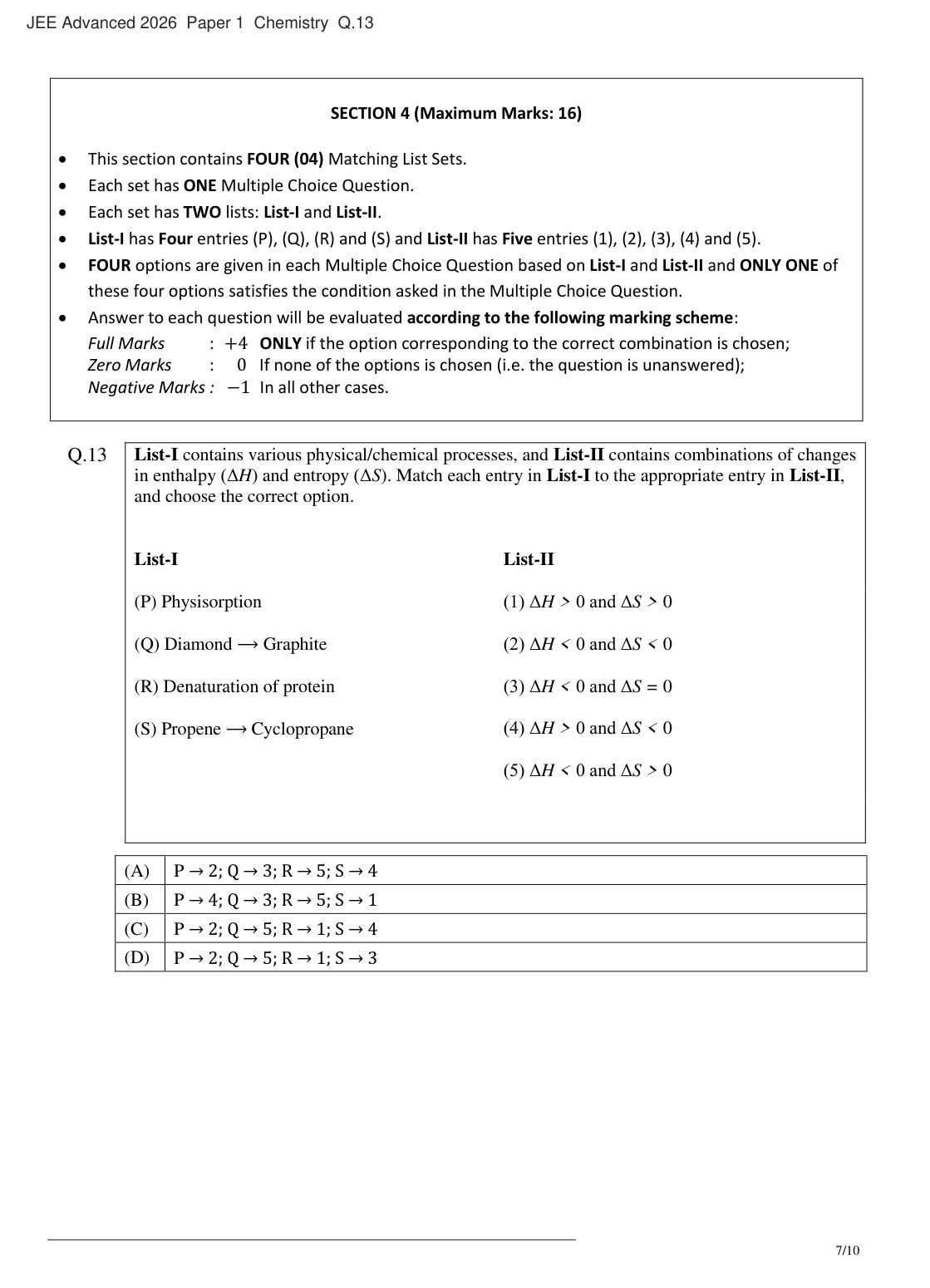
Question 13
The printed question, the official key, and each model’s JSON answer plus the reasoning it wrote.
Q13
Official C
Model answers
Claude Fable 5.1
Anthropic
C
Claude Fable 5.1 reasoning
Physisorption: exothermic, entropy decreases → ΔH < 0, ΔS < 0 → 2. Diamond → Graphite: ΔH < 0 (graphite more stable), ΔS > 0 (graphite has higher entropy) → 5. Denaturation of protein: endothermic, entropy increases → 1. Propene → Cyclopropane: cyclopropane is less stable (ring strain), ΔH > 0; ring formation reduces entropy, ΔS < 0 → 4. Option C.
GPT 6 Astra
OpenAI
C
GPT 6 Astra reasoning
No written reasoning was returned for this item.
GPT 5.5
OpenAI
C
GPT 5.5 reasoning
**Evaluating thermodynamic properties** I’m examining the stability of diamond versus graphite. Graphite is more stable, with negative ΔH since the enthalpy of diamond is about 1.9 kJ/mol higher, indicating the conversion releases energy. For entropy, I recall graphite has a higher standard molar entropy (5.74 J/K·mol) compared to diamond (2.38 J/K·mol), which leads to ΔS being greater than zero. However, some might consider the entropy change during this solid conversion as negligible. I'll confirm the sources for accuracy. As for protein denaturation, it’s primarily an endothermic process with ΔH and ΔS both positive, aligning with options C/D. Lastly, I'm looking into the isomerization from propene to cyclopropane and need to clarify their phase states. **Analyzing propene conversion** I'm considering the conversion of propene to cyclopropane and need to decide between two options based on changes in enthalpy (ΔH) and entropy (ΔS). Cyclopropane has ring strain, which affects its enthalpy compared to propene. After reviewing standard enthalpies, it appears that converting propene to cyclopropane is endothermic with ΔH = +32.9 kJ/mol. Additionally, the entropy decreases, so I conclude that option C is correct since ΔS < 0. **Evaluating isomerization and denaturation** I'm examining isomerization and the associated entropy. If it's simplistic, entropy could equal 0 for isomerization, but option D with S = 3 and negative ΔH seems inconsistent. I still aim for answer C. I also notice that treating processes like diamond to graphite might misinterpret ΔS as 0, even while being exothermic. Then, for protein denaturation, it's usually endothermic with entropy increase, but breaking hydrogen bonds needs heat. So, could some processes show positive ΔH and ΔS? It's complicated! **Evaluating thermodynamic principles** Alright, I’m exploring the endothermic process, where entropy increases. It seems that R->1 indicates A/B is unlikely, but I shouldn't dismiss it completely. The question might be from a source like "JEE Advanced 2026," possibly even fake. I'll need to solve it, considering enthalpy and Gibbs free energy. For spontaneous processes at low temperatures, ΔH must be negative, especially for physisorption. Regarding the transition from diamond to graphite, it looks thermodynamically spontaneous, though slow. For denaturation of proteins, it involves breaking bonds with positive entropy.
Claude Sonnet 5
Anthropic
C
Claude Sonnet 5 reasoning
Physisorption is exothermic with both enthalpy and entropy decreasing, pointing to option 2. For diamond converting to graphite, enthalpy decreases since graphite is more stable, while entropy increases due to its layered, more disordered structure, matching option 5. Protein denaturation involves bond breaking, so it's endothermic with entropy increasing as the structure unfolds. For propene converting to cyclopropane, the ring strain makes cyclopropane higher in energy so enthalpy increases, while the rigid ring structure reduces degrees of freedom, decreasing entropy - matching option 4. So the mapping comes out to P→2, Q→5, R→1, S→4, giving option C. Looking at each process: - **Physisorption**: Exothermic (weak van der Waals forces release energy) and decreases randomness of gas molecules on surface → ΔH<0, ΔS<0 → (2) - **Diamond → Graphite**: Graphite is more thermodynamically stable (lower enthalpy) and has more disordered layered structure → ΔH<0, ΔS>0 → (5) - **Denaturation of protein**: Breaking of H-bonds and other interactions (endothermic) causes unfolding, increasing disorder → ΔH>0, ΔS>0 → (1) - **Propene → Cyclopropane**: Ring closure introduces angle strain (higher energy, endothermic) and reduces rotational freedom (more ordered) → ΔH>0, ΔS<0 → (4) This matches option (C): P→2; Q→5; R→1; S→4 ```json