2026 · Paper 1 · Chemistry
Question 12
The printed question, the official key, and each model’s JSON answer plus the reasoning it wrote.
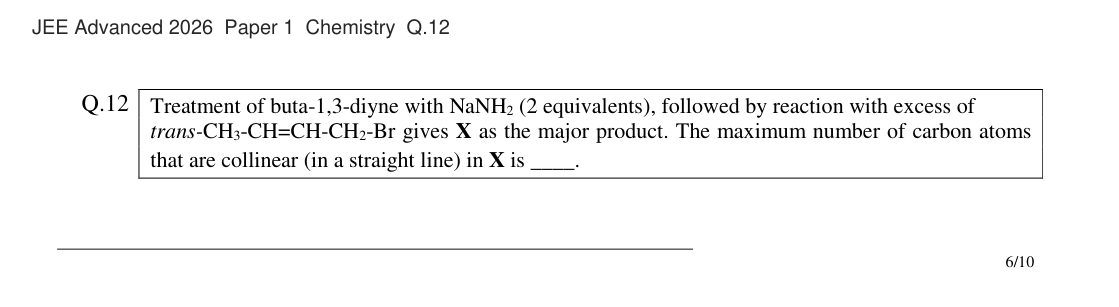
Q12
Official 6
Model answers
Claude Fable 5.1
Anthropic
6
Claude Fable 5.1 reasoning
Buta-1,3-diyne (HC≡C–C≡CH) with 2 equiv NaNH2 gives the dianion, which is then dialkylated by the allylic bromide (SN2), giving: CH3–CH=CH–CH2–C≡C–C≡C–CH2–CH=CH–CH3 The linear (sp) segment is –CH2–C≡C–C≡C–CH2–: the four sp carbons plus the two attached CH2 carbons are all collinear, giving 6 collinear carbon atoms.
GPT 6 Astra
OpenAI
6
GPT 6 Astra reasoning
**Analyzing carbon chains** I need to determine the maximum number of carbon atoms in a straight line, possibly considering 6 versus 8 with trans configurations. I'm analyzing the reaction of butadiyne and dianion crotyl bromide, aiming for the structure CH3CH=CHCH2-C≡C-C≡C-CH2CH=CHCH3. With central C6 potentially collinear, I wonder whether the geometry influences this count. My best guess is to focus on 6 as the answer, but I'll consider presenting this in JSON format if needed. **Ensuring alkylation totals** I need to ensure that central alkylation leads to a total of 12 carbons and confirms a linear arrangement of 6. It seems logical that focusing on the product structure would help. My approach could be to present this information clearly through a JSON format. I think that might be sufficient, as it gives a concise overview of the findings without unnecessary complexity.
GPT 5.5
OpenAI
6
GPT 5.5 reasoning
**Solving chemistry problem** I need to carefully tackle this chemistry question involving buta-1,3-diyne and sodium amide. This compound is a type of diacetylene. I'll start by confirming that buta-1,3-diyne is indeed HC≡C-C≡C-H. When treated with NaNH2, it creates a dianion. Then, it reacts with trans-CH3-CH=CH-CH2-Br, which seems to be an allylic bromide. The goal is to determine the major product and count the maximum number of collinear carbon atoms. **Analyzing reaction pathways** This question seems to explore the reactions involving a terminal alkyne and sodium amide followed by an alkyl halide. The allylic halide could potentially undergo SN2' to form an allene. I'm thinking about how the nucleophile interacts with the allylic bromide, which may lead to substitution via SN2 or SN2' at the other end of the chain. The goal is to figure out the major product, which could include symmetrical dialkylation and analyze the maximum number of collinear carbons in the product formed. **Evaluating molecular alignments** In a planar zigzag molecule, non-bonded atoms might accidentally align based on conformation. The question is about the "maximum number of carbon atoms that are collinear," typically relating to hybridization, not just conformational coincidence. I wonder if I should consider possible arrangements carefully. In structures like cumulenes or alkynes, the sp carbons align, but in zigzag chains, nonconsecutive atoms might align due to conformation. It's tricky because "maximum" might allow for some rotational alignment without arbitrary constraints. **Evaluating molecular orientation** I need to consider whether the product can allow both crotyl groups to orient in a way that some of the alkene carbons lie along a central line. It's an interesting idea, and I wonder how the arrangement might affect the overall geometry. I should evaluate if this alignment actually alters the properties or behavior of the molecule. Aligning carbons in this manner could have implications that I need to think through carefully. **Assessing carbon geometry** I'm considering the geometry of carbon arrangements. Even if a nonadjacent carbon, like a methyl group, is at the end, it could still align with the central axis. I need to count nuclei without focusing on the connectivity. If a carbon isn't directly bonded to CH2, it might still align along the axis through rotation, despite its predecessor not being on that line. However, bond angles might complicate the geometry, especially with a tetrahedral CH2 affecting the orientation at approximately 109.5 degrees. **Exploring carbon angles** I'm analyzing the geometry of vinylic carbon positions relative to a CH2 group. The angle from CH2 to vinylic carbon is about 120 degrees, which means the vector might potentially orient back onto the x-axis. I'm calculating that the bond length is roughly 1.5 Å at a 109° angle. So, if I align the central atoms correctly, the endpoint could technically lie on the x-axis. However, the arrangement might not be straightforward since adjacent carbons are off-axis due to tetrahedral geometry. Let's dig deeper into the possibilities! **Considering carbon alignment** I'm pondering whether the next methyl carbon could align on the central axis, even if the adjacent vinylic one isn’t aligned. It seems subsequent carbon positions can potentially cross the line due to rotations and geometry. With a rotatable single bond between C(sp3) and C(sp2), the downstream atoms could form a circular arrangement. It's conceivable that one of those carbons might align with the central axis. But I have to consider if collinearity in this context allows for such alignment or if it’s strictly about counting atoms. Let’s think through this! **Analyzing collinearity in chemical reactions** I'm revisiting the problem related to the treatment of buta-1,3-diyne with NaNH2 and then with trans-CH3-CH=CH-CH2-Br. The question asks for the maximum number of collinear carbon atoms in product X. The mention of "trans" could indicate its role in determining the stereochemistry, affecting how many carbons are in line. I'm considering the structural geometry; could the all-trans arrangement allow for collinearity of more than six carbons? Let's dive deeper into the structure! **Evaluating vector conditions** I'm looking at the vector from B to C and trying to ensure it meets certain conditions. I've figured out that the dot product of (-u) and v, divided by the magnitude of v, should equal cos(120°), which is -1/2. This leads me to conclude that the equation u·v/|v| must equal 1/2. I'm curious to see how these relationships will help me further analyze this vector scenario! **Exploring reaction mechanisms** I’m considering the potential relationship between various components and their bond angles in skeletal drawings. The idea of using idealized equal lengths for these drawings could be helpful. I’m also thinking about how acetylide anions might interact with allylic bromides, especially regarding E2 eliminations. If a strong base like NaNH2 is involved, it could facilitate the elimination of HBr to form buta-1,2-diene. I need to clarify the structure and hydrogen positioning in these reactions! **Evaluating reaction pathways** I'm analyzing the reaction conditions after deprotonation, with a strong nucleophile involved. The allylic bromide may undergo elimination, but I wonder if the major product will come from nucleophilic substitution due to it being a primary allylic compound. The "trans" configuration matters for E2 reactions, as the anti-periplanar geometry leads to a specific stereoisomer that could eliminate to form an allene. Searching my mental notes, I recall that treating buta-1,2-diene with NaNH2 can lead to the creation of other compounds. Interesting connections arise with organocopper reagents in relation to stereochemistry. **Analyzing acetylide reactions** I’m exploring how acetylide anions can be converted to organocuprates for reactions with allylic halides, though copper isn’t involved here. Naming the product is interesting: using disodium butadiynide with crotyl bromide could lead to (3E,9E)-dodeca-3,9-dien-5,7-diyne. I’m counting carbons and thinking about the structure’s linearity and collinearity, especially the maximum number of collinear carbon atoms. If deprotonation happens effectively, I wonder if NaNH2 could help dialkylate further. **Exploring synthesis and products** I'm considering that using 2 equivalents of NaNH2 could produce terminal anions without any leftover base. If I react butadiyne with NaNH2, could it result in "sodium carbides"? The dianion might be symmetrical with terminal sp carbons. I’m also thinking about the reaction with excess allylic bromide and the potential substitution products. It's interesting they’re asking a numerical question related to collinearity of an allene product in a Chemistry context, even if it refers to a generated exam! **Analyzing alkylation reactions** I'm examining a specific product: trans-CH3CH=CHCH2-C≡C-C≡CH, focusing on counting monosubstitution. With monoalkylation, there are five carbons; with bisubstitution, six. The potential for polymer formation arises, but it's unclear if dibromide will react with a dianion. I wonder if both alkylations can occur at the same terminal. After the first deprotonation, can the equivalent add across the triple bond? Also, sodium amide's ability to isomerize alkynes could be possible. **Considering alkylation reaction** I'm thinking about whether the treatment of buta-1,3-diyne with NaNH2 and trans-CH3-CH=CH-CH2-Br leads to an alkylation of acetylide through an SN2 reaction. Disodium butadiynide is a strong base and the allylic bromide is ambident, which complicates things. In polar solvents, the nucleophilic attack generally occurs at the less hindered carbon. My suspicion is that the major product will involve eight collinear carbon atoms if everything aligns properly. I'll need to consider the expected output regarding the maximum number of carbon atoms in a straight line. **Analyzing product specifications** They're using "maximum" to refer to how the product contains two consecutive triple bonds, and the attached CH2 carbons are also in a straight line. It's interesting that they might not factor in trans side chains for this count. So, I wonder why they mentioned "trans." Perhaps it’s meant to clarify any stereochemical ambiguity, but it seems irrelevant for counting carbons. Official questions often include descriptors that aren't strictly necessary. I'll have to be mindful of that! **Exploring carbon collinearity** I’m curious about whether the "maximum number of carbon atoms collinear" includes the idea of having carbon atoms in a straight line, which may differ from simply being in a chain. I wonder if this could arise from "trans" double bonds or a mix of alkyne and alkene carbons. I'll model the ideal product and conformations to explore the math behind this. There might be ways to align over six carbon nuclei collinearly due to conformation, but the term "maximum" could complicate things. I’ll need to investigate! **Analyzing carbon chains** I’m considering how "trans" could imply a conventional straight-chain drawing, like in trans-CH3-CH=CH-CH2-Br. I’d need to visualize it using a line-angle representation: for an E alkene, the single bonds on either side are positioned oppositely around the double bond. If I draw a zigzag at 120°, the terminal carbon atoms might not be collinear with the central double bond. However, I wonder if C1 and C4 could end up being collinear. It's interesting to model! **Analyzing alkynes and sodium amide** I’m considering NaNH2 with terminal alkynes, especially if both are deprotonated in liquid ammonia. The dianion might be too basic, potentially leading to unintended elimination reactions rather than substitution. There's a concern about the acidic terminal hydrogens of buta-1,3-diyne, likely due to their conjugation, which affects acidity. Using 2 equivalents should yield a disodium salt. For reactions with trans-crotyl bromide, I’ll confirm what type of allylic halide it is. Let's explore this further. **Exploring chemical reactions** I’m considering what happens if butadiyne dianion's end attacks allylic bromide through an SN2' mechanism. It leads to a C(sp) connected directly to C2 sp3—that's intriguing. This might simplify to just six. I want to ensure I understand the implications here fully, like the role of connectivity and hybridization in such a reaction. It’s fascinating to visualize these complex bonds forming in organic chemistry! **Exploring molecular conformations** I'm thinking about whether a molecule could have 7 or 8 carbons aligned based on its geometry. Officially, that might not be allowed, but let’s explore if it’s physically possible. If "maximum" is relevant, I need to check the conformations with terminal methyl groups around a central axis. Organic geometry terms like "collinear" are important here, especially since JEE often queries the maximum number of carbon atoms in the same plane. It seems like conformational adjustments might be allowed if they're in conjugated fragments. **Analyzing bond rotations** I'm looking into how A, which is sp3, bonds with an sp carbon. The side chain can rotate freely around the A-Csp bond. There's a double bond B=C that restricts rotation, but I can still rotate the A-B and C-D single bonds. While the A-B bond is hindered, it’s still slightly rotatable. The C-D bond stays within the alkene plane and its rotation doesn't affect the position of carbon D. I'm wondering if ideal bond lengths and angles could create a situation with D on the central axis. Let's explore that! **Solving an inverse kinematics problem** I'm considering an inverse kinematics issue for a three-bond chain from A to D, where the bond angles at A are fixed. At point A, the angle between the central axis (+x) and A-B is α = 109.5°. At B, the angle A-B-C is β = 120°, and at C, the angle B-C-D is γ = 120°. Plus, I need to think about how E/trans affects D and A across the double bond, possibly corresponding to a dihedral angle of either π (trans) or 0. Let’s work through that! **Evaluating vector geometry** This situation depends on the angle and the magnitude of the vectors involved, particularly between AD and AB. I’ll work with the lengths l_AB, l_BC, and l_CD while using specified values. The tetrahedral geometry at point A is crucial since it dictates the angles. At point B, the angle between BA and BC is set, which influences the coordinates of point C. I need to make sure I'm applying these angles and vectors correctly to determine the final configuration. **Determining vector CD** For trans E at point C, I need to ensure that CD lies within the same x-z plane and is positioned on the opposite side of point A. To find vector CD, which has a length of c and forms a 120-degree angle with CB, I should consider both possible directions within that plane. I've already established the direction for CB, which moves from C to B with coordinates (-0.866, 0, -0.5). Now, I can calculate CD based on this information. **Analyzing angles and bonds** I’m considering the angle between AD and AB, which isn't fixed due to the rotation around AB. The endpoint of AD forms a circle, and the angle φ with AB is somewhat rigid. For φ to align with the central axis, it must equal either α or 180-α, and since φ is about 60 degrees—not 70.5—it raises questions about the bond lengths. If the central axis direction from A to sp is +x, then I'm figuring out how the side chain extends in relation to different angles. **Finalizing JSON output** I'm confirming that the angle between CH2 and the sp terminal is indeed 180 degrees. This means the line passes through both of those points, which is great! Now, for the official numerical answer format, the user wants "6.00" but as a number, not a string. I'll make sure the JSON object is formatted as a number, specifically “6”, without any trailing explanation. I just need to ensure the "unanswered" is set to false.
Claude Sonnet 5
Anthropic
6
Claude Sonnet 5 reasoning
Buta-1,3-diyne has two terminal acetylenic hydrogens, and treating it with two equivalents of NaNH2 deprotonates both ends to form the disodium acetylide. Reacting this with excess trans-crotyl bromide performs SN2 alkylation at both termini, giving a symmetric product with crotyl groups on each end of the diyne core. Now I'm numbering the twelve-carbon chain to figure out which atoms are collinear. The diyne core (four sp carbons) is linear by geometry, and since carbons attached directly to sp carbons via a single bond also lie along that same axis, the collinearity extends outward to include the CH2 groups on either side of the triple bonds. So C4 through C9 form one continuous straight line - six collinear carbons. But C4 itself is CH2 with tetrahedral geometry, meaning the chain bends there, so the collinearity stops before reaching C3. Same logic applies at the other end: C9 connects to C10, but C9 is also sp3, breaking the line at that junction. That gives a maximum of 6 collinear carbons. Looking at this problem: **Step 1: Formation of disodium acetylide** Buta-1,3-diyne (HC≡C–C≡CH) with 2 equiv NaNH₂ deprotonates both terminal alkynyl H's: NaC≡C–C≡CNa **Step 2: Alkylation** Reaction with excess *trans*-crotyl bromide (CH₃-CH=CH-CH₂-Br) via SN2 at both acetylide ends gives: **X = CH₃-CH=CH-CH₂-C≡C-C≡C-CH₂-CH=CH-CH₃** **Step 3: Analyzing collinearity** Label carbons: C1(CH₃)-C2=C3-C4(CH₂)-C5≡C6-C7≡C8-C9(CH₂)-C10=C11-C12(CH₃) - The sp-hybridized carbons (C5, C6, C7, C8) forming the diyne unit are linear (180° bond angles). - Since C5 (sp) is bonded to C4 via a single bond and to C6 via triple bond, the bond angle at C5 is 180°, making **C4-C5-C6 collinear**. - Similarly, C8 (sp) bonded to C7 (triple) and C9 (single) forces **C7-C8-C9 collinear**. - Thus the entire segment **C4–C5≡C6–C7≡C8–C9** is collinear (6 carbons). - However, C4 and C9 are sp³ (CH₂ groups) with tetrahedral geometry, so C3 (attached to C4) and C10 (attached to C9) are **not** collinear with this chain — the direction bends at C4 and C9. Therefore, the maximum number of collinear carbon atoms is **6** (C4, C5, C6, C7, C8, C9). ```json