
2026 · Paper 1 · Chemistry
Question 15
The printed question, the official key, and each model’s JSON answer plus the reasoning it wrote.
Q15
Official C
Model answers
Claude Fable 5.1
Anthropic
C
Claude Fable 5.1 reasoning
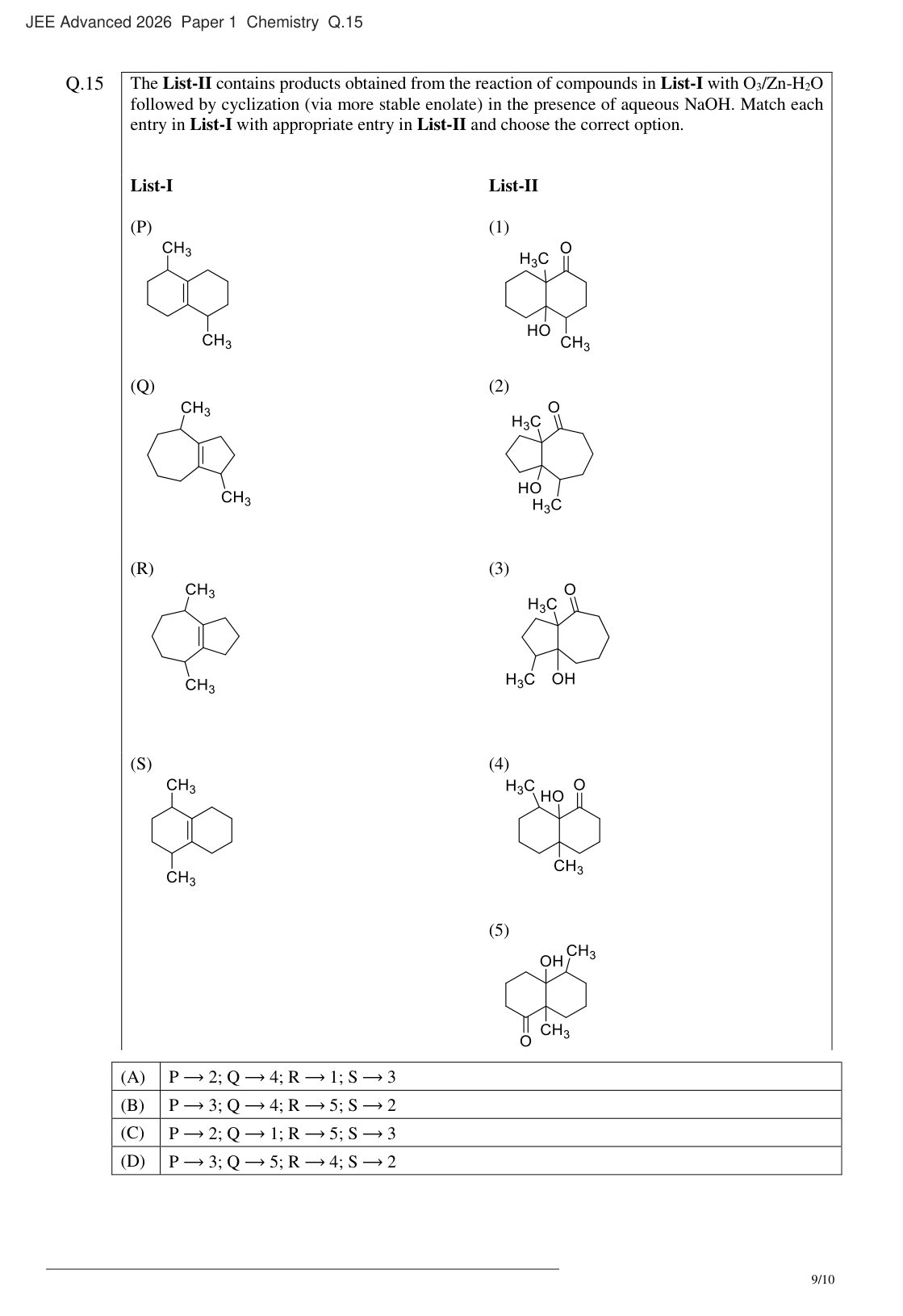
I'm working through structure P, a fused bicyclic ring system with a tetrasubstituted double bond at the ring fusion, noting the positions of the two methyl substituents relative to the fusion carbons. Ozonolysis of that fusion alkene should open the bicycle into a ten-membered ring diketone, with each carbonyl flanked by a methyl-bearing carbon on one side. I'm mapping out the carbon numbering around that macrocycle to track where the alpha carbons and methyls sit, so I can figure out which enolate forms and how the subsequent intramolecular aldol closes into a new six-membered ring. Considering which enolate is more stable—the more substituted one at C1 or C5—and tracing where intramolecular aldol attack would close the ring. Enolate at C1 attacking Cb closes a 5-membered ring (C1-C2-C3-C4-Cb), and symmetrically enolate at C5 attacking Ca also gives a 5-membered ring, so the product should be a 5-7 fused bicyclic hydroazulenone system. Now I'm mapping out the exact fusion carbons: attack of C1 on Cb gives a 5-membered ring (C1-C2-C3-C4-Cb) fused to a 7-membered ring (C1-Cb-C5-C6-C7-C8-Ca), with the methyl-bearing quaternary fusion carbon adjacent to the ketone, and the hydroxyl-bearing fusion carbon adjacent to the methyl-substituted carbon. I'm comparing this substitution pattern against the known structure of compound (3) to check if it matches. Confirming it's the more substituted enolate as stated. Now for S, a 6-6 system with methyls on both left-ring carbons adjacent to the fusion points—ozonolysis gives two ketones with methyl and CH2 alpha carbons at each fusion, so the more stable enolate forms at the methyl-bearing carbon and attacks the other carbonyl, giving a 5-membered ring from C1-C2-C3-C4-Cb. Working out the complementary 7-membered ring, I get a 5-7 fused product matching structure (3), with methyls at the ring fusion and adjacent position, and the ketone in the seven-membered ring—consistent with options A and C. Now moving to Q and R, which are both 5-7 bicyclic systems, I need to track where the methyls sit relative to the ring fusions in each case. Tracing the 10-membered ring closure Ca-C1-C2-C3-C4-C5-Cb-C6-C7-C8-Ca, I check which enolate attack gives the more stable product: C1 attacking Cb yields two fused six-membered rings, one bearing the C1/Cb ring fusion with methyl and hydroxyl, the other containing the Ca ketone flanked by the C1 fusion carbon and the C6 methyl-bearing carbon adjacent to Cb. Comparing this to structure (1), the ketone position and methyl/hydroxyl placement line up correctly, confirming that match. Structure (4) is trickier since both the methyl and hydroxyl seem to sit near the top fusion carbon, so I'm working out whether that's consistent with the same connectivity or represents a different regiochemistry. I'm testing alternative enolate attack positions to see whether any of them could actually produce that arrangement, but the ring sizes keep coming out wrong—several routes give four-membered rings, which rules them out. Continuing to trace option (4): the ketone carbon should sit adjacent to whichever fusion carbon comes from the nucleophilic enolate site, while the OH-bearing fusion carbon comes from the electrophile. That mapping suggests (4) is likely a structurally inconsistent distractor rather than a valid regiochemical outcome. Meanwhile (5) fits better: fusion carbons are C(OH) and C(CH3), with the ketone positioned adjacent to the C(CH3) fusion carbon — consistent with that carbon originating as the enolate carbon, and the second methyl sitting adjacent to the C(OH) fusion in the other ring. I'm now checking option R, which has a seven-membered ring fused to a five-membered ring, with both methyls placed on the seven-membered ring. Tracing the ozonolysis and aldol cyclization for this diketone, the enolate at one alpha carbon attacking the other ketone carbon gives two six-membered rings sharing a fusion where one carbon bears the methyl and the other bears the resulting OH, with the remaining ketone positioned adjacent to the methyl-bearing fusion carbon. Matching this to the given structures gives R→5, and combined with P→2, Q→1, S→3, the answer corresponds to option (C). **Analysis** O₃/Zn–H₂O cleaves the tetrasubstituted ring-fusion C=C in each bicyclic alkene, giving a 10‑membered 1,6‑diketone. Intramolecular aldol then occurs through the more stable (more substituted) enolate, i.e. at the CH(CH₃) α‑carbon, which attacks the other carbonyl. - **P** (6‑6, methyls on opposite rings, each α to the alkene): The CH(CH₃) enolate carbon is separated from the other carbonyl by three carbons → 5‑membered ring formed, giving a 5‑7 system with CH₃ and OH at the fusion carbons, C=O in the 7‑ring next to the C–CH₃ fusion, and the second CH₃ in the 7‑ring next to C–OH → **(2)**. - **S** (6‑6, both methyls on the same ring): Same 5‑ring closure, but now the second CH₃ ends up in the 5‑ring next to C–OH → **(3)**. - **Q** (5‑7, methyls on different rings): Enolate carbon and other carbonyl separated by four carbons → 6‑membered ring; 6‑6 product with C=O and the second CH₃ in the same ring (C=O next to C–CH₃ fusion, CH₃ next to C–OH) → **(1)**. - **R** (5‑7, both methyls on the 7‑ring): 6‑6 product where the ketone ring is unsubstituted and the second CH₃ lies in the other ring adjacent to C–OH → **(5)**. Thus P→2, Q→1, R→5, S→3.
GPT 6 Astra
OpenAI
C
GPT 6 Astra reasoning
**Analyzing aldol reaction** I’m considering the structure of the aldol product, specifically looking at the beta OH relative to the ketone. The ketone A is bonding with enolate C, which then puts the hydroxyl group on B. This creates a situation where C and B are bridged, making the carbonyl adjacent to a methyl group instead of an OH. I need to break it down further to understand the implications of this configuration more clearly.
GPT 5.5
OpenAI
C
GPT 5.5 reasoning
**Solving chemical structures** I need to parse an image related to the reaction of fused bicyclic alkenes with O3/Zn-H2O and find dicarbonyl products. I’ll analyze the structures carefully, especially looking at ozonolysis cleavage of the double bond at the ring junction. There are four bicyclic alkenes, and I should map the ring sizes and methyl positions. The goal is to determine products through intramolecular aldol cyclization and match them to the given options in JSON format. **Visualizing bicyclic structures** I'm looking at the structure, which seems to be a decalin-like compound with two cyclohexane rings fused by a bond. I'm trying to visualize the left cyclohexane sharing an edge with the right. The double bond is left of the fusion and drawn as a vertical line next to that edge. There's a methyl group on the top carbon of the left ring. I need to carefully parse this from the image and identify the vertices of the left cyclohexane, labeling them appropriately as A, B, C, D, and so on. **Clarifying ring structure** Actually, there are six vertices to consider. The right cyclohexane shares the B-C edge, where B represents the upper-right vertex, moving down to the lower-right, which is the methyl group at C. In the image, the B-C edge is marked by a double bond that runs vertically along the fused edge. It seems that this double bond connects the two shared junctions, with one line representing the ring boundary and another inside the left ring. The rings appear to be fused through this double bond. **Evaluating bicyclic structures** I'm considering a bicyclic compound fused along a double bond. If the left ring has m atoms, including the two fusion carbons from the double bond, and the right ring has n atoms, then during ozonolysis, it seems to yield a single ring composed of m+n-2 atoms. I'm curious about the implications of this process. Does the loss of those two fusion carbons actually simplify the structure effectively? It feels like there's more to explore! **Evaluating chemical bonds** I’m trying to figure out the structure of a product with a fused ring and its relationships with carbon bonds. Is there a new carbon-carbon bond involved? Or is it about the bond between the alpha carbon and hydroxy carbon? Hmm, I probably need a detailed map of the structure. With dual paths for the dicarbonyl C1 and C2, I’m considering lengths L and R, represented as p and q, respectively. There’s a lot to unpack here! **Parsing ring sizes** I'm starting with Q and R, wondering if they can yield 6/6 and I need to solve the matching. I want to parse the ring sizes and substituents. For structure P, I see a fused 6/6 with CH3 at positions near the top and bottom carbonyls. In S, I notice a similar fused structure, but both methyls are on the left path. I need to determine which option yields the best product, checking down to Q and R's fused 7/5 structure! **Evaluating enolate stability** I’m considering how enolates can form at l1 or r1. When looking at stability, in an unsymmetrical dione, the thermodynamic enolate tends to form at the more substituted alpha position, especially if there's a methyl substituent. In cyclization, the goal is to choose the enolate that forms a stable structure and allows for feasible ring formation. It seems likely that a methyl-bearing alpha carbon would be preferred over a non-methyl one. **Comparing ring sizes and enolates** I'm considering comparing ring sizes, but I also need to explore the scenario of substituted double bonds. The enolate on one side can create a C=C bond between the carbonyl carbon and the alpha carbon. If the alpha carbon is tertiary, it's tricky — it may lack an H, or not? I might need to verify what happens after ozonolysis, as there could be either tri-substituted or less substituted alpha carbons based on their makeup. Then, there's the aldol reaction, where the enolate attacks the other carbonyl. **Examining enolate reactions** I’m thinking through a reaction involving enolates — say enolate A at l1 attacks B, producing a ketone at A and an OH at B with a fused bond at B-l1. If the situation flips, then enolate B at lp would create a ketone at B and an OH at A. The product drawings show a central fused bond between two bridgehead carbons, one possibly being an OH-bearing tertiary alcohol. The carbonyl structure needs to stay adjacent to these bridgeheads. **Mapping product structures** In this product, the ketone is located on a ring carbon that’s adjacent to one end of the central fused bond, while the OH group is at the other end (B) of that bond. This aligns with the product descriptions I'm considering. I need to map these product drawings to some generic variables based on ring sizes and the positions of the substituents related to the OH and ketone. First, I’ll parse through all the product structures in List-II to identify the details for products (1) to (5). For product (1), it looks like a fused bicyclic structure, possibly with a central vertical bond. **Evaluating molecular structure** I'm thinking about the position of "H3C" in relation to the carbon structure. It seems to be located at the bottom, possibly attaching to the lower central carbon. I need to visualize this better. The bond connecting "H3C" to the vertical central carbon needs more consideration. It looks like the methyl group is attached to the lower bridgehead. I'll keep working on this to better understand the molecular layout! **Determining molecular structure** I need to solve the problem involving Q and R. It seems that Q and R are fused at the 7/5 positions? The products 1, 4, and 5 correspond to 6/6 structures, but I need to confirm that. First, I should analyze Q, which might be a cycloheptane based on its left ring. I’ll need to be thorough in my approach to ensure accuracy in determining the structures! **Parsing a chemical structure** I'm trying to visualize the product based on the description. The left ring has a central top bridgehead where the vertical carbonyl and left ring bond meet. There's a "H3C" connected to this central point. I should label that vertex at the upper-left. I thought it was adjacent to the left ring carbon, but I need to make sure I'm interpreting it correctly. I really want to get this right! **Parsing line drawings** I’m looking at a line drawing of a product. The central fused carbon connects to a double bond C=O, while the left ring's top edge extends from U towards an upper-left vertex. If there's a methyl on that vertex, a bond would go from there up-left to the label. The label "H3C" is positioned near the left of U, above that upper-left vertex. The bond connecting to the label seems to lead to a vertex at the upper-left of the ring. I’ll need to check product (4) for H3C. **Exploring chemical mechanisms** I'm trying to think through the chemical mechanisms involved and the starting options available. The products represent possible aldol products, and I’m considering how methyl substituents can end up at bridgeheads. Specifically, the enolate carbon with a methyl group might become part of a new fused bond. In my drawings, I'm noting several methyls possibly located at the bridgeheads: product (4) has a CH3 at the bottom bridgehead, while product (5) may have one at the top too. **Considering enolate stability** In a cyclic system, the stability of an enolate can rely on the carbonyl groups. If we have two ketones, A and B, they're equivalent, but if there's methyl at different alpha positions near different carbonyls, the enolates might still be similar. When considering reaction products, maybe there’s a more stable enolate arising after ozonolysis. I need to think more about how substituents affect the bridgehead enolate. Also, not all starting methyl positions are alpha; it’s important to clarify that. **Analyzing carbonyl structures** I'm exploring the alpha and beta positions related to a carbonyl and double bonds. The structures I'm looking at have methyls on carbons adjacent to alkenes. For the configurations I've drawn, I need to clarify where the substituents are placed. There are different positions for methyl groups in the P/S/Q/R structures, especially after cleavage. I’m considering how enolate formation may depend on stability and ring size. It could be interesting to analyze endocyclic and exocyclic double bonds. **Considering stereochemistry in dicarbonyls** After ozonolysis, I'm looking at a dicarbonyl within a monocycle, where each carbonyl has two alpha carbons. For structure P, each methyl alpha position seems symmetric with respect to the carbonyls, possibly showing C2 symmetry. The enolates I see may be equivalent after rotation. For structure S, both methyls are on the same path, which might maintain symmetry if other parameters are equal. I wonder if the products from these configurations will be unique or not! **Examining ring sizes in Q/R** For structures Q and R, I've noticed that with p=5 and q=3, the methyl-bearing positions aren't equivalent. It seems that one configuration might favor certain ring sizes, like 6/6 versus 4/8. Taking a closer look, with p=5, we’re dealing with a heptane, and for q=3, it gives a pentane. If the enolate forms on the left path with p=5, the resulting product could yield two rings of size 6, which is quite appealing! **Analyzing enolate formation** I’m looking at the sizes, and it seems like we have cyclobutane linked to being unfavorable. The products list shows only 6/6, which indicates that aldol occurs via the enolate on the long path. If I think about the methyl groups, the left path with a methyl seems to be the right choice for stability. That leaves me focusing on how the enolate at the left path will attack, leading to the product formation. **Exploring regioisomer possibilities** For compound R, I see that there are left path methyls at both l1 and lp, which might lead to two possible 6/6 regioisomers depending on which end I choose to enolate. If I take the values p=5 and q=3 into account, it seems both left path methyls are symmetric. The top and bottom substituents at l1 and lp can imply a symmetry. The starting R has both methyls along the left path, while the right path lacks symmetry. So, I suspect that the enolate formation could correspond to unique products, likely related by rotation or reflection. **Mapping product possibilities for Q** For compound Q, the starting point has methyl groups at l1 and r_q, so there's no symmetry here. I'm considering forming an enolate at l1 on the long path, which will lead to a product at the top. Now, the question is which product among 1, 4, or 5 I should focus on. I feel like I might need to create a map or some sort of diagram to visualize this and clarify my options. **Choosing the stable enolate** I'm considering the stability of the enolate at l1 because if it only has methyl left, it seems to be more stable compared to the unmethylated lp. So, my best choice would be to select l1 for starting. It’s interesting how the presence of that methyl group really influences the stability of the enolate! **Clarifying product orientation** I’m realizing there’s some ambiguity, especially regarding product 1 H3C. It might actually be on the left ring rather than the bridgehead. To figure it out, I need to see things more clearly. Maybe I could mirror or rotate our orientation or drawing to align it better with product 5. That could help clear up my confusion and ensure I’m accurate in my assessments. **Considering product orientation** It looks like product 5's carbonyl placement at the bottom-left might not be accurate. On the other hand, product 4 has its carbonyl at the top-right, which aligns with donor carbonyl A, assuming enolate l1 is not lp. I think it’s important to focus on matching connectivity rather than relying on top or bottom orientations in the drawing. After all, line drawings can be rotated or mirrored! **Analyzing molecular structure** I'm considering the product of the reaction involving S (l1 and l_p methyl). The small ring, on the left path, contains the l1 bridgehead CH3 and an adjacent OH from l_p, while the large ring lacks a second methyl. It seems that the product is likely to have both methyls on the small ring. I wonder about the options for configuration A or C in this context. This structure is quite interesting to analyze! **Evaluating enolate stability** I’m considering what "more stable enolate" could mean. It might suggest choosing the enolate leading to specific products. For Q/R, the left path might form a more substituted product. I wonder if the enolate at r_q could occur without alpha hydrogen, and I think about the ozonolysis product leading to a possible enolate formation. However, it seems the "more stable enolate" could prefer l1 due to less transannular strain. I should confirm that the official options include only the 6/6 products. **Analyzing product structure** I’m considering the structure of Product 1. If I'm thinking correctly, it has a CH3 at the top bridgehead and an OH at the bottom bridgehead, with a carbonyl close to the top bridgehead. The CH3 seems to be on the same ring as the carbonyl, which is next to the OH. From the image of Product 1, it appears that the left ring might not have a carbonyl but does contain the bridgehead CH3.
Claude Sonnet 5
Anthropic
—
Claude Sonnet 5 reasoning
No written reasoning was returned for this item.