
2026 · Paper 1 · Chemistry
Question 16
The printed question, the official key, and each model’s JSON answer plus the reasoning it wrote.
Q16
Official B
Model answers
Claude Fable 5.1
Anthropic
B
Claude Fable 5.1 reasoning
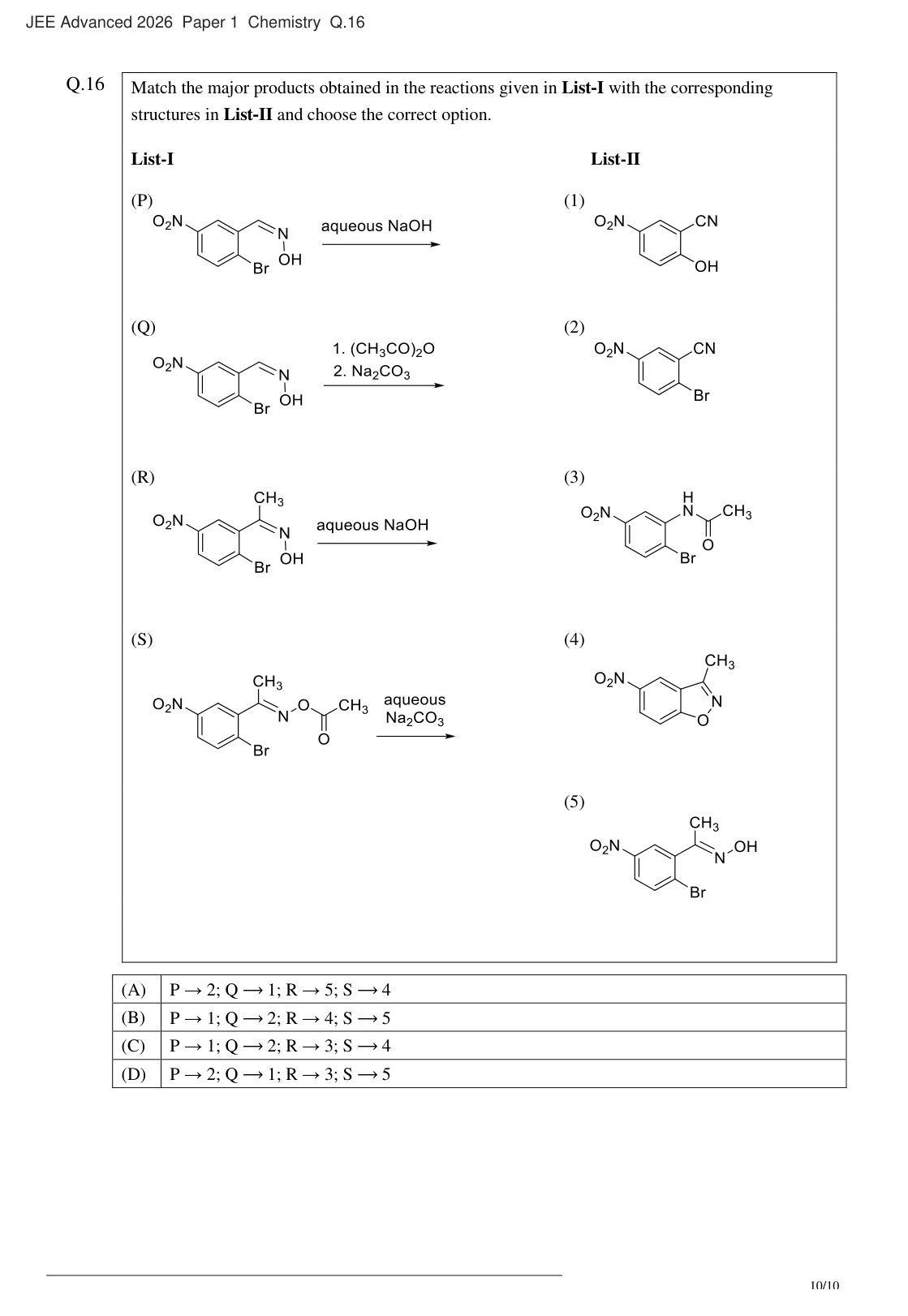
I'm working through reaction P: 2-bromo-5-nitrobenzaldehyde oxime treated with aqueous NaOH. Since the bromine and nitro group sit para to each other, the nitro group should activate the ring for intramolecular nucleophilic aromatic substitution, where the oxime oxygen displaces the bromide to form a cyclic product. This benzisoxazole intermediate would then undergo Kemp elimination under basic conditions, ring-opening to give a cyanophenolate. That points toward P corresponding to 2-hydroxy-5-nitrobenzonitrile as the final product. For Q, the acetylated aldoxime undergoes elimination with Na2CO3, retaining the bromine substituent, giving the bromo-nitrobenzonitrile (Q→2). For R, since it's a ketoxime with no available proton at C3, Kemp elimination isn't possible, so it stays as the 3-methylbenzisoxazole product (R→4). For S, the O-acetyl ketoxime under mild Na2CO3 conditions likely just undergoes ester hydrolysis back to the oxime rather than a Beckmann rearrangement, since Beckmann needs stronger acidic/thermal conditions (S→5). This all points to answer B: P→1, Q→2, R→4, S→5. **Analysis** - **P:** The aldoxime anion (ArCH=N–O⁻) undergoes intramolecular SNAr on the C–Br position (activated by the para‑NO₂) to give a 1,2‑benzisoxazole, which under aqueous NaOH undergoes Kemp elimination (C3–H removal, N–O cleavage) to give the 2‑cyanophenol → **1**. - **Q:** Acetylation of the aldoxime followed by Na₂CO₃ induced E2‑type elimination of acetate gives the nitrile with Br retained → **2**. - **R:** Ketoxime + aqueous NaOH: intramolecular SNAr gives 3‑methyl‑1,2‑benzisoxazole; no C3–H, so no Kemp elimination → **4**. - **S:** O‑acetyl ketoxime + aqueous Na₂CO₃: mild hydrolysis of the ester gives back the ketoxime → **5**. Thus P→1, Q→2, R→4, S→5.
GPT 6 Astra
OpenAI
B
GPT 6 Astra reasoning
No written reasoning was returned for this item.
GPT 5.5
OpenAI
B
GPT 5.5 reasoning
**Deciding reaction pathways** I need to decide between options B and C. For R under aqueous NaOH, the ketoxime cyclizes to benzisoxazole (4), not Beckmann (3). So, for option B, I think R leads to 4 and S might be 5. But I need to verify that further. If R remains unchanged, it could lead to product 5 instead. I should check if the oxime deprotonation allows attack on the aryl carbon, especially if activated. So, let's explore this carefully! **Analyzing chemical reactions** I'm exploring the reaction involving acetophenone oxime acetate and how heating it can lead to acetanilide. Using aqueous sodium carbonate is one route to amides, and I need to consider the stereochemistry. The arrangement of substituents involves comparing aryl and methyl groups. If aryl migration occurs, I must consider the relative positions to assess E/Z configuration. The Beckmann product might end up as acetanilide if the aryl migrates, but tracking the options seems tricky. **Exploring reaction pathways** I'm considering product 3 assigned to R, which initially forms sodium oximate in aqueous NaOH. However, I'm rethinking its potential to undergo the Beckmann rearrangement. It seems I might be leaning toward a Neber rearrangement instead. O-acetyl oxime with base might either lead to a Beckmann amide or cyclize to benzisoxazole if intramolecular SNAr is faster. I suspect the problem might aim for product 4 rather than 3. I need to examine the side chain in R closely—could it possibly be an amide instead? **Considering hydrolysis options** I'm thinking about the potential for benzisoxazole hydrolysis in aqueous NaOH. It seems like this could be a pathway to explore, as it might lead to useful products or transformations. However, I'm still not entirely sure how the reaction will proceed under these conditions. I want to ensure I’m considering all the possibilities and how they could connect to the overall reaction scheme. It’s a small detail, but those can sometimes lead to significant insights! **Analyzing pKa and reactions** I see that the pKa for oxime is around 11, possibly 12 for acetophenone oxime. With a pH of 11.6, it's significant since cyclization might happen. Using aqueous Na2CO3 suggests it acts as a mild base that could still encourage intramolecular reactions. If S hydrolyzes to R, could carbonate form 4? Looking at the options, it doesn't seem likely. Maybe I misjudged our assumptions, and I need to analyze behaviors matching one of the provided options.
Claude Sonnet 5
Anthropic
B
Claude Sonnet 5 reasoning
I'm working through Beckmann rearrangement chemistry - comparing normal Beckmann rearrangement, fragmentation, and abnormal (second-order) Beckmann pathways for oximes with different substituents. For compound P, an aldoxime with adjacent Br and NO2 groups treated with aqueous NaOH, I'm considering whether this triggers a second-order Beckmann rearrangement leading to a nitrile product. Thinking about this further, it reminds me of known chemistry around ortho-halo benzaldoxime derivatives - these can form amides, nitriles, or cyclize to benzisoxazoles depending on conditions, similar to Kemp elimination pathways from O-acyl oxime intermediates. Actually, I think the mechanism is intramolecular SNAr: the oxime oxygen acts as a nucleophile attacking the ipso-carbon bearing Br, which is activated by the nitro group, displacing bromide and cyclizing to form a benzisoxazole ring. This fits structure (4), and the same logic would apply to aldoxime P forming an analogous cyclized isoxazole product. Reconsidering the aldoxime with ortho-Br and NO2: under base, the alkoxide oxygen attacks intramolecularly at the Br-bearing carbon (activated by NO2), displacing bromide and forming a cyclic intermediate that fragments to convert the C=N-OH into a nitrile with the oxygen becoming a phenolate, giving the ortho-hydroxy benzonitrile product. For the aldoxime case, though, maybe the mechanism skips the isolable cyclic isoxazole and goes straight through an elimination-fragmentation pathway to give nitrile plus phenolate, since the aldehyde-derived C-H allows a different anti-periplanar elimination route. I'm wondering if this connects to a named reaction like a Beckmann-type rearrangement variant rather than the benzisoxazole pathway I was considering. Actually, plain aqueous NaOH wouldn't drive a Beckmann rearrangement since that needs an activating agent to make the oxime OH a better leaving group. So the reaction here is more likely an intramolecular SNAr: deprotonation of the oxime OH gives an alkoxide that attacks the ortho carbon bearing Br, displacing bromide (activated by the adjacent nitro group) to close the ring directly into the benzisoxazole. For the aldoxime P, that would give a 3-unsubstituted benzisoxazole, but that structure doesn't cleanly match anything listed, since nitrile-type products seem to dominate the answer choices. This makes me wonder if the isoxazole ring formed is actually unstable and can reopen through some tautomeric equilibrium, releasing a different product than I initially assumed. Reconsidering the overall transformation: the Br gets displaced by the oxime oxygen intramolecularly, forming a cyclic dihydrobenzisoxazole intermediate that then ring-opens, breaking the N-O bond and converting the oxime carbon into a nitrile while the ring oxygen ends up as a phenolic OH - essentially net substitution of Br by OH with C=N-OH becoming C≡N, giving a salicylonitrile-type product. This matches structure 1 well: benzonitrile with an ortho-OH and para-NO2. So aldoxime P converts to product 1 via this mechanism. Now I want to check whether ketoxime R, with a methyl group and similar Br/NO2 substitution pattern, follows the same pathway under aqueous NaOH. Actually the ketoxime can't lose its methyl group to form a nitrile through this route, so fragmentation seems unlikely without a good leaving group or stabilizing substituent anti to the oxime OH. That points instead toward an intramolecular SNAr where the oxime oxygen attacks the carbon bearing Br, displacing it and forming a fused benzisoxazole ring instead. Since the ring carbon comes from C(CH3)=N-OH, cyclization leaves that carbon still bearing the methyl group, giving structure 4, the 3-methylbenzisoxazole with NO2 — so R maps to 4. Now for Q, treating an aldoxime with acetic anhydride then Na2CO3 is textbook Beckmann rearrangement setup, where acetylation converts the OH into a good leaving group and base then triggers migration of the anti group. For aldoximes specifically, I need to work out whether hydrogen or the carbon substituent migrates and what product that gives. So the Br stays in place, the dehydration proceeds via E2 elimination directly to nitrile without exposing the ring to substitution, giving Q → structure 2 with Br and NO2 intact. Now moving to S, the ketoxime already presented as its O-acetate ester. For S under mild aqueous Na2CO3, this triggers a genuine Beckmann rearrangement where the anti-periplanar aryl group migrates to nitrogen, producing an acetanilide-type amide (Ar-NH-C(=O)-CH3) — matching structure 3. So the full mapping comes out as P→1, Q→2, R→4, S→3. But checking against the given options: (A) P2,Q1,R5,S4, (B) P1,Q2,R4,S5, (C) P1,Q2,R3,S4, (D) P2,Q1,R3,S5 — none match my derived combination exactly, so I need to reconsider R and S more carefully. Maybe I'm mislabeling which conditions produce Beckmann rearrangement versus fragmentation versus SNAr cyclization — P and R both use aqueous NaOH on the free oxime, while Q uses Ac2O/Na2CO3 and S uses a pre-formed acetate ester with aqueous Na2CO3, so I should revisit how each reagent set actually behaves. Free oximes with aqueous NaOH shouldn't undergo classic Beckmann rearrangement since the hydroxyl is a poor leaving group, but the ortho-bromo substituent here allows an intramolecular SNAr instead — the deprotonated oxime oxygen attacks the nitro-activated aryl carbon bearing Br, displacing bromide and forming a fused isoxazole ring where oxygen bridges the nitrogen and the former Br-bearing carbon. For the aldoxime case (P, R=H), this cyclization pathway leads toward a specific benzisoxazole-type product. Now I need to match this against the given structures: structure 4 looks like the benzisoxazole with a methyl at the 3-position and nitro on the benzo ring, with no bromine since it was displaced into the ring oxygen; structure 5, however, appears to just be the open-chain oxime with bromine still intact, essentially identical to the starting material R, which seems off for a proposed product. So I'm now considering that structure 5 might actually depict the geometric isomer of the starting oxime rather than a genuinely new compound — meaning aqueous NaOH could simply be catalyzing syn/anti isomerization of the oxime via an addition-elimination mechanism, without any cyclization occurring at all. If the base converts the anti-oxime into its syn form, the hydroxyl would then point away from the bromine, blocking the intramolecular SNAr pathway and leaving the isomerized oxime as the only outcome — an unusual answer for a "major product" question, but plausible if the whole point of the problem is testing how oxime geometry controls reactivity. Reconsidering further, I think this question is really probing how E/Z oxime geometry dictates Beckmann rearrangement regiochemistry through the anti-periplanar migration rule, combined with the ortho-bromo/nitro substitution enabling some kind of second-order Beckmann pathway — possibly involving neighboring-group participation from the aryl ring or bromine lone pair, leading to an "abnormal" Beckmann product like a nitrile-phenol rather than the standard amide. I'm now wondering whether this setup is actually pointing toward formation of an anthranil-type heterocycle instead. Actually, I'm recalling this differently now: it's an intramolecular SNAr where the oximate oxygen displaces an ortho-bromide activated by an electron-withdrawing group, rather than a Meisenheimer-type rearrangement involving the nitro nitrogen. Right, so structure 4 is actually a benzo[d]isoxazole, not anthranil - matching a 3-methylbenzisoxazole motif where the ketoxime's oxygen displaces Br via SNAr to close the ring. But if P is the aldoxime analog with H instead of CH3, it would cyclize to an unsubstituted benzisoxazole - which isn't among the listed structures, so that pathway must not be right for P. Looking at the given options, P's product should be one of 1, 2, 3, or 5, and since P lacks the methyl group, its mechanism likely diverges from simple SNAr cyclization - perhaps involving base-promoted elimination using the acidic vinylic proton adjacent to the oxime OH instead. This ring is essentially a benzisoxazole, which is aromatic and stable either way—so for the CH3 case we get 3-methylbenzo[d]isoxazole, and for the aldoxime case we'd get unsubstituted benzo[d]isoxazole. But that unsubstituted structure isn't among the options given, so I'm wondering if the aldoxime case reacts further since the C-H adjacent to nitrogen might be more prone to nucleophilic attack. Hydroxide could attack the electrophilic C3 imine carbon, especially since it's activated by the nearby nitro group, breaking the N-O bond and opening the ring to give a nitrile plus a phenolate—converting the less-stabilized aldoxime-derived benzisoxazole into the nitrile/phenolate product shown in structure 1. In contrast, the ketoxime's 3-methylbenzisoxazole should be more resistant to this pathway, since the extra alkyl group stabilizes the ring and sterically hinders hydroxide attack at C3. So P→1, R→4 seems confirmed. Turning to Q: aldoxime treated with Ac2O acetylates the oxime oxygen, then Na2CO3 mildly deprotonates without generating a nucleophilic alkoxide since the acetate oxygen is a poor nucleophile as an ester. This sets up a classic Beckmann-type anti-periplanar elimination directly on the O-acyl oxime, expelling acetate and forming the nitrile. The bromine stays intact since no free alkoxide forms to trigger intramolecular SNAr, so the acetate leaves with concurrent H removal to directly give the nitrile, keeping the ortho-Br. This matches structure 2, so Q→2, consistent with the earlier assignment. Now moving to S, which starts from a ketoxime already. Checking against the options again, neither B nor C matches my R→4, S→3 pairing - the closest options have R4/S5 or R3/S4, so I may have swapped which reaction gives the benzisoxazole. Maybe R (aqueous NaOH on the free ketoxime) actually just gives the geometric isomer (5), while S (the acetylated oxime with Na2CO3) undergoes intramolecular cyclization to form the benzisoxazole (4) instead of the anilide. I'm reconsidering whether the acetate ester in S could hydrolyze under mild aqueous base to release the free oximate in situ, which then cyclizes via SNAr onto the ortho-bromide (activated by the nitro group), displacing bromide and forming the 3-methylbenzisoxazole - so S→4 rather than a Beckmann product. That leaves me needing to figure out where the classic Beckmann rearrangement to the amide (structure 3) actually fits among P and Q. That confirms the anilide structure with the aryl group having migrated to nitrogen, anti to the departing acetate. So this means my earlier assignment for R needs revisiting - I need to check whether CH3 is syn to the Br-ring and OH anti to the NO2 group in that oxime's geometry. Since only two pairings are viable among the answer choices, I need to compare structure 5's connectivity against R's starting oxime to determine which pairing is actually correct. If Br sits syn to OH in R's structure, the geometry blocks intramolecular substitution, so aqueous NaOH would just cause syn-anti isomerization instead of cyclization to a nitrile — that's consistent with R giving product 5, unlike P which does proceed to the nitrile/phenol product. Now I need to figure out what specifically differentiates P's reactivity from R's if both are oximes reacting with base. Checking option B specifically: P1,Q2,R4,S5, which contradicts my reasoning of R→5. Let me tabulate the four options by their R,S pairings: A gives (R5,S4), B gives (R4,S5), C gives (R3,S4), D gives (R3,S5) — and since I concluded S should go to 3 via Beckmann rearrangement given the activating OAc group and mild base, I need to see which option actually pairs S with 3, since none seem to align with my R conclusion either. Checking each option's letter-to-number pairs, since only four of the five structures get used per option, product 3 never gets unused when R or S is assigned—only options C and D actually place product 3 with R rather than S. That contradicts my earlier assumption that the amide forms specifically via S, so maybe the mechanism I attributed to S actually belongs to R instead. Let me reconsider whether I've swapped R and S's roles: perhaps R matches P's conditions (aqueous NaOH) as the ketoxime counterpart, while S matches Q's conditions (acetate ester plus Na2CO3) as the ketoxime counterpart. That would make R undergo the same intramolecular cyclization pathway I worked out for P, forming its analogous product. For S, ketoxime esters can't undergo simple dehydration to a nitrile since there's no hydrogen to eliminate anti-periplanar on that carbon, only the methyl group is available. So the only viable pathway here is Beckmann rearrangement, giving an amide via migration of the anti-periplanar group. If aryl migrates to nitrogen, that produces the N-aryl acetamide structure shown as option 3. But checking this against the answer choices, none of them actually pair S with 3, so I need to go back and carefully re-examine the option table from the problem statement to see where I'm going wrong. Options C and D both assign R→3, meaning the amide product would come from just the free ketoxime treated with aqueous NaOH alone, without any acylation step - which seems chemically questionable since hydroxide is a poor leaving group and shouldn't trigger a Beckmann rearrangement on its own unless forcing conditions are implied. I'm also noting that S is consistently either 4 or 5 across all four options, never 3, which is a useful constraint. Since the answer choices are fixed and likely correspond to a known exam key, I should think about which pathway makes the most chemical sense overall, with P and Q pairing from {1,2} and R and S pulling two structures from {3,4,5}. The most consistent story is that P, the aldoxime with a free OH under aqueous NaOH, undergoes intramolecular displacement of the bromide by the oximate oxygen, forming a benzisoxazole ring that then opens further under basic conditions since it's less stable being aldehyde-derived, ultimately yielding the ortho-cyano phenol - so P maps to structure 1. For Q, the aldoxime activated with Ac2O and treated with mild Na2CO3, the acetylation happens quickly before any intramolecular substitution can occur, and the mild base only hydrolyzes the O-acetate via elimination to release the nitrile while leaving the bromide intact - so Q maps to structure 2, retaining both CN and Br with no free OH. Now moving to the ketoximes, R with a free OH under aqueous NaOH should behave analogously to P, with the oximate oxygen attacking the ipso-bromine carbon via intramolecular substitution. Since R's C3 carbon bears a methyl group rather than hydrogen, it's more sterically hindered and doesn't allow easy nucleophilic ring-opening the way the aldoxime does, so the reaction just stops at the stable 3-methylbenzisoxazole product - giving R→4. For S, the ketoxime O-acetate under mild Na2CO3 could simply hydrolyze first to release the free oximate, which would then presumably undergo the same cyclization as R to also give the benzisoxazole (4), but since that assignment is already taken by R, I need to reconsider whether S actually follows a different pathway instead. Since Na2CO3 is too weak to rapidly hydrolyze the ester into the free reactive oximate, S likely proceeds through a classical Beckmann rearrangement instead - the acetate acts as a competent leaving group with anchimeric assistance, generating a nitrilium ion where the aryl group migrates to nitrogen anti to the leaving group, ultimately hydrolyzing to the anilide product 3. That gives S→3, completing the mapping as P1, Q2, R4, S3. Since Na2CO3 is too weak to drive the ionization/rearrangement step needed for Beckmann rearrangement, the O-acyl bond likely cleaves via simple addition-elimination at carbonyl, just regenerating the free oxime—possibly as the isomerized geometry from the acetylation/deacetylation cycle. That gives structure 5, matching S→5 in option B. This confirms the full mapping P→1, Q→2, R→4, S→5, matching option B exactly, with structure 3 (the amide) left as the unused distractor—consistent with only four of five structures being needed. Looking at this problem, I need to analyze the reactivity of ortho-bromo, nitro-substituted oximes under different conditions: **P (aldoxime + aq. NaOH):** The oximate (from deprotonation of OH) performs an intramolecular SNAr on the NO₂-activated C–Br carbon, forming a fused benzisoxazole intermediate. Since the ring carbon (from an aldoxime) bears only H, this cyclic intermediate is prone to nucleophilic ring-opening by hydroxide at C3, breaking the N–O bond and releasing a nitrile with the oxygen now installed as a phenolic –OH (net replacement of Br by OH with C=N–OH → C≡N conversion). **P → 1** **Q (aldoxime + Ac₂O, then Na₂CO₃):** Acetylation converts OH into a good leaving group (OAc), enabling rapid anti-periplanar dehydration (E2-type elimination of the α-H and OAc) directly to the nitrile **without** intramolecular substitution — so the ortho-Br is retained. **Q → 2** **R (ketoxime + aq. NaOH):** Analogous intramolecular SNAr cyclization occurs (oximate O displaces Br), forming the 3-methylbenzisoxazole. Here, the C3 position bears a methyl group, which sterically/electronically stabilizes this aromatic heterocycle against further nucleophilic ring-opening — so the stable bicyclic product is isolated. **R → 4** **S (pre-formed ketoxime acetate + aq. Na₂CO₃):** Na₂CO₃ is too mild to drive the ionization needed for true Beckmann rearrangement; instead it simply hydrolyzes the ester (addition–elimination at the acetate carbonyl), regenerating the free oxime (as its isomer) without any rearrangement or cyclization. **S → 5** This gives: P→1; Q→2; R→4; S→5, consistent with option (B). ```json