
2026 · Paper 1 · Mathematics
Question 1
The printed question, the official key, and each model’s JSON answer plus the reasoning it wrote.
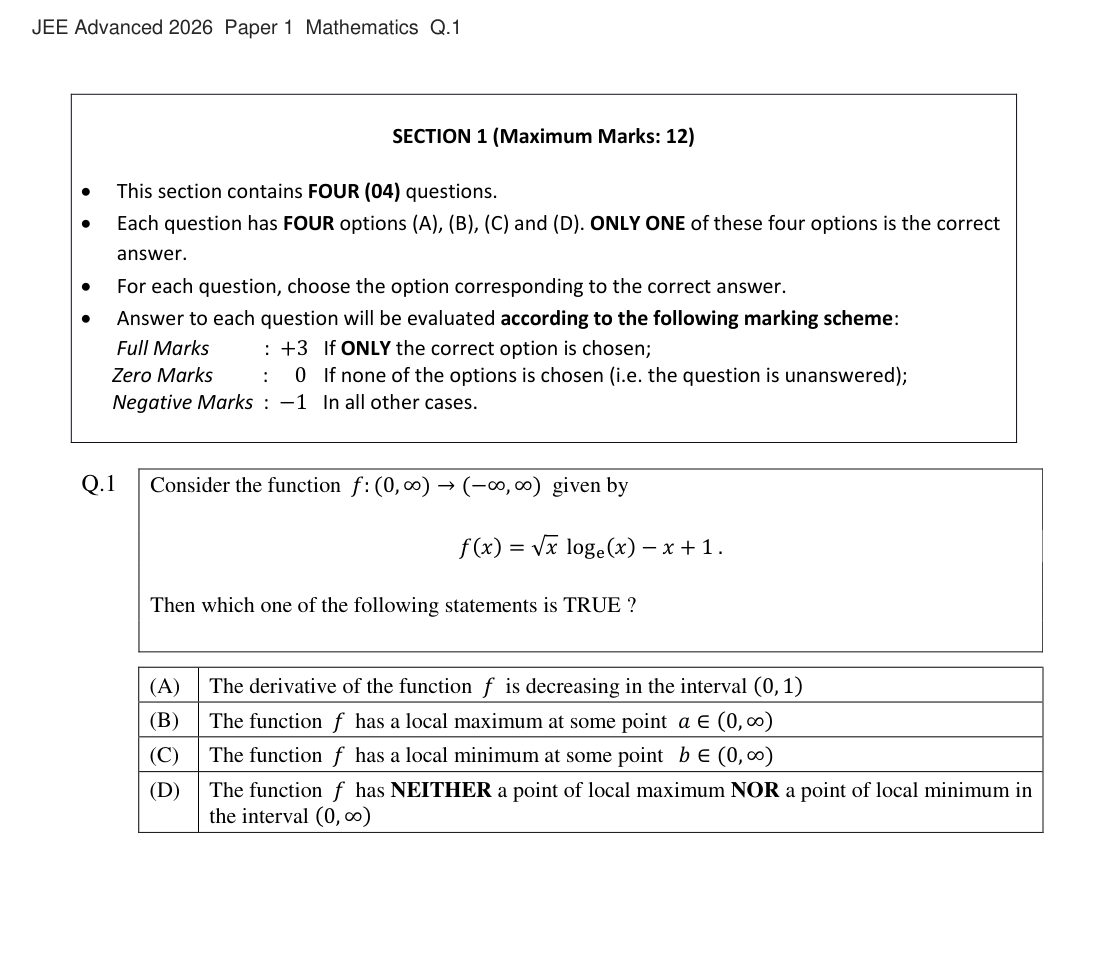
Q01
Official D
Model answers
Claude Fable 5.1
Anthropic
D
Claude Fable 5.1 reasoning
I'm computing the derivative of f(x) = √x ln x − x + 1, simplifying it into a form involving g(x) = ln x + 2 − 2√x, and checking that g(1) = 0 while analyzing where g is increasing or decreasing by examining its own derivative. So g reaches its maximum at x=1, meaning g(x) ≤ 0 everywhere, which makes f'(x) ≤ 0 with equality only at x=1 — f is monotonically decreasing with no local extrema, confirming statement D. Checking option A, I see f' actually increases from -∞ toward 0 on (0,1), rather than decreasing, so A is false, leaving D as the correct answer. **Solution.** f(x) = √x ln x − x + 1, so f'(x) = ln x/(2√x) + 1/√x − 1 = (ln x + 2 − 2√x)/(2√x). Let g(x) = ln x + 2 − 2√x. Then g'(x) = 1/x − 1/√x = (1 − √x)/x, so g increases on (0,1), decreases on (1,∞), with maximum g(1) = 0. Hence g(x) ≤ 0 for all x > 0, with equality only at x = 1. Thus f'(x) ≤ 0 everywhere and vanishes only at x = 1 (without changing sign), so f is strictly decreasing on (0,∞) and has neither a local maximum nor a local minimum. Option (A) is false since f'(x) → −∞ as x → 0⁺ and f'(1) = 0, so f' actually increases on (0,1).
GPT 6 Astra
OpenAI
D
GPT 6 Astra reasoning
No written reasoning was returned for this item.
GPT 5.5
OpenAI
D
GPT 5.5 reasoning
No written reasoning was returned for this item.
Claude Sonnet 5
Anthropic
D
Claude Sonnet 5 reasoning
I'm differentiating f(x) = √x ln x - x + 1, getting f'(x) = (ln x + 2)/(2√x) - 1, then defining g(x) = ln x + 2 - 2√x to analyze the sign of f'. I'm checking the value at x=1 to understand the critical point behavior. Now I'm computing f''(x) = -(ln x)/(4x^{3/2}) to understand concavity of f'. On (0,1), ln x is negative so f'' is positive, meaning f' is increasing there—ruling out the claim that f' decreases on (0,1). For x>1, f'' is negative, so f' decreases on (1,∞), making x=1 a maximum for f' where f'(1)=0. Checking boundary behavior: as x→0+, f'(x)→-∞ since the (ln x)/(2√x) term dominates negatively, while as x→∞, f'(x)→-1. So f' rises from -∞ up to 0 at x=1, then declines afterward. So f' ≤ 0 throughout with equality only at x=1, meaning f is monotonically decreasing everywhere and the sign of f' never actually flips — x=1 just has a horizontal tangent, not a true extremum. That means f has no local max or min, so the answer is D. Looking at this problem, I need to analyze f(x) = √x ln(x) - x + 1. **Computing f'(x):** f'(x) = (1/2)x^(-1/2) ln(x) + x^(-1/2) - 1 = (ln x + 2)/(2√x) - 1 At x = 1: f'(1) = (0+2)/2 - 1 = 0, so x=1 is a critical point. **Computing f''(x):** f''(x) = -1/4 x^(-3/2) ln x + 1/2 x^(-3/2) - 1/2 x^(-3/2) = -(ln x)/(4x^(3/2)) **Analyzing f'(x) behavior:** - For x ∈ (0,1): ln x < 0, so f''(x) > 0 → f' is **increasing** on (0,1). This rules out option (A). - For x ∈ (1,∞): ln x > 0, so f''(x) < 0 → f' is decreasing on (1,∞). So f' increases on (0,1) up to f'(1)=0, then decreases on (1,∞) starting from f'(1)=0. **Checking boundary behavior of f':** As x→0⁺: ln x → -∞, so (ln x)/(2√x) → -∞, giving f'(x) → -∞. As x→∞: (ln x)/(2√x) → 0 and 1/√x → 0, so f'(x) → -1. **Conclusion about f':** - f' increases from -∞ to 0 as x goes from 0 to 1. - f' decreases from 0 toward -1 as x goes from 1 to ∞. Thus f'(x) ≤ 0 for all x ∈ (0,∞), with equality **only** at x = 1. Since f'(x) doesn't change sign around x=1 (it's ≤ 0 on both sides, touching 0 only at the single point x=1), f is monotonically non-increasing (in fact strictly decreasing except at the single point) throughout (0,∞). This means **x=1 is not a local extremum** — f has no local maximum and no local minimum anywhere in (0,∞). This confirms option (D) is correct, and rules out (B) and (C) as well. ```json