
2026 · Paper 1 · Mathematics
Question 2
The printed question, the official key, and each model’s JSON answer plus the reasoning it wrote.
Q02
Official C
Model answers
Claude Fable 5.1
Anthropic
C
Claude Fable 5.1 reasoning
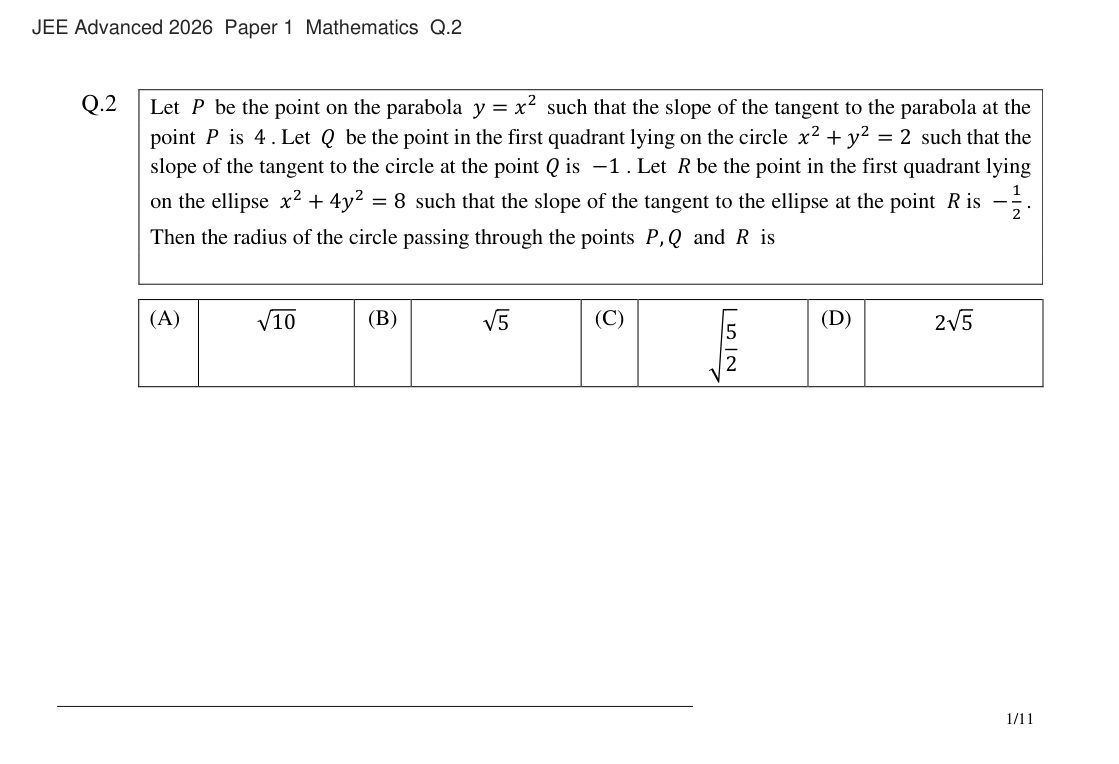
P: y = x², slope 2x = 4 → x = 2, P = (2, 4). Q: circle x² + y² = 2, slope -x/y = -1 → x = y, first quadrant: Q = (1, 1). R: ellipse x² + 4y² = 8, slope = -x/(4y) = -1/2 → x = 2y. Then 4y² + 4y² = 8 → y = 1, x = 2. R = (2, 1). Circle through (2,4), (1,1), (2,1): PR is vertical (x=2), QR is horizontal (y=1), so angle at R is 90°, PQ is the diameter. PQ = √(1 + 9) = √10, radius = √10/2 = √(5/2).
GPT 6 Astra
OpenAI
C
GPT 6 Astra reasoning
No written reasoning was returned for this item.
GPT 5.5
OpenAI
C
GPT 5.5 reasoning
**Calculating circumradius** I need to deliver my final answer as a JSON object. First, I’ll carefully solve the math problem involving points on a parabola, circle, and ellipse. For the parabola \(y = x^2\), the slope at point \(P\) is 4, giving \(P = (2, 4)\). For the circle, the point \(Q\) is \((1, 1)\) based on its slope. Lastly, on the ellipse, point \(R\) is \((2, 1)\). I’ll compute their coordinates and then find the circumradius. It looks like I’m on the right track! **Finalizing the JSON output** I'm working out the dimensions: the horizontal length from Q to R is 1, the vertical length from R to P is 3, and the slope of QP is 3/1, with a length of \(\sqrt{10}\). There's a right angle at R. The circumradius is calculated as half the hypotenuse, which gives me \(\sqrt{10}/2\) or \(\sqrt{5/2}\), which corresponds to option C. Now, I need to compile this into a final JSON format while ensuring I've marked the answer for option C as not unanswered. Let's get that crafted!
Claude Sonnet 5
Anthropic
C
Claude Sonnet 5 reasoning
For point P on y=x², setting the derivative to 4 gives x=2, y=4, so P=(2,4). For Q on the circle x²+y²=2 with tangent slope -1, solving x=y in the first quadrant gives Q=(1,1). Now for R on the ellipse x²+4y²=8, I'm differentiating implicitly to get y'=-x/(4y), which needs to equal -1/2. Solving x=2y and substituting back into the ellipse equation gives y=1, x=2, so R=(2,1). Now I'm setting up the general circle equation through P, Q, and R, plugging in each point to get three linear equations in D, E, F, then solving the system: D=-3, E=-5, F=6. Computing the radius from these coefficients gives radius²=5/2, so radius=√(5/2). Looking at this problem, I need to find points P, Q, R using the tangent slope conditions. **Finding P:** For y = x², dy/dx = 2x = 4, so x = 2, y = 4. **P = (2, 4)** **Finding Q:** For x² + y² = 2, implicit differentiation gives slope = -x/y = -1, so x = y. Substituting: 2x² = 2, x = 1 (first quadrant). **Q = (1, 1)** **Finding R:** For x² + 4y² = 8, differentiation gives 2x + 8y·y' = 0, so y' = -x/(4y) = -1/2, giving x = 2y. Substituting: 4y² + 4y² = 8, y = 1, x = 2. **R = (2, 1)** **Finding the circle through P(2,4), Q(1,1), R(2,1):** General circle: x² + y² + Dx + Ey + F = 0 For Q(1,1): 1 + 1 + D + E + F = 0 → D + E + F = -2 For R(2,1): 4 + 1 + 2D + E + F = 0 → 2D + E + F = -5 For P(2,4): 4 + 16 + 2D + 4E + F = 0 → 2D + 4E + F = -20 Subtracting first from second: D = -3 Subtracting second from third: 3E = -15 → E = -5 From first equation: -3 - 5 + F = -2 → F = 6 **Radius calculation:** r² = (D/2)² + (E/2)² - F = (9/4) + (25/4) - 6 = 34/4 - 6 = 8.5 - 6 = 2.5 = 5/2 r = √(5/2) ```json