
2026 · Paper 1 · Mathematics
Question 3
The printed question, the official key, and each model’s JSON answer plus the reasoning it wrote.
Q03
Official B
Model answers
Claude Fable 5.1
Anthropic
B
Claude Fable 5.1 reasoning
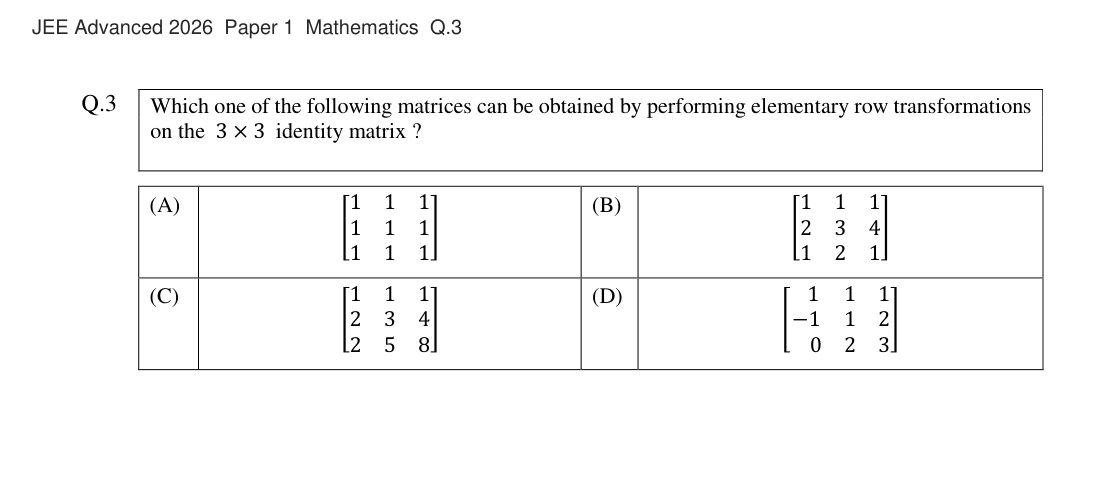
A matrix obtainable from the identity via elementary row operations must be invertible (nonzero determinant). (A) det = 0 (all rows equal). (B) det = 1(3−8) − 1(2−4) + 1(4−3) = −5 + 2 + 1 = −2 ≠ 0. (C) det = 1(24−20) − 1(16−8) + 1(10−6) = 4 − 8 + 4 = 0. (D) det = 1(3−4) − 1(−3−0) + 1(−2−0) = −1 + 3 − 2 = 0. Only (B) is invertible.
GPT 6 Astra
OpenAI
B
GPT 6 Astra reasoning
**Calculating determinants** I need to solve for the determinant of a matrix, specifically for B, which is [1 1 1; 2 3 4; 1 2 1]. To move forward, I'll subtract and simplify down to [0 1 2; 0 1 0]. This leads me to a determinant of -2. Then, I’ll manipulate the matrix further for other steps like C and D but ultimately need to output everything in JSON format only, as per the instructions.
GPT 5.5
OpenAI
B
GPT 5.5 reasoning
**Analyzing matrix transformations** I need to answer which matrices can be obtained from a 3x3 identity matrix using elementary row transformations. The options are matrices A, B, C, and D. Elementary transformations like adding rows, swapping rows, or scaling them can help create invertible matrices from the identity matrix. I'll compute the determinants to see which options are nonsingular (nonzero det). For option B, I find its determinant is nonzero, meaning it's invertible. I'm curious about the others, too! **Calculating determinants** I need to determine the determinants of the matrices to find out which ones are invertible. For option C with the rows manipulated, I confirm that the determinant equals zero. Then for option D, the rows become equal after transformations, which also results in a determinant of zero. It turns out option B is the only invertible matrix. Since the user requests a final answer in JSON format only, I’ll make sure my output adheres closely to that without additional text.
Claude Sonnet 5
Anthropic
B
Claude Sonnet 5 reasoning
Since elementary row operations preserve invertibility, the resulting matrix must have nonzero determinant—so I can rule out any option whose rows are all identical, since that forces det=0. Now I'm computing determinants for the remaining candidates to check which stay nonsingular. Working through option C, I check whether row3 is a combination of the other rows, then compute the determinant directly, getting zero—so it's excluded. Option D also comes out to zero, leaving only B with a nonzero determinant, confirming B as the answer. Looking at this problem: elementary row operations transform the identity matrix into row-equivalent matrices, and since elementary operations are invertible, they preserve the property of being non-singular (invertible). Since the identity matrix has det = 1 ≠ 0, any matrix obtained through elementary row transformations must also have a **non-zero determinant**. **Checking each option:** **(A)** All rows identical → det = 0. Excluded. **(B)** Rows: [1,1,1], [2,3,4], [1,2,1] det = 1(3·1 − 4·2) − 1(2·1 − 4·1) + 1(2·2 − 3·1) = 1(3−8) − 1(2−4) + 1(4−3) = −5 + 2 + 1 = **−2 ≠ 0** **(C)** Rows: [1,1,1], [2,3,4], [2,5,8] det = 1(3·8 − 4·5) − 1(2·8 − 4·2) + 1(2·5 − 3·2) = (24−20) − (16−8) + (10−6) = 4 − 8 + 4 = 0. Excluded. **(D)** Rows: [1,1,1], [−1,1,2], [0,2,3] det = 1(1·3 − 2·2) − 1(−1·3 − 2·0) + 1(−1·2 − 1·0) = (3−4) − (−3) + (−2) = −1 + 3 − 2 = 0. Excluded. Only option **(B)** has a non-zero determinant, so it's the only matrix that can be obtained via elementary row transformations from the identity matrix. ```json