
2026 · Paper 1 · Mathematics
Question 7
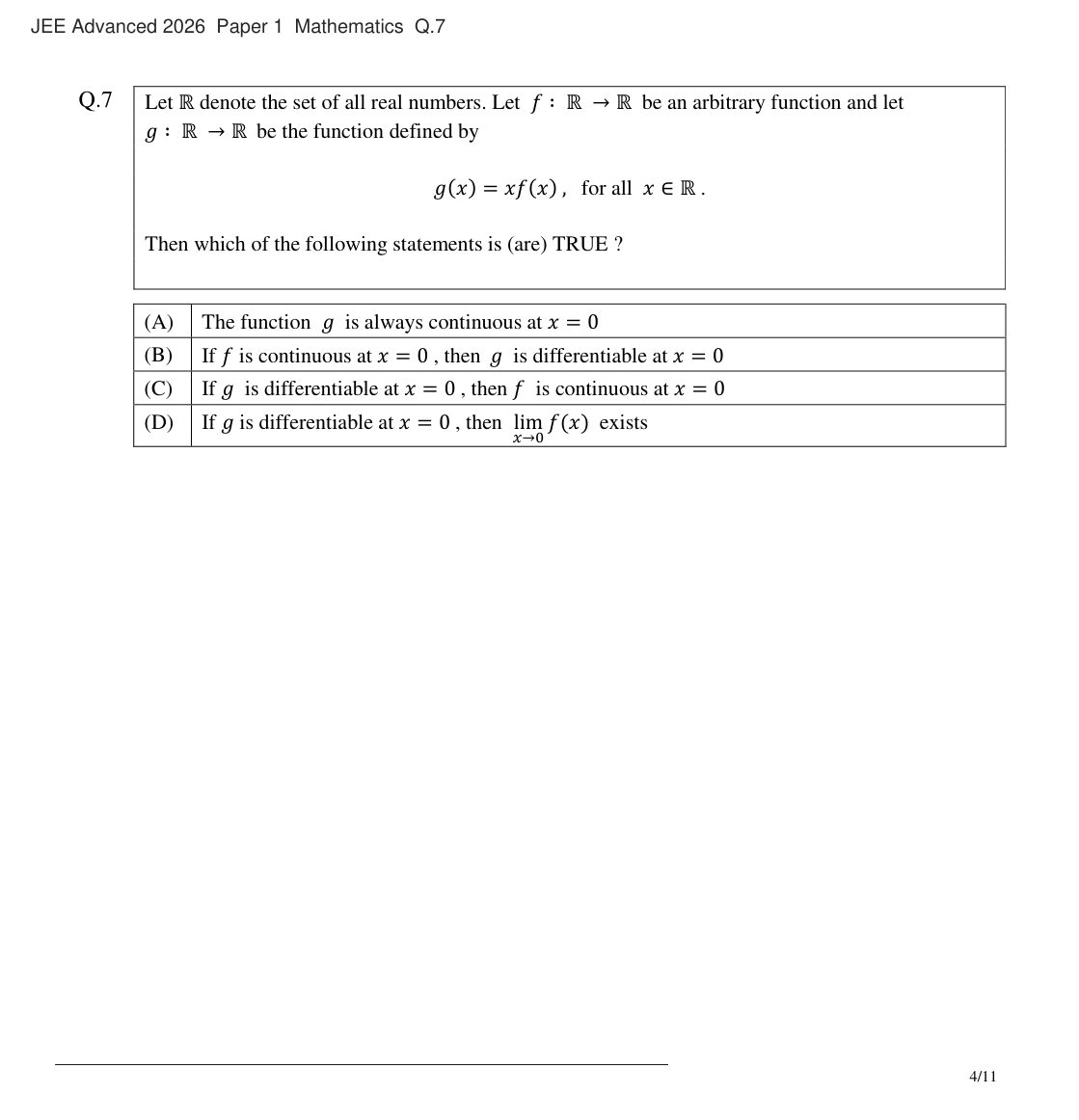
The printed question, the official key, and each model’s JSON answer plus the reasoning it wrote.
Q07
Official B, D
Model answers
Claude Fable 5.1
Anthropic
B, D
Claude Fable 5.1 reasoning
Testing option (A) with f(x)=1/x for x≠0 and f(0)=0 shows g isn't always continuous at 0, so that's false. For (B), computing g'(0) as the limit of f(x) confirms it equals f(0) when f is continuous there, so g is differentiable — that one holds true. Now I'm starting to check option (C). For (C), even if g is differentiable at 0, f itself need not be continuous there — a counterexample with f(0)=1 but f(x)=0 elsewhere shows g stays identically zero, so f's discontinuity doesn't break g's differentiability, making (C) false. Then for (D), since g(0)=0 always, g'(0) reduces exactly to the limit of f(x) as x→0, so differentiability of g at 0 guarantees this limit exists — making (D) true. So the correct answers are B and D. **Analysis:** Note g(0) = 0 always, and for x ≠ 0, (g(x) − g(0))/x = f(x). So g is differentiable at 0 ⇔ lim_{x→0} f(x) exists. - (A) False: take f(x) = 1/x for x ≠ 0, f(0) = 0. Then g(x) = 1 for x ≠ 0, g(0) = 0 — discontinuous. - (B) True: if f is continuous at 0, lim f(x) = f(0) exists, so g'(0) = f(0) exists. - (C) False: take f(x) = 0 for x ≠ 0, f(0) = 1. Then g ≡ 0 is differentiable, but f is not continuous at 0. - (D) True: g differentiable at 0 means lim_{x→0} f(x) = g'(0) exists.
GPT 6 Astra
OpenAI
B, D
GPT 6 Astra reasoning
**Deciding on JSON output** I think I need to solve a straightforward problem involving B and D. We want to determine if outputting just JSON is sufficient for the user. I’ll validate the reasoning: if g0=0 and the quotient is f(h), it's differentiable if there’s a finite limit. Both B and D are true, and C indicates that f0 can be arbitrary. A confirms that f=1/x is non-zero. So, we’ll finalize with JSON for the best request.
GPT 5.5
OpenAI
B, D
GPT 5.5 reasoning
**Analyzing differentiability and continuity** I'm exploring whether differentiability of g at 0 implies continuity for f at 0. Since f(h) can be expressed through g(h), the limit suggests f(0) could be arbitrary. This matters because f's continuity at 0 could fail even with g's differentiability. An example is f(x)=1 for x≠0 and f(0)=0 while g(x)=x, indicating f's lack of continuity at 0. Therefore, the conclusion is that D is true while C is false. The answer should just include ["B", "D"].
Claude Sonnet 5
Anthropic
B, D
Claude Sonnet 5 reasoning
Testing option A, I try f(x) = 1/x for x≠0 with f(0)=0, which makes g(x)=1 everywhere except g(0)=0 — so g isn't continuous at 0, ruling out A. Now I'm checking option B, considering what happens when f itself is continuous at 0. For B, since g(0)=0 always, g'(0) reduces to the limit of f(h) as h→0, which equals f(0) by continuity — so g is differentiable at 0 with g'(0)=f(0), confirming B is true. For C, I realize g(0)=0 regardless of f(0)'s actual value, so g'(0) existing only requires the limit of f(x) to exist, not that it equals f(0) — meaning f could have a removable discontinuity at 0 while g remains differentiable there, so C looks false. Since g'(0) existing is exactly equivalent to lim f(x) existing as x→0, D is true. So the answer is B and D. Looking at this problem, I need to analyze g(x) = xf(x) where f is arbitrary. **Option A:** Consider f(x) = 1/x for x≠0, f(0)=0. Then g(x) = 1 for x≠0, g(0)=0. So g is discontinuous at 0. **A is FALSE.** **Option B:** g(0) = 0·f(0) = 0. Compute g'(0) = lim_{h→0} [g(h)-g(0)]/h = lim_{h→0} [hf(h)]/h = lim_{h→0} f(h). If f is continuous at 0, this limit equals f(0), so g'(0) exists. **B is TRUE.** **Option C:** Note that g(0) = 0·f(0) = 0 regardless of the value of f(0) — the value f(0) itself never enters this product. So differentiability of g at 0 depends only on lim_{x→0} f(x) existing, not on f(0). Take f(x) = 1 for x≠0, but f(0) = 5. Then g(x) = x for x≠0, g(0) = 0, so g(x) = x everywhere — g is differentiable at 0 with g'(0)=1. But f(0)=5 ≠ lim_{x→0}f(x) = 1, so f is discontinuous at 0. Thus g differentiable does NOT imply f continuous. **C is FALSE.** **Option D:** From the computation above, g'(0) exists iff lim_{h→0} f(h) exists (as a finite limit), directly from g'(0) = lim_{h→0} f(h). So if g is differentiable at 0, this limit must exist. **D is TRUE.** ```json