
2026 · Paper 1 · Mathematics
Question 8
The printed question, the official key, and each model’s JSON answer plus the reasoning it wrote.
Q08
Official A, C, D
Model answers
Claude Fable 5.1
Anthropic
A, C, D
Claude Fable 5.1 reasoning
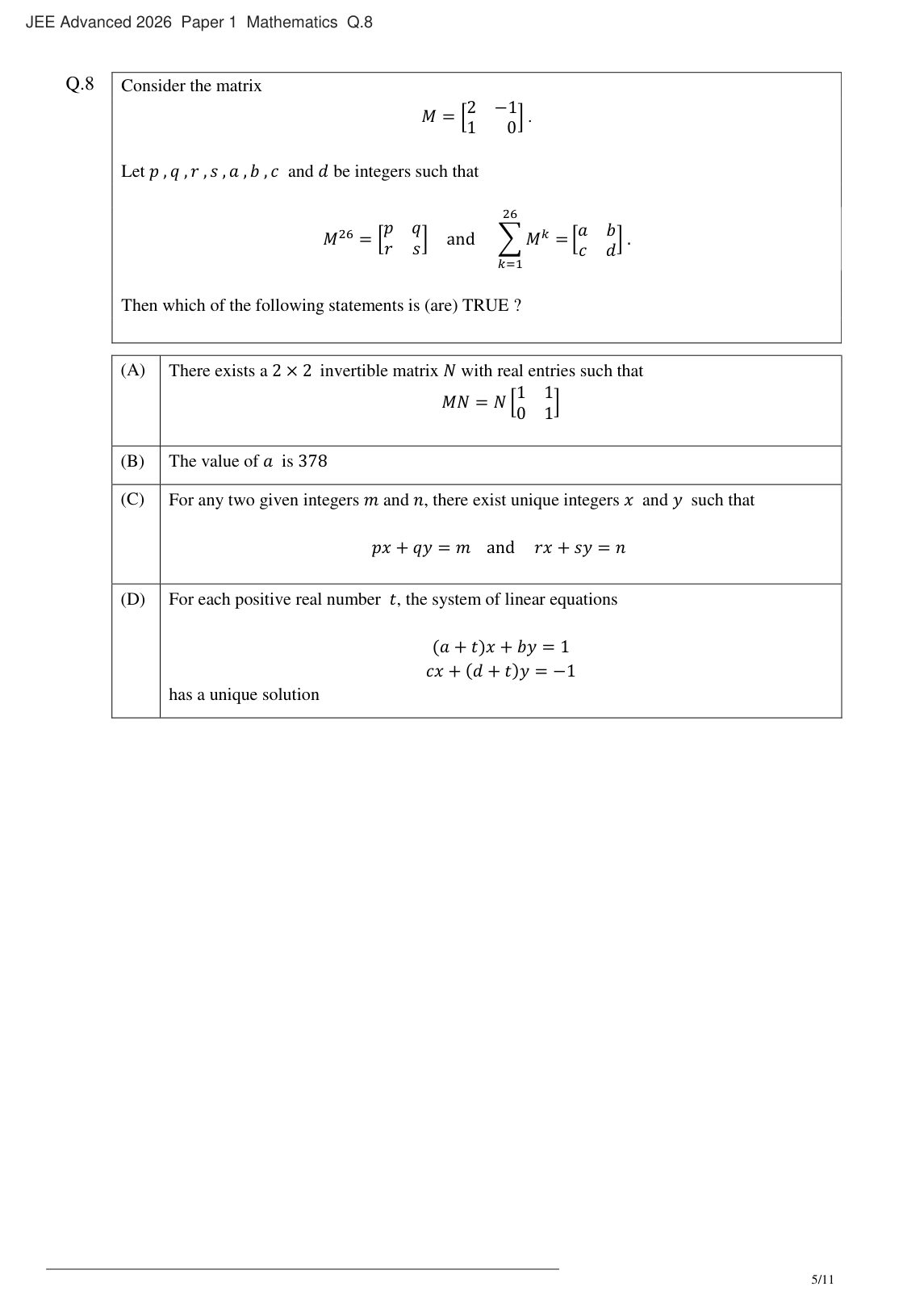
The matrix has a repeated eigenvalue of 1, so I decompose M as I plus a nilpotent matrix N, which lets me compute M^k directly as I + kN. Applying this for k=26 gives M^26 = [[27,-26],[26,-25]], and I'm now computing its determinant. Determinant is -675+676=1, so M is unimodular, meaning (C) is true. Summing M^k from 1 to 26 gives S = [[377,-351],[351,-325]], so a=377 not 378, making (B) false. Since M isn't diagonalizable, it's similar to a Jordan block, confirming (A) is true; and since S+tI has eigenvalue 26+t with positive determinant for t>0, (D) also holds. So the answer is A, C, D. **Analysis:** $M = I + N$ with $N=\begin{bmatrix}1&-1\\1&-1\end{bmatrix}$, $N^2=0$. So $M^k = I + kN = \begin{bmatrix}1+k&-k\\k&1-k\end{bmatrix}$. - $M^{26}=\begin{bmatrix}27&-26\\26&-25\end{bmatrix}$, $\det = 1$ → integer system has unique integer solution (C true). - $\sum_{k=1}^{26}M^k = 26I + 351N = \begin{bmatrix}377&-351\\351&-325\end{bmatrix}$, so $a=377$ (B false). - $M$ has eigenvalue 1 (double) and $M\ne I$, so it is similar to the Jordan block $\begin{bmatrix}1&1\\0&1\end{bmatrix}$ (A true). - $\det(S+tI) = (26+t)^2 > 0$ for $t>0$ → unique solution (D true).
GPT 6 Astra
OpenAI
A, C, D
GPT 6 Astra reasoning
No written reasoning was returned for this item.
GPT 5.5
OpenAI
A, C, D
GPT 5.5 reasoning
No written reasoning was returned for this item.
Claude Sonnet 5
Anthropic
A, C, D
Claude Sonnet 5 reasoning
Computing trace and determinant of M gives eigenvalues both equal to 1, so it's a repeated root. Checking M minus the identity shows it has rank 1 rather than being the zero matrix, meaning M isn't diagonalizable — it behaves like a single Jordan block with eigenvalue 1. This confirms M is similar to the Jordan block [[1,1],[0,1]], satisfying the condition in (A), which I mark true. Writing M as I+K where K=M-I, I find K squares to zero, so M^k simplifies to I+kK, giving a clean closed form for M^26 as [[27,-26],[26,-25]]. Now I'm setting up the sum of M^k from k=1 to 26 using this formula. Working through the arithmetic, the sum equals 26I + 351K, which gives entries a=377, b=-351, c=351, d=-325 -- so a is 377, not 378, meaning statement (B) is false. Now I'm turning to (C), checking whether there exist unique integer solutions x,y to the system px+qy=m, rx+sy=n for any given integers m,n. Since M has determinant 1, M^26 also has determinant 1, meaning its inverse has integer entries, so unique integer solutions exist for any m,n -- (C) is true. For (D), I need to check whether the determinant (a+t)(d+t)-bc stays nonzero for all t>0, using a=377, b=-351, c=351, d=-325. Working through the algebra, this determinant simplifies neatly to (t+26)^2, which is always positive for t>0, confirming the system has a unique solution for every such t. So (D) is TRUE, and the final answers are A, C, D. Looking at this problem, I need to analyze the matrix M = [[2,-1],[1,0]]. **Key computation:** M - I = [[1,-1],[1,-1]] = K, and K² = 0 (nilpotent). So M = I + K, giving: $$M^k = I + kK = \begin{bmatrix} 1+k & -k \\ k & 1-k\end{bmatrix}$$ **M²⁶:** p=27, q=-26, r=26, s=-25. det(M²⁶) = det(M)²⁶ = 1²⁶ = 1. **Sum:** ∑M^k = 26I + (351)K where 351 = 26·27/2 - a = 26+351 = 377, b = -351, c = 351, d = 26-351 = -325 **(A):** Since M has eigenvalue 1 (double, as trace=2, det=1), and M-I = K ≠ 0 but K²=0, M has geometric multiplicity 1 for eigenvalue 1. Thus M is similar to Jordan block J=[[1,1],[0,1]], meaning there exists invertible N with N⁻¹MN = J, i.e., MN = NJ. **TRUE** **(B):** a = 377, not 378. **FALSE** **(C):** Since det(M²⁶)=1 (integer), the system with integer coefficients p,q,r,s and det=±1 has a unique integer solution for any integers m,n (inverse matrix has integer entries via adjugate/det). **TRUE** **(D):** Determinant of system: (a+t)(d+t) - bc = (377+t)(-325+t) - (-351)(351) = t² + 52t - 122525 + 123201 = t² + 52t + 676 = (t+26)² For t > 0, (t+26)² > 0 always, so determinant never vanishes — unique solution always exists. **TRUE** ```json