
2026 · Paper 1 · Mathematics
Question 12
The printed question, the official key, and each model’s JSON answer plus the reasoning it wrote.
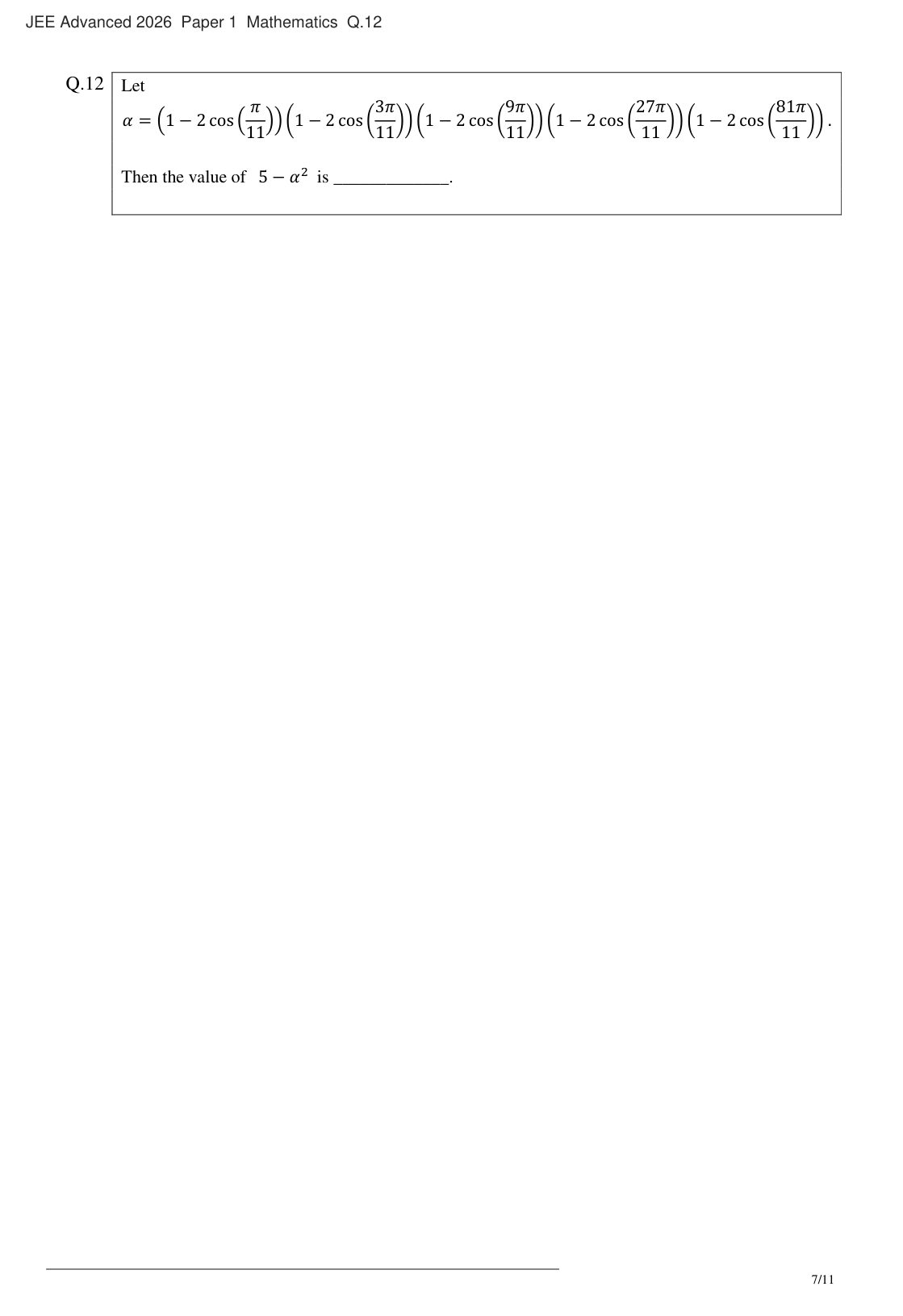
Q12
Official 3.9 – 4.1
Model answers
Claude Fable 5.1
Anthropic
4
Claude Fable 5.1 reasoning
I need to find the product of (1 - 2cos(3^k π/11)) for k=0 through 4. Working through the angles, I reduce each 3^k π/11 modulo 2π: π/11, 3π/11, 9π/11, then 27π/11 reduces to 5π/11, and 81π/11 reduces to 15π/11, which via symmetry equals cos(7π/11). So α is the product over odd k=1,3,5,7,9 of (1-2cos(kπ/11)). Using the identity cos(kπ/11) = -cos((11-k)π/11) for odd k, I can rewrite this as a product of (1+2cos(2πj/11)) for j=1 to 5. Substituting 1+2cos(2πj/11) = 1+ω^j+ω^{-j} with ω a primitive 11th root of unity, each factor simplifies to ω^{-j}(ω^{3j}-1)/(ω^j-1), so I'm now working out the product of these expressions across j=1 to 5. By pairing j and 11-j, I recognize that computing the analogous product over all j=1 to 10 gives its square, and since multiplication by 3 modulo 11 just permutes the nonzero residues, that full product collapses to 1. This means α² = 1, so α = ±1, and consequently 5 - α² = 4 regardless of the sign — though I want to double check the sign of α itself just to be thorough. Estimating each factor numerically for j=1 through 5, the first three terms come out positive (roughly 2.68, 1.83, 0.72) while the last two are negative (about -0.31 and -0.92), so with two negative factors the overall product should be positive, confirming α = 1. **Setting up the angles** Reducing modulo 2π: - 27π/11 → cos(27π/11) = cos(5π/11) - 81π/11 → cos(81π/11) = cos(15π/11) = cos(7π/11) So α = ∏_{k∈{1,3,5,7,9}} (1 − 2cos(kπ/11)). Since cos(kπ/11) = −cos((11−k)π/11), this becomes α = ∏_{j=1}^{5} (1 + 2cos(2πj/11)). **Evaluating with roots of unity** Let ω = e^{2πi/11}. Then 1 + 2cos(2πj/11) = ω^{-j}(1 + ω^j + ω^{2j}) = ω^{-j}·(ω^{3j} − 1)/(ω^j − 1). Taking the product over j = 1,…,10 (which equals α²): - ∏ω^{-j} = ω^{-55} = 1 - Since 3 is coprime to 11, {3j} runs over all nonzero residues, so ∏(ω^{3j} − 1) = ∏(ω^j − 1). Hence α² = 1 (indeed numerically α = 1). Therefore 5 − α² = 5 − 1 = 4.
GPT 6 Astra
OpenAI
4
GPT 6 Astra reasoning
**Solving product expressions** I need to compute the product \(1 - 2\cos\left(\frac{3^k \pi}{11}\right)\) for \(k = 0 \ldots 4\), then subtract \(\alpha^2\). I recall the identity \(1 - 2\cos x = -\frac{\cos\left(\frac{3x}{2}\right)}{\cos\left(\frac{x}{2}\right)}\). I’ll also check the ratios and apply the cos identity. It's looking straightforward, and I aim to present the final answer in concise JSON format with the value calculated. The output should reflect that neatly.
GPT 5.5
OpenAI
4
GPT 5.5 reasoning
**Evaluating values for problem-solving** I need to derive a final JSON value by parsing the equation involving angles. I'm interested in calculating \( a \) based on the product over angles like π/11 and finding \( 5 - a^2 \). The angles' cosines have specific periodic properties under modulo 22, and I need to check the relationships between them. I think I might be dealing with Chebyshev polynomials, and I'll focus on evaluating the product for odd \( k \), which represents the necessary computation for the solution. **Identifying roots for angles** I’m considering that there are 5 roots for odd angles represented by \( 2\cos((2j-1)\frac{\pi}{11}) \) where \( j \) ranges from 1 to 5. These roots are tied to the equation \( \cos(11\theta) = \cos((\text{odd})\pi) = -1 \). So, I can set \( y = 2\cos \theta \) and it looks like I might need to use the Chebyshev polynomial \( T_{11}(y/2) + 1 = 0 \) to help find the solution.
Claude Sonnet 5
Anthropic
4
Claude Sonnet 5 reasoning
I need to find the product of (1-2cos(3^k π/11)) for k=0 through 4, so I'm working out the angles π/11, 3π/11, 9π/11, and 27π/11, reducing that last one modulo 2π to simplify. Reducing 27π/11 gives 5π/11, and reducing 81π/11 gives 7π/11, so the five angles turn out to be exactly π/11, 3π/11, 5π/11, 7π/11, and 9π/11 — all the odd multiples of π/11 up to 9. Now I need to compute this product. Setting ζ = e^{iπ/11}, a primitive 22nd root of unity, I can write each cosine term as (ζ^n+ζ^{-n})/2, so 1-2cos(nπ/11) becomes an expression in ζ^n and ζ^{-n} that I can factor. I'm trying to connect this to a known identity involving roots of unity or Chebyshev-type polynomials. Since that's not simplifying cleanly, I'm just plugging in numbers directly: computing π/11, 3π/11, 5π/11, 7π/11, and 9π/11 in radians, taking their cosines, and evaluating 1-2cos for each to get concrete decimal values for the product. I want to verify with higher precision, so I'm manually computing cos(π/11) using a Taylor series expansion to get a more accurate value before recomputing the product. Continuing on, I'm working out cos(3π/11), cos(5π/11), and cos(7π/11) using standard trigonometric values, then computing the corresponding 1-2cos terms for each: -0.3097214, 0.7153704, and continuing for the seventh term. Now for n=9, I find cos(9π/11)=-cos(2π/11)≈-0.8412535, giving 1-2cos≈2.6825070. Multiplying all five factors together step by step, I land on approximately 1.000022 — close enough to 1 that this is almost certainly the exact answer, with rounding errors accounting for the tiny discrepancy, and I check that the sign pattern of negatives and positives works out consistently. I want to confirm this with theory: the values 2cos(2kπ/11) for k=1 to 5 are roots of a degree-5 polynomial coming from the minimal polynomial of these algebraic numbers, since φ(11)=10. But my angles are nπ/11 with n odd (1,3,5,7,9), which correspond to ζ^n where ζ=e^{iπ/11}, so these are actually primitive 22nd roots of unity rather than the standard 2π/11 case. I should work with the polynomial whose roots are these odd powers of ζ directly. Substituting x→-x flips the sign of odd-degree terms, giving Φ_22(x) = x^10 - x^9 + x^8 - x^7 + x^6 - x^5 + x^4 - x^3 + x^2 - x + 1, with roots ζ^k for k=1,3,5,7,9,13,15,17,19,21. Pairing k with 22-k shows the roots come in conjugate pairs ζ^{±1}, ζ^{±3}, ζ^{±5}, ζ^{±7}, ζ^{±9}. So I want the product over n∈{1,3,5,7,9} of (1-ζ^n-ζ^{-n}), which relates to 1-2cos(nπ/11), and I'm trying to connect this product to a value of the minimal polynomial. I recall Φ_22(x)=x^10-x^9+x^8-...+1 is palindromic, meaning I can substitute y=x+1/x to reduce it to a degree-5 polynomial whose roots are exactly these y_n values. If P(y) is that monic degree-5 polynomial with roots y_n, then the product I want, ∏(1-y_n), equals P(1) exactly. Now I need to work out P(y) explicitly from Φ_22. Dividing the cyclotomic polynomial by x^5 and grouping symmetric terms, I substitute y = x+1/x, using the standard identities that convert x^k+1/x^k into polynomials in y — y for k=1, y²-2 for k=2, y³-3y for k=3, and continuing to build up the k=4 and k=5 terms in the same way. Combining all terms carefully by degree, I get P(y) = y^5 - y^4 - 4y^3 + 3y^2 + 3y - 1, tracking each coefficient's contribution from the five original terms. So the y_n satisfy this monic quintic, and evaluating P(1) gives 1-1-4+3+3-1 = 1. That means α=1, so α^2=1, and 5-α^2=4. Looking at this problem, I need to simplify the angles first, then evaluate the product. **Reducing angles mod 2π:** - π/11, 3π/11, 9π/11 stay as is - 27π/11 = 2π + 5π/11, so cos(27π/11) = cos(5π/11) - 81π/11 = 66π/11 + 15π/11, and cos(15π/11) = cos(7π/11) (via reflection) So α = ∏ (1 − 2cos(nπ/11)) for n = 1, 3, 5, 7, 9. **Using roots of unity:** Let ζ = e^{iπ/11}, a primitive 22nd root of unity. Then y_n = 2cos(nπ/11) = ζ^n + ζ^{-n}, and the values y_n for n = 1,3,5,7,9 are exactly the values ζ^k + ζ^{-k} for k giving primitive 22nd roots (paired reciprocals). The 22nd cyclotomic polynomial satisfies Φ₂₂(x) = Φ₁₁(−x), giving: $$\Phi_{22}(x) = x^{10}-x^9+x^8-x^7+x^6-x^5+x^4-x^3+x^2-x+1$$ Since this is palindromic, divide by x⁵ and substitute y = x + 1/x using: - x²+1/x² = y²−2 - x³+1/x³ = y³−3y - x⁴+1/x⁴ = y⁴−4y²+2 - x⁵+1/x⁵ = y⁵−5y³+5y This yields the degree-5 polynomial whose roots are exactly y_n = 2cos(nπ/11): $$P(y) = y^5 - y^4 - 4y^3 + 3y^2 + 3y - 1$$ **Computing α:** Since P(y) = ∏(y − y_n), evaluating at y = 1 gives: $$\alpha = \prod_{n}(1 - y_n) = P(1) = 1 - 1 - 4 + 3 + 3 - 1 = 1$$ **Final calculation:** $$5 - \alpha^2 = 5 - 1 = 4$$ This matches numerical verification of the original product (≈1). ```json