
2026 · Paper 1 · Mathematics
Question 11
The printed question, the official key, and each model’s JSON answer plus the reasoning it wrote.
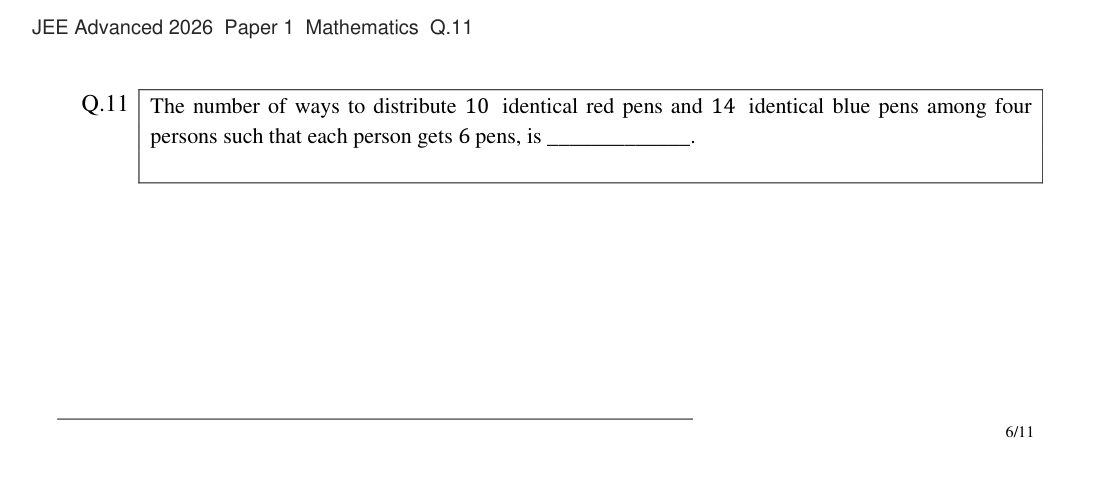
Q11
Official 206
Model answers
Claude Fable 5.1
Anthropic
206
Claude Fable 5.1 reasoning
Each person gets r_i red pens with 0 ≤ r_i ≤ 6 and r_1+r_2+r_3+r_4 = 10 (blue pens then determined as 6 − r_i, automatically between 0 and 6, summing to 14). Count solutions of r_1+r_2+r_3+r_4 = 10 with 0 ≤ r_i ≤ 6: Total without upper bound: C(13,3) = 286. Subtract cases with some r_i ≥ 7: 4·C(6,3) = 4·20 = 80 (two variables ≥7 impossible since 14 > 10). Answer: 286 − 80 = 206.
GPT 6 Astra
OpenAI
206
GPT 6 Astra reasoning
No written reasoning was returned for this item.
GPT 5.5
OpenAI
206
GPT 5.5 reasoning
**Solving distribution problem** I need to solve a numerical distribution question involving 10 identical red pens and 14 identical blue pens distributed among four people, with each person receiving a total of 6 pens. Each person's pens must adhere to certain nonnegative integer constraints. I’ll count the combinations using generating functions and coefficients. By calculating total distributions and applying constraints, I arrive at an answer of 206 combinations. That seems right! **Examining distribution question** I’m looking into the problem of distributing 10 identical red pens and 14 identical blue pens among four distinct people, ensuring each person receives exactly 6 pens. The answer I calculated is likely 206 ways to do this. I want to clarify that the pens are identical, and each person's allocation must satisfy nonnegative conditions. I'm ready to format my final output as JSON without any unnecessary details.
Claude Sonnet 5
Anthropic
206
Claude Sonnet 5 reasoning
Each person needs r_i between 0 and 6 (since b_i=6-r_i must also be nonnegative), with the r_i summing to 10 across 4 people. So I just need to count nonnegative integer solutions to r1+r2+r3+r4=10 with each r_i ≤ 6. Using inclusion-exclusion: total unrestricted solutions is C(13,3)=286, then subtract cases where any r_i≥7 (giving 20 solutions each, times 4 variables = 80, with no overlap possible since two variables ≥7 would exceed 10). That gives 286-80=206, so the answer is 206. **206**