
2026 · Paper 1 · Mathematics
Question 14
The printed question, the official key, and each model’s JSON answer plus the reasoning it wrote.
Q14
Official B
Model answers
Claude Fable 5.1
Anthropic
B
Claude Fable 5.1 reasoning
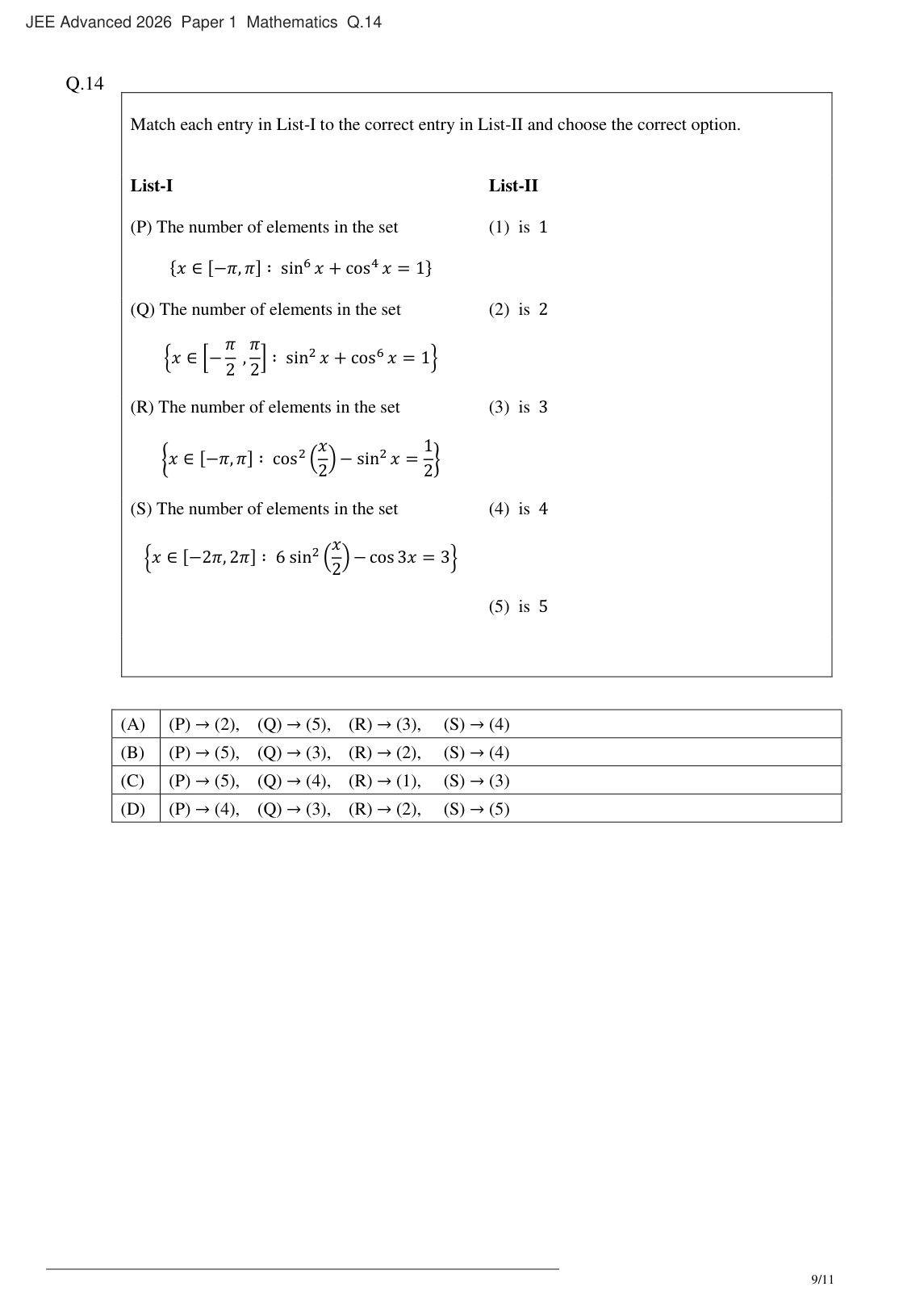
For sin^6 x + cos^4 x = 1 to hold, since sin^6 x ≤ sin^2 x and cos^4 x ≤ cos^2 x with equality only at extreme values, I need sin x and cos x each to be 0 or ±1. That gives x = 0, ±π/2, ±π on the interval, so 5 solutions. For (Q), sin^2 x + cos^6 x = 1 on [−π/2, π/2] similarly forces cos x ∈ {0, ±1}, giving x = 0, ±π/2 — 3 solutions. For (R), rewriting cos²(x/2) − sin² x = 1/2 using the half-angle identity leads to a quadratic in cos x: 2c² + c − 2 = 0, giving c = (−1+√17)/4 as the only valid root, which yields 2 solutions in [−π, π]. For (S), 6 sin²(x/2) − cos 3x = 3 simplifies down to cos x = 0, giving x = ±π/2, ±3π/2 on [−2π, 2π] — 4 solutions. So P→5, Q→3, R→2, S→4, matching answer choice B. **(P)** Since sin⁶x ≤ sin²x and cos⁴x ≤ cos²x, equality forces sin x ∈ {0, ±1}, cos x ∈ {0, ±1}: x = 0, ±π/2, ±π → 5 elements. **(Q)** cos⁶x = cos²x ⇒ cos x ∈ {0, ±1}: x = 0, ±π/2 → 3 elements. **(R)** (1+cos x)/2 − (1 − cos²x) = 1/2 ⇒ 2cos²x + cos x − 2 = 0 ⇒ cos x = (−1+√17)/4 ≈ 0.78 (other root invalid) → 2 elements in [−π, π]. **(S)** 3(1 − cos x) − cos 3x = 3 ⇒ cos 3x = −3cos x ⇒ 4cos³x = 0 ⇒ cos x = 0: x = ±π/2, ±3π/2 → 4 elements. So (P)→5, (Q)→3, (R)→2, (S)→4.
GPT 6 Astra
OpenAI
B
GPT 6 Astra reasoning
No written reasoning was returned for this item.
GPT 5.5
OpenAI
B
GPT 5.5 reasoning
**Analyzing trigonometric equations** I'm looking into the equation sin²x = 0 or 1 within the interval of [-π, π]. For sin = 0, I find x = -π, 0, π, totaling 3 solutions. For sin² = 1, the solutions are x = ±π/2, adding 2 more for a total of 5. Then, I'm considering the next question involving sin²x + cos⁶x = 1, where I set c = cos²x in the range [0, 1], leading me to sin² = 1 - c and cos⁶ = c³. **Solving trigonometric equation** I'm starting with the equation \(3(1 - \cos x) - \cos 3x = 3\). After simplifying, I get to \(-3 \cos x - \cos 3x = 0\), which means \(\cos 3x = -3 \cos x\). I also know that \(\cos 3x = 4c^3 - 3c\). Setting \(4c^3 - 3c = -3c\), I simplify it to \(4c^3 = 0\), leading me to the solution \(c = 0\). **Calculating trigonometric solutions** I’m starting with the equation cos x = 0. In the range [-2π, 2π], the solutions take the form x = π/2 + kπ. I need to find integer values of k such that -2π ≤ π/2 + kπ ≤ 2π. Once I divide by π, that leads to -2.5 ≤ k ≤ 1.5, giving me k values of -2, -1, 0, and 1. That results in four solutions: -3π/2, -π/2, π/2, and 3π/2. So, S = 4. Now, I need to produce the final JSON!
Claude Sonnet 5
Anthropic
B
Claude Sonnet 5 reasoning
For the first equation, I substitute s=sin²x to turn it into a cubic: s³+s²-2s=0, which factors as s(s+2)(s-1)=0, giving valid solutions s=0 or s=1. For s=0, sinx=0 gives x=-π,0,π (3 values in the interval); for s=1, sinx=±1 gives x=±π/2, so P has 5 total elements. Moving to Q, I substitute c=cos²x and get c³-c=0, factoring to c(c-1)(c+1)=0, so c=0 or c=1 are the valid roots (c=-1 is rejected). c=0 gives x=±π/2, and c=1 gives x=0 within the restricted domain, so Q has 3 elements. Now for R, I convert cos²(x/2) using the half-angle identity and sin²x using the Pythagorean identity, then substitute into the equation and simplify by multiplying through by 2 to get an equation purely in cos x. Solving 2cos²x + cosx - 2 = 0 via the quadratic formula, only one root falls within valid cosine bounds (≈0.7808), giving two x-solutions in the interval, so R has 2 elements. For S, I rewrite sin²(x/2) using the half-angle identity, simplify the equation to -3cosx - cos3x = 0, then apply the triple angle formula for cos3x to express everything in terms of cosx. That reduces to 4cos³x = 0, so cosx = 0, giving x = π/2 + kπ. Checking which k values land within [-2π, 2π], I find x = -3π/2, -π/2, π/2, 3π/2 all fit, while 5π/2 falls outside the range. So S gives 4 solutions, meaning P→5, Q→3, R→2, S→4 — matching option B. Looking at each equation: **P:** sin⁶x + cos⁴x = 1 on [-π,π]. Let s = sin²x: s³ + (1-s)² = 1 → s(s-1)(s+2) = 0, giving s=0 or s=1. - s=0: x = -π, 0, π - s=1: x = -π/2, π/2 Total: **5 elements** **Q:** sin²x + cos⁶x = 1 on [-π/2,π/2]. Let c = cos²x: c³ - c = 0 → c(c-1)(c+1)=0, giving c=0 or c=1. - c=0: x = ±π/2 - c=1: x = 0 Total: **3 elements** **R:** cos²(x/2) - sin²x = 1/2 on [-π,π]. Using half-angle formulas: (1+cosx)/2 - (1-cos²x) = 1/2 → 2cos²x + cosx - 2 = 0 cosx = (-1+√17)/4 ≈ 0.781 (valid), other root invalid (out of [-1,1]) This gives x = ±arccos(0.781): **2 elements** **S:** 6sin²(x/2) - cos3x = 3 on [-2π,2π]. Using sin²(x/2) = (1-cosx)/2: 3(1-cosx) - cos3x = 3 → -3cosx - (4cos³x-3cosx) = 0 → 4cos³x = 0 → cosx = 0 Solutions x = π/2 + kπ within [-2π,2π]: x = -3π/2, -π/2, π/2, 3π/2 Total: **4 elements** So: P→5, Q→3, R→2, S→4, matching option (B). ```json