
2026 · Paper 1 · Mathematics
Question 15
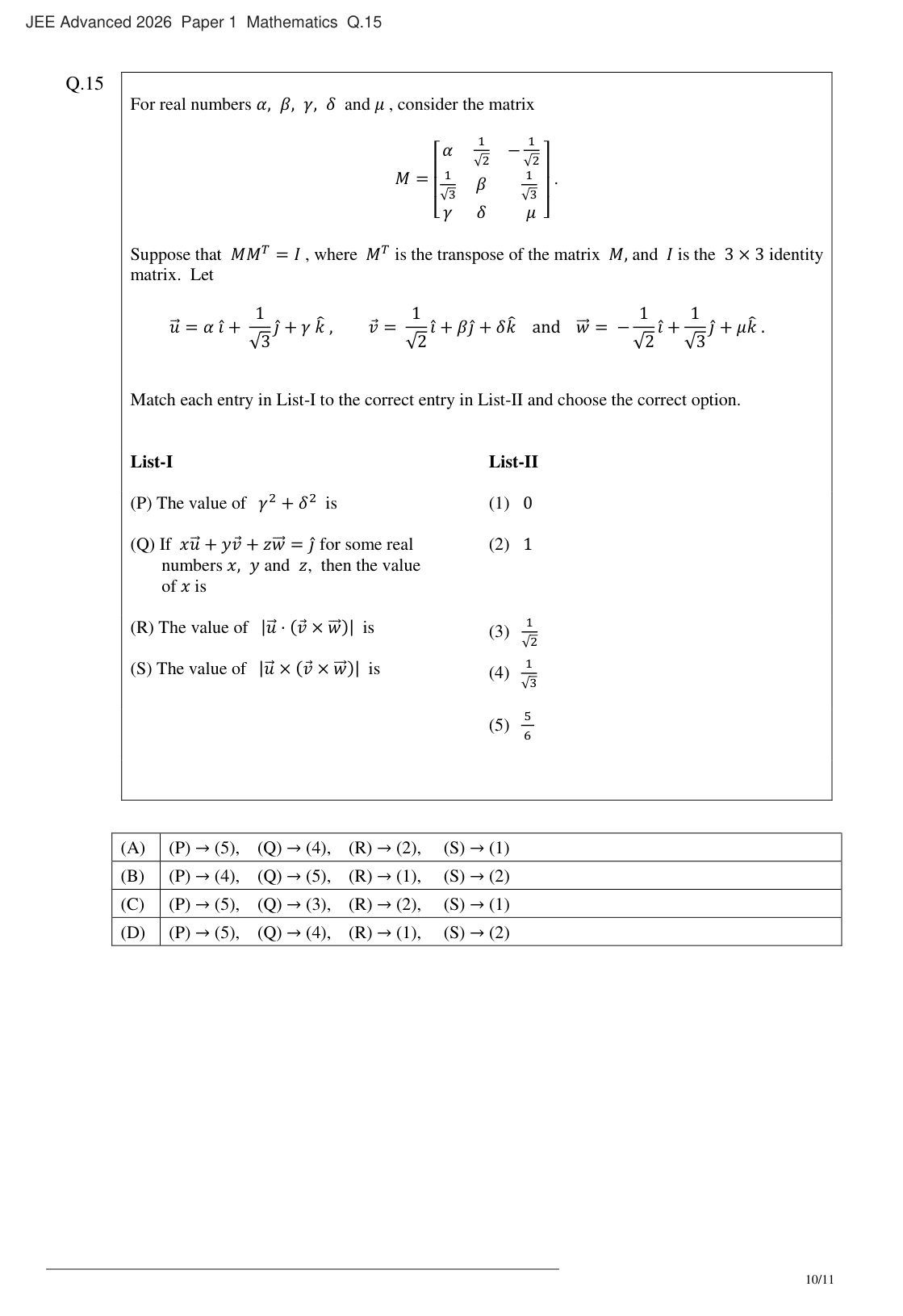
The printed question, the official key, and each model’s JSON answer plus the reasoning it wrote.
Q15
Official A
Model answers
Claude Fable 5.1
Anthropic
A
Claude Fable 5.1 reasoning
Using orthogonality, I find α must be 0 from the first row's unit norm condition, and β equals ±1/√3 from the second row. Now I'm checking the dot product of rows one and two to pin down further constraints. Solving that gives β = 1/√3. Then checking column orthonormality: γ² = 2/3 from column one and δ² = 1/6 from column two, so γ²+δ² = 5/6, pointing P to option 5. Treating the columns as vectors u, v, w, I find x = u·j = 1/√3, giving Q→4. The scalar triple product |u·(v×w)| equals the determinant magnitude, which is 1, so R→2. And since u×(v×w) reduces to (u·w)v − (u·v)w = 0 by orthonormality, S→1. That confirms the answer is A. **Solution outline** Since $MM^T=I$, rows are orthonormal: - Row 1: $\alpha^2+\tfrac12+\tfrac12=1\Rightarrow \alpha=0$. - Row 2: $\tfrac13+\beta^2+\tfrac13=1$, and Row1·Row2 $=0$ gives $\beta=\tfrac{1}{\sqrt3}$. Columns are also orthonormal, so: - Column 1: $\alpha^2+\tfrac13+\gamma^2=1\Rightarrow\gamma^2=\tfrac23$ - Column 2: $\tfrac12+\tfrac13+\delta^2=1\Rightarrow\delta^2=\tfrac16$ **(P)** $\gamma^2+\delta^2=\tfrac56$ → (5) Note $\vec u,\vec v,\vec w$ are exactly the columns of $M$, hence an orthonormal set. **(Q)** $\hat j = x\vec u+y\vec v+z\vec w \Rightarrow x=\vec u\cdot\hat j=\tfrac{1}{\sqrt3}$ → (4) **(R)** $|\vec u\cdot(\vec v\times\vec w)|=|\det M|=1$ → (2) **(S)** $\vec u\times(\vec v\times\vec w)=(\vec u\cdot\vec w)\vec v-(\vec u\cdot\vec v)\vec w=\vec 0$, so value $=0$ → (1) Matches option (A).
GPT 6 Astra
OpenAI
A
GPT 6 Astra reasoning
No written reasoning was returned for this item.
GPT 5.5
OpenAI
A
GPT 5.5 reasoning
**Thinking through a prompt's authenticity** I'm considering the prompt that says it has an attached official question, but it could be fake because it's about "JEE Advanced 2026," which is in the future. I want to solve the image associated with it and produce the best final answer. It’s important that I ensure the answer reflects correct formatting, like being in letter form. So, I’ll need to focus on that as I move forward.
Claude Sonnet 5
Anthropic
A
Claude Sonnet 5 reasoning
Since MM^T = I, the rows of M must be orthonormal vectors, meaning the columns α, 1/√3, γ actually form u itself as a row rather than a column — I need to check whether u, v, w correspond directly to the matrix rows. Rechecking: u = (α, 1/√3, γ) matches column1 of M, v = (1/√2, β, δ) matches column2, and w = (-1/√2, 1/√3, μ) matches column3. Since M is orthogonal, both rows and columns are orthonormal, so from row1 I get α² + 1/2 + 1/2 = 1, giving α = 0, and from row2, β² = 1/3, and I'm using these to work out γ² + δ². From column1, γ² = 2/3, and from column2, δ² = 1/2 - 1/3 = 1/6, so γ² + δ² = 5/6, matching option (5). For x u + y v + z w = j, since u, v, w form an orthonormal basis, the coefficient x equals u·j = 1/√3, matching option (4). For u·(v×w), since u, v, w are orthonormal, this scalar triple product has absolute value 1, matching option (2). Now I'm working out u×(v×w) using the vector triple product identity, which simplifies to v(u·w) - w(u·v), and since u, v, w are mutually orthogonal both dot products vanish. So that magnitude is 0, matching option (1). Putting it all together: P→5, Q→4, R→2, S→1, which corresponds to option A. Looking at this problem, since $MM^T = I$ and $M$ is square, $M$ is orthogonal, so both rows AND columns of $M$ are orthonormal vectors. **Setting up:** Note that $\vec{u}, \vec{v}, \vec{w}$ are exactly the **columns** of $M$: - Column 1 = $(\alpha, 1/\sqrt3, \gamma) = \vec{u}$ - Column 2 = $(1/\sqrt2, \beta, \delta) = \vec{v}$ - Column 3 = $(-1/\sqrt2, 1/\sqrt3, \mu) = \vec{w}$ So $\vec{u}, \vec{v}, \vec{w}$ form an **orthonormal set**. **Finding constants from row orthonormality:** - Row 1: $\alpha^2 + \tfrac12 + \tfrac12 = 1 \Rightarrow \alpha = 0$ - Row 2: $\tfrac13 + \beta^2 + \tfrac13 = 1 \Rightarrow \beta^2 = \tfrac13$ **Column norms:** - Column 1: $\alpha^2 + \tfrac13 + \gamma^2 = 1 \Rightarrow \gamma^2 = \tfrac23$ - Column 2: $\tfrac12 + \beta^2 + \delta^2 = 1 \Rightarrow \delta^2 = \tfrac12 - \tfrac13 = \tfrac16$ **(P)** $\gamma^2+\delta^2 = \tfrac23+\tfrac16 = \tfrac56$ → matches **(5)** **(Q)** Since $\vec u,\vec v,\vec w$ are orthonormal, $x = \vec u\cdot \hat j = \tfrac{1}{\sqrt3}$ → matches **(4)** **(R)** $|\vec u\cdot(\vec v\times\vec w)|$ is the absolute value of the determinant of an orthogonal matrix, which equals $|\det M| = 1$ → matches **(2)** **(S)** Using vector triple product: $\vec u\times(\vec v\times\vec w) = \vec v(\vec u\cdot\vec w) - \vec w(\vec u\cdot\vec v) = \vec 0$ since $\vec u\perp\vec v$ and $\vec u\perp \vec w$ → matches **(1)** This gives: (P)→(5), (Q)→(4), (R)→(2), (S)→(1), which is option **(A)**. ```json