
2026 · Paper 1 · Physics
Question 1
The printed question, the official key, and each model’s JSON answer plus the reasoning it wrote.
Q01
Official C
Model answers
Claude Fable 5.1
Anthropic
C
Claude Fable 5.1 reasoning
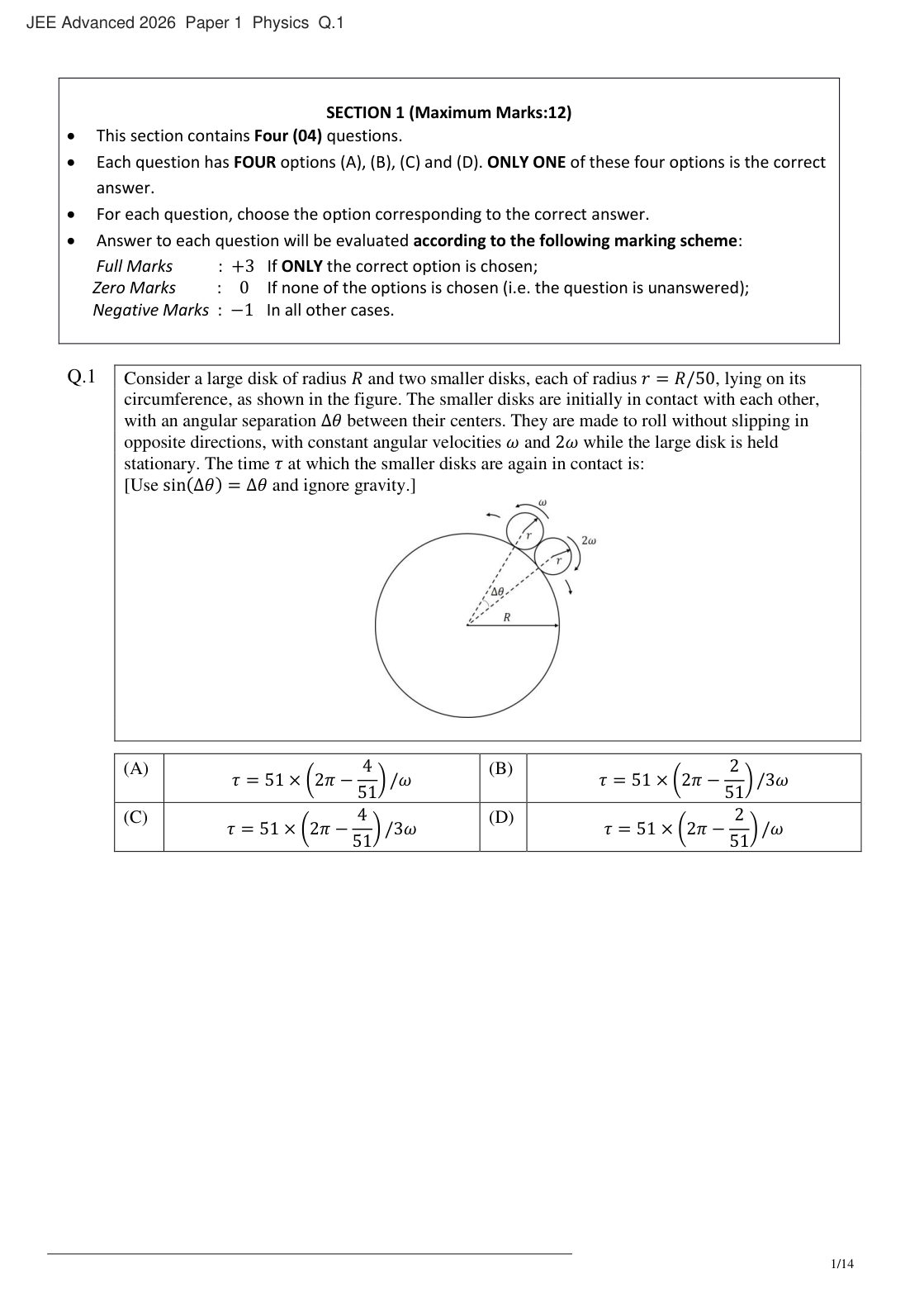
I'm working out the rolling-without-slipping condition for a small disk rolling on the outside of a large disk, relating the spin angular velocity ω to the orbital angular velocity Ω of the center via v = ωr = Ω(R+r). For disk 1, Ω1 = ω/51, and disk 2, moving oppositely with twice the spin, gives Ω2 = 2ω/51, so their relative angular rate is 3ω/51. The initial angular separation Δθ satisfies sin(Δθ/2) = 1/51 ≈ Δθ/2, and they meet again after covering 2π − 4/51 radians of relative angle, giving τ = 51(2π − 4/51)/(3ω), which matches option C. **Setting up the motion** For a small disk of radius $r$ rolling without slipping on the stationary large disk, the contact point is at rest, so the speed of the small disk's centre is $v = \omega r$. The centre moves on a circle of radius $R+r$, so its angular velocity about the centre of the large disk is $$\Omega = \frac{\omega r}{R+r} = \frac{\omega}{51}.$$ Similarly, the second disk (spin $2\omega$) has $\Omega_2 = \dfrac{2\omega}{51}$, in the opposite sense. **Initial separation** When the small disks touch, the distance between their centres is $2r$, so $$\sin\frac{\Delta\theta}{2} = \frac{r}{R+r} = \frac{1}{51} \;\Rightarrow\; \Delta\theta \approx \frac{2}{51}.$$ **Time to meet again** They move apart and meet on the far side when the relative angle swept is $2\pi - 2\Delta\theta = 2\pi - \dfrac{4}{51}$, with relative angular rate $\Omega_1+\Omega_2 = \dfrac{3\omega}{51}$: $$\tau = \frac{2\pi - \frac{4}{51}}{3\omega/51} = 51\left(2\pi - \frac{4}{51}\right)\Big/3\omega.$$
GPT 6 Astra
OpenAI
C
GPT 6 Astra reasoning
No written reasoning was returned for this item.
GPT 5.5
OpenAI
C
GPT 5.5 reasoning
**Determining spin rate** I need to figure out how to determine the rate of angular coordinate around the center for the small disk I’m looking into. This involves calculating its spin rate, often denoted as Ω_spin. It seems simple enough, but I want to ensure I'm considering all the relevant factors for an accurate calculation. I'll have to clarify the specifics as I work through this to get it just right! **Analyzing angular motion** I’m considering the directions indicated by the symbols, where the top left with ω and the top arrow could imply counterclockwise, while the right with 2ω suggests clockwise. Their centers move in opposite directions along the circumference, starting with an initial separation, Δθ. As the large disk remains stationary, the smaller disks roll around it. Their angular speeds influence the time until they next contact, with calculations revealing a differential change that guides when that will happen again. **Considering angular separation** At t=0, as the disks start moving, I see the separation increasing from Δθ if they’re moving away from each other. They will make contact again after circling around, when their separation modulo 2π equals Δθ. I should think about the relative angle difference being 2π - Δθ. To clarify things further, I’ll define angle coordinates around the larger center, noting that θ2 - θ1 starts equal to Δθ for the smaller disks on either side. **Evaluating rolling motion** I'm working on the relationship for rolling motion, using the formula Ω_spin = (R+r)/r * Ω_orbit for a hoop rolling around another. I remember that for a coin rolling around another of the same size, it rotates twice as it orbits once. For a small circle radius r rolling around a fixed circle radius R, I find that Ω_spin = (R+r)/r * Ω_orbit holds. But I need to recheck contact conditions, especially the no slip condition. It’s all about ensuring that the contact point has zero velocity! **Analyzing motion and contact** I’m considering how positive counterclockwise rotation (Ω) leads to a positive angular velocity (θdot). If the spin is in opposite directions, motion at the center has the same sign. I'm curious about the contact situation when overtaking occurs—if the speeds are unequal, the distance between them increases. They would come back together when α = 2π - Δθ, as they nearly complete their circumferences. But I need to check if a collision might happen before that! **Analyzing angular velocity** I'm approximating sin(Δθ/2) as Δθ/2, which means Δθ equals 2/51. This leads to options A and C for solutions. I notice that options B and D deal with different subtractions. There's a point to consider about the denominator: they either have ω or 3ω. If I'm correct, I go with option C, as it uses 3ω and subtracts 4/51. I must confirm the factor of 51 and check the relative orbital angular velocity too. Finally, I see the small disks start in contact, which adds nuance. **Exploring rotational dynamics** I'm considering how a rigid disk's rotation ties into angular velocity and its symmetry. The symmetry seems to make orientation a non-issue, except for markings. Rolling without slipping connects the rotational and translational velocities. Now I want to derive the contact angular separation. When evaluating options, both B and C show slight differences, with C looking like the likely choice. I need to verify the central angle based on small disks' geometry. This leads me to delve into sin and small angles, trying to derive the exact relationship here. **Analyzing angular separation** I’m thinking about how, with small angles, I can approximate sin Δθ as Δθ. This gives us a relation between the base and radius based on arc length. If I analyze the contact angle between two disks, it seems the central angle could be Δθ instead of 2π - Δθ if one disk overtakes the other. I'm defining "angular separation" as the smaller angle between center radii, ranging from 0 to π. As the disks move apart in opposite directions, this angle increases and can decrease again once they realign. Contact happens when this minor separation equals Δθ again, leading to an interesting dynamic. **Considering initial roll direction** I'm contemplating a scenario where two objects roll toward each other, moving in opposite directions. It seems like the arrows would be pointing toward one another, creating an interesting dynamic. This raises questions about how their motions affect angular separation and interaction. I wonder how their speeds and paths will change once they meet. This could imply a need to analyze their velocities and any potential interactions once they come into contact.
Claude Sonnet 5
Anthropic
C
Claude Sonnet 5 reasoning
I'm setting up the geometry: a large fixed disk of radius R, with two small disks of radius r = R/50 rolling without slipping along the outside edge of the big disk's circumference, like beads tracing the rim externally. Since the small disks roll without slipping on a stationary surface, the center of each small disk sits at distance R+r from the big disk's center, and its orbital speed around the big disk must equal r times its own spin rate ω about its own center. The contact point P lies along OC at distance R from O. Setting up radial and tangential unit vectors, I find the velocity of C is (R+r)φ' in the tangential direction, and the spin contributes an additional -rω_s term in the tangential direction to the contact point's velocity, so setting the total contact point velocity to zero gives the rolling constraint relating φ' and ω_s. This means each small disk's center revolves around the big disk with angular speed φ' = rω_s/(R+r), and since the two disks spin at ω and 2ω in opposite directions, I need to work out how their spins translate into opposite directions of orbital motion along the circumference. Since the disks rotate oppositely, the separation rate between them is φ1' - φ2' = 3rω/(R+r). Using the initial contact condition, the angular separation Δθ between centers relates to the chord length 2r via the small-angle approximation sin(Δθ)≈Δθ, since both centers sit at radius R+r from the origin. Solving gives Δθ ≈ 2r/(R+r), and plugging in r=R/50 yields Δθ ≈ 2/51. Now I need to figure out how much total relative angle must be traversed for the disks to separate fully around and touch again on the other side. I'm setting up positions with each disk's angle as a function of time based on their rotation rates, so I can track when the growing gap between them closes the loop and they meet again on the far side. Since they rotate in opposite directions, the small gap Δθ grows at rate 3rω/(R+r) while the far gap shrinks correspondingly, so the small gap will expand all the way around toward 2π - Δθ before the disks meet again from the other side. Working out the relative angular speed as 3rω/(R+r) = ω/17 (using R=50r), and with Δθ=2/51, the required angular travel is 2π - 4/51, giving the time τ as that quantity divided by ω/17. Checking against the answer options, which have a factor of 51, I notice 17 times 3 equals 51 — so the correct time expression must be τ = 51(2π - 4/51)/ω, matching option (A). Now I'm verifying the angle calculation: the chord between the two circle centers equals 2r, and using the small-angle approximation sin(Δθ) ≈ Δθ gives 2(R+r)Δθ = 2r, confirming the setup is consistent. This makes 2Δθ = 4/51, matching the numerator structure I found earlier for option C, so I'm comparing that against option A to see which denominator form is actually correct. Computing the relative angular speed as 3ω/51 = ω/17, I get τ = 17(2π - 4/51)/ω, which matches option C exactly (51 divided by 3ω gives 17/ω) while option A's 51/ω factor doesn't match. So the answer is C. Looking at this problem, I need to find the rolling constraint for each small disk on the stationary large disk. **Setting up rolling constraint:** For a small disk of radius r spinning with angular velocity ω_s while rolling without slipping on the stationary large disk (radius R), with its center at distance (R+r) from center O, the orbital angular velocity of its center is: φ' = r·ω_s/(R+r) **Opposite spins → opposite orbital motion:** Disk 1 (spin ω): φ₁' = rω/(R+r) Disk 2 (spin 2ω, opposite direction): φ₂' = −2rω/(R+r) Relative angular separation rate: φ₁' − φ₂' = 3rω/(R+r) With r = R/50, R+r = 51R/50: 3r/(R+r) = 3(R/50)/(51R/50) = 3/51 = 1/17 So relative angular speed = ω/17. **Initial angular separation Δθ:** Since both centers lie on radius (R+r) and the disks touch (center distance = 2r): 2(R+r) sin(Δθ/2) ≈ (R+r)Δθ = 2r → Δθ = 2r/(R+r) = 2(R/50)/(51R/50) = 2/51 **Angle to be covered for disks to meet again:** Starting from touching (gap Δθ), disks separate; they meet again after the gap sweeps through: 2π − 2Δθ = 2π − 4/51 **Time calculation:** τ = (2π − 4/51) / (ω/17) = 17(2π − 4/51)/ω = 51(2π − 4/51)/(3ω) This matches option (C).