
2026 · Paper 1 · Physics
Question 2
The printed question, the official key, and each model’s JSON answer plus the reasoning it wrote.
Q02
Official C
Model answers
Claude Fable 5.1
Anthropic
C
Claude Fable 5.1 reasoning
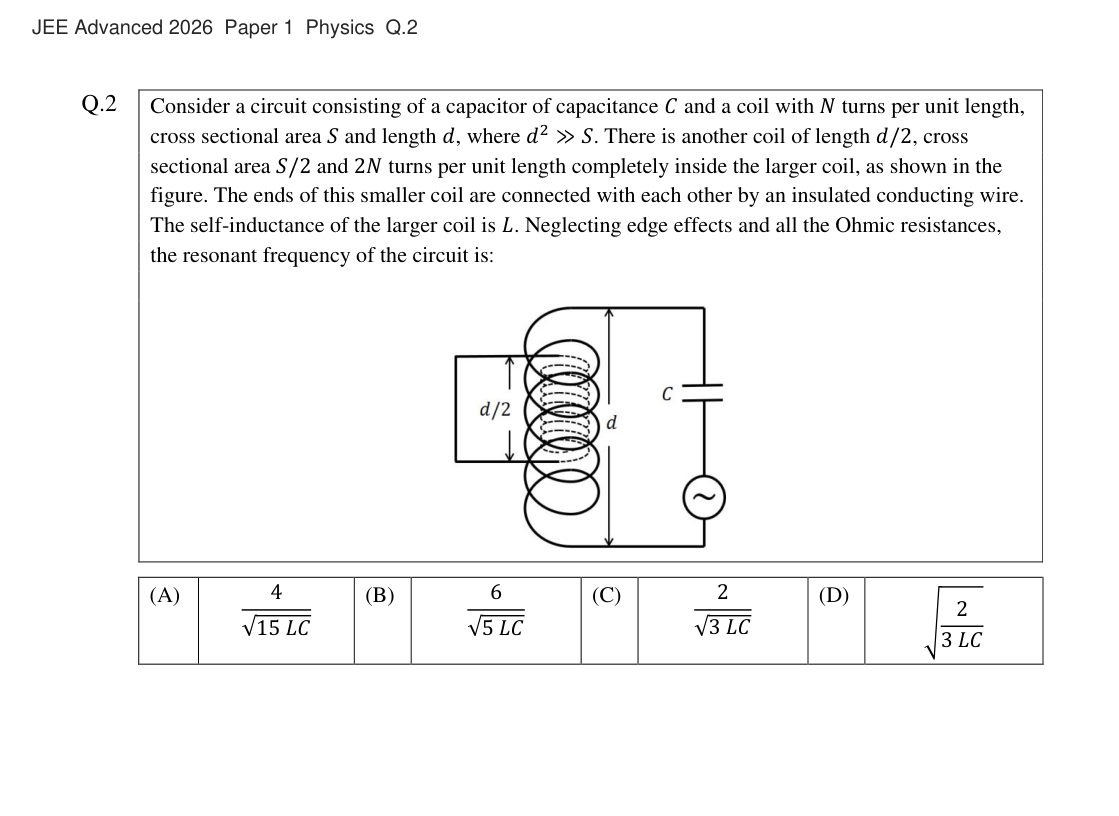
I'm setting up the two solenoids' self-inductances, finding they're equal, and now computing the mutual inductance by working out the flux the large coil's field produces through the small coil. Since the small coil is shorted with zero resistance, its flux stays fixed at zero, giving I2 = -I1/2. This lets me compute the effective inductance seen by the large coil as 3L/4, so the resonant frequency comes out to ω = 2/√(3LC), matching answer C. **Setting up:** Large coil: $L=\mu_0 N^2 S d$. Small coil: $L_2=\mu_0 (2N)^2 \left(\frac{S}{2}\right)\left(\frac{d}{2}\right)=\mu_0 N^2 S d = L$. Mutual inductance: field of large coil $B=\mu_0 N I_1$ passes through the small coil's area $S/2$ and its $2N\cdot\frac{d}{2}=Nd$ turns: $$M=\mu_0 N\cdot\frac{S}{2}\cdot Nd=\frac{L}{2}.$$ **Shorted, resistance-free small coil:** total flux through it stays constant (zero), so $L_2 I_2 + M I_1 = 0 \Rightarrow I_2=-\frac{I_1}{2}$. Effective inductance of the large coil: $$L_{\text{eff}} = L-\frac{M^2}{L_2}=L-\frac{L}{4}=\frac{3L}{4}.$$ **Resonant frequency:** $$\omega=\frac{1}{\sqrt{L_{\text{eff}}C}}=\frac{2}{\sqrt{3LC}}.$$
GPT 6 Astra
OpenAI
C
GPT 6 Astra reasoning
No written reasoning was returned for this item.
GPT 5.5
OpenAI
C
GPT 5.5 reasoning
**Evaluating solenoid specifications** I need to be careful when discussing the specifications of a solenoid. It has N turns per unit length, a cross-sectional area S, and a length d, where d squared is much greater than S. This context is key for understanding the solenoid's behavior and properties correctly, especially if I'm going to delve into applications or calculations later. So, I'll keep these details top of mind as I explore further. **Analyzing resonant circuits** I see the text refers to a circuit made of a capacitor and a coil, possibly involving a resonance measurement. An AC source could drive this circuit. The resonant frequency formula might be 1/sqrt(L_eq * C). If the inner coil is shorted, it behaves like a transformer secondary. Effective primary inductance could depend on frequency if there's no resistance. The input impedance Z could be more complex than I initially thought. I'm delving into this! **Computing magnetic linkage** I'm trying to compute the linkage M from the outer flux caused by the inner solenoid. For the inner current (I2), the magnetic field exists within the solenoid with a specific area and length. The outer coil has turns in that region, and I’m determining the flux per outer turn. The flux linked to the outer coil involves the inner solenoid’s magnetic field. I’m pondering whether every outer turn, outside the overlapping length, links with the flux from the inner solenoid's field lines. **Evaluating solenoid field effects** In an ideal long solenoid, the external field is negligible, but flux does return at the ends, which I’m ignoring for simplicity. Since the diameter squared is much larger than the area, the inner length being d/2 should be sufficient. I’m neglecting edge effects, confirming that only overlapping turns matter for flux calculations. To find mutual effects, I can integrate the fields, which seems like a straightforward next step. Everything appears to align nicely! **Evaluating circuit connections** I'm considering how a conducting wire outside might affect the entire circuit. The return wire loops could potentially enclose some magnetic flux, especially if it's not twisted. The ends of the insulated wire must connect to complete the circuit around the small coil. So, I should factor in that the additional loop from the terminal short conductor could indeed enclose more area and flux. I need to think this through carefully. **Analyzing coil connections** In the figure, there's a wire connecting the top and bottom of the inner coil, which might suggest additional turns with the return wire. I'm pondering whether that's significant. Typically, a coil's self-inductance assumes many circular turns, and the leads are often negligible. The shorting wire being insulated and possibly placed outside could add a turn that encloses outer flux. I should consider the geometry of the helical coil and how the connections may affect flux linkage across turns. **Reviewing Faraday's Law** Actually, Faraday's law for a conducting loop states that the EMF around the entire wire equals the negative rate of change of magnetic flux through any surface bound by that closed wire. For a multi-turn coil, the closed path includes a helix and a return wire, resembling a helicoid. The flux through it is essentially the total flux linked by the N turns. The return wire’s contribution might often be negligible, and I should focus on the ideal coil's inductance here. **Evaluating inductance values** I’m considering that our ω is slightly greater than 1 over the square root of LC since a shorted secondary reduces inductance. So, I think option C seems good. Now I just need to focus on producing the final result in JSON format. It sounds simple, but I want to make sure everything is precise! Keeping the details accurate is key. Let’s get this wrapped up!
Claude Sonnet 5
Anthropic
C
Claude Sonnet 5 reasoning
Computing the self-inductance of the large coil using the solenoid formula, then checking the small coil with double the turn density but half the length and area—interestingly, the factors cancel out so L2 equals L exactly. Now I need to work out the mutual inductance between the two coils. Since the small coil sits entirely within the large coil's uniform field, I can compute the flux linkage directly and find M = L/2. With the small coil shorted into a closed loop, this becomes a classic transformer problem: the induced current in the secondary opposes changes in flux, effectively modifying the primary's inductance to L_eff = L - M²/L2 for the shorted-secondary configuration. Plugging in M = L/2 and L2 = L gives L_eff = 3L/4, so the resonant frequency works out to ω = 2/√(3LC), matching option C. Looking at this problem: **Setup:** - Large coil: n₁ = N, length d, area S → L = μ₀N²Sd - Small coil: n₂ = 2N, length d/2, area S/2 → L₂ = μ₀(2N)²(S/2)(d/2) = μ₀N²Sd = L (same as L) - Mutual inductance: flux from large coil through small coil gives M = L/2 **Effective inductance with shorted secondary:** Since the small coil is a closed (shorted) loop with no resistance, it behaves like a shorted secondary in a transformer, giving: $$L_{eff} = L - \frac{M^2}{L_2} = L - \frac{(L/2)^2}{L} = L - \frac{L}{4} = \frac{3L}{4}$$ **Resonant frequency:** $$\omega = \frac{1}{\sqrt{L_{eff}C}} = \frac{1}{\sqrt{\frac{3L}{4}C}} = \frac{2}{\sqrt{3LC}}$$ This matches option (C). ```json