
2026 · Paper 1 · Physics
Question 10
The printed question, the official key, and each model’s JSON answer plus the reasoning it wrote.
Q10
Official 0.32 – 0.34
Model answers
Claude Fable 5.1
Anthropic
0.33
Claude Fable 5.1 reasoning
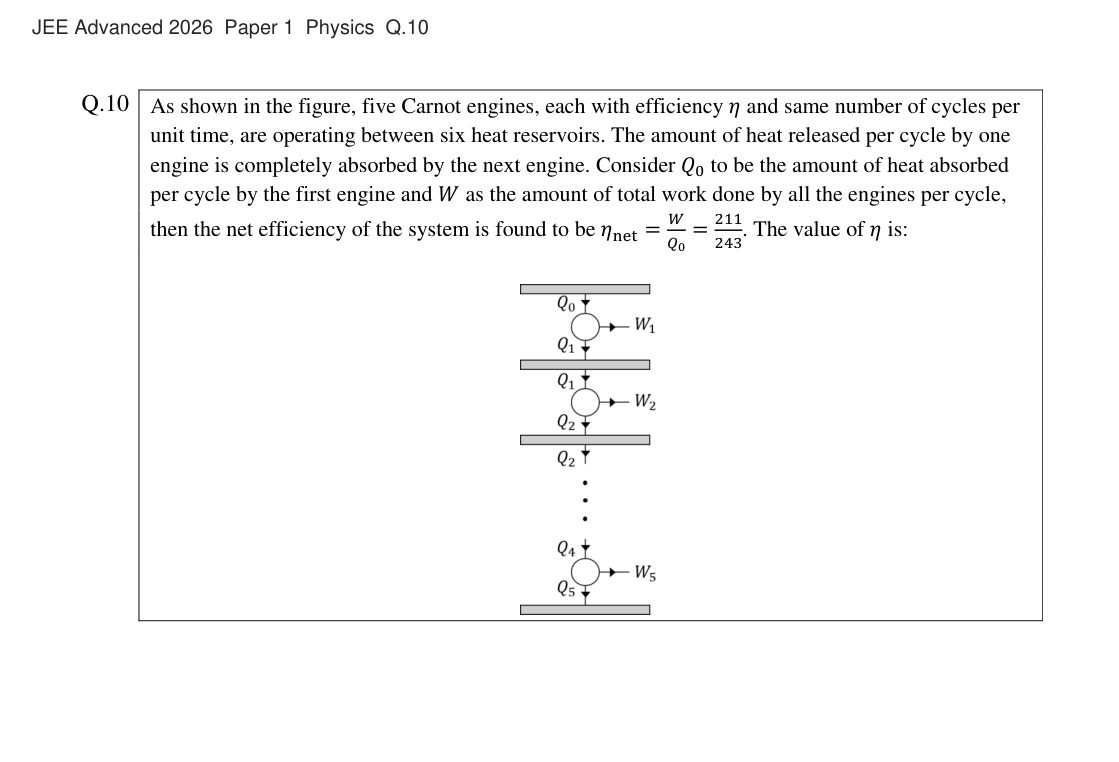
Each engine has efficiency η, so heat passed to the next engine is Q_{i+1} = (1−η)Q_i. After five engines, Q_5 = (1−η)^5 Q_0. Net efficiency: η_net = (Q_0 − Q_5)/Q_0 = 1 − (1−η)^5 = 211/243 So (1−η)^5 = 32/243 = (2/3)^5 ⇒ 1−η = 2/3 ⇒ η = 1/3 ≈ 0.33
GPT 6 Astra
OpenAI
0.3333333333333333
GPT 6 Astra reasoning
**Calculating eta** I'm working through the equation 1 - (1 - eta)^5, which simplifies to 211/243. When I evaluate this, it equals 32/243, leading me to eta as 1/3. I realize I need to present this as a final JSON numeric value of 0.3333333333333333, which is the best format. I've got to keep my explanation brief before delivering the final output in JSON format as the user requested. So, the answer is 0.3333333333333333.
GPT 5.5
OpenAI
0.3333333333333333
GPT 5.5 reasoning
**Clarifying JSON requirements** It seems like exact fractions, like "1/3," aren’t valid JSON numbers. I could use a decimal like 0.3333333333333333 instead. If I consider the context of the question, where it discusses five Carnot engines and their efficiency, I need to be careful with how I interpret the details. Each engine absorbs and releases heat in a cycle, matching the number of cycles per unit time. Ultimately, the final answer needs to be just one JSON object—no additional characters after that. **Finalizing JSON response** I need to ensure that the final response consists of only JSON. That's crucial for clarity. Also, I have to make sure that the field "unanswered" is set to false. This indicates that we've addressed the question fully. I want to avoid any extraneous information, keeping everything tidy and clear in the JSON format. So, I’m getting ready to finalize that response with just the essential details wrapped in a well-structured JSON object.
Claude Sonnet 5
Anthropic
0.333
Claude Sonnet 5 reasoning
After five stages, net efficiency is 1-(1-η)^5=211/243, so (1-η)^5=32/243=(2/3)^5, giving η=1/3. **Solution:** Each engine has efficiency η, so heat rejected = Q(1-η). After 5 engines: Q₅ = Q₀(1-η)⁵ Net efficiency: η_net = 1 - Q₅/Q₀ = 1 - (1-η)⁵ = 211/243 So (1-η)⁵ = 32/243 = (2/3)⁵ Thus 1-η = 2/3, giving **η = 1/3 ≈ 0.333** ```json