
2026 · Paper 1 · Physics
Question 9
The printed question, the official key, and each model’s JSON answer plus the reasoning it wrote.
Q09
Official 1.7 – 1.75
Model answers
Claude Fable 5.1
Anthropic
1.73
Claude Fable 5.1 reasoning
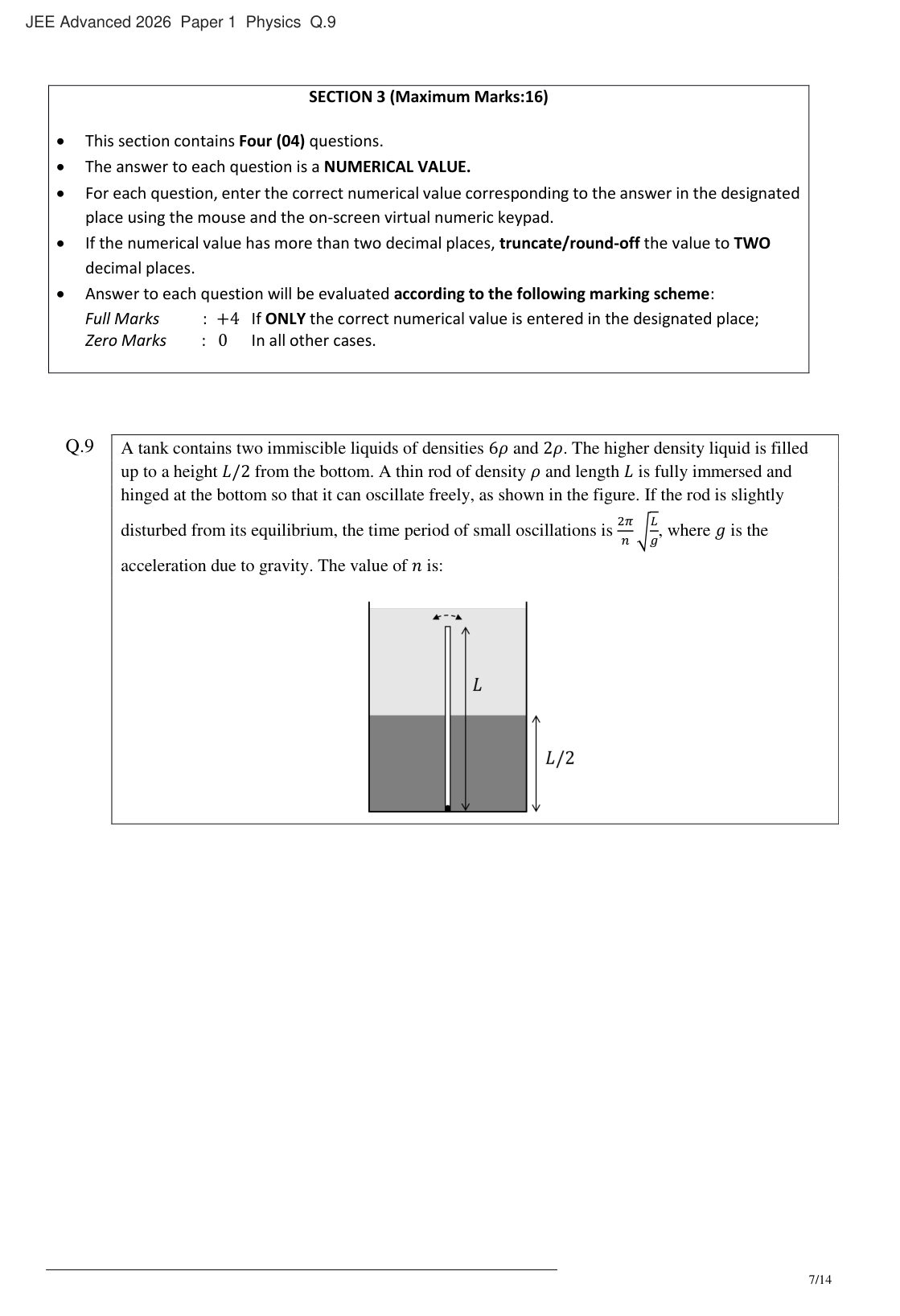
I'm setting up the rod problem: hinged at the bottom, half submerged in liquid of density 6ρ, half in liquid of density 2ρ, and now working out the gravitational torque about the hinge for a small tilt angle θ. The buoyancy forces from each liquid segment act at their centroids, giving restoring torques, while gravity acts destabilizing since the hinge is at the bottom. Combining these, I get a net restoring torque proportional to ρAgL²θ, and using the moment of inertia of the rod about the hinge, I find ω² = 3g/L, giving a period T = (2π/√3)√(L/g). So n = √3 ≈ 1.73, ignoring fluid inertia effects as is standard for this type of problem. **Setting up torques about the hinge** (rod tilted by small angle θ, cross-section A): - Weight: ρAL·g at L/2 → destabilizing torque = ρAgL²(1/2)θ - Buoyancy from lower half (density 6ρ): 6ρA(L/2)g at L/4 → restoring torque = (3/4)ρAgL²θ - Buoyancy from upper half (density 2ρ): 2ρA(L/2)g at 3L/4 → restoring torque = (3/4)ρAgL²θ Net restoring torque = (3/4 + 3/4 − 1/2)ρAgL²θ = ρAgL²θ Moment of inertia about hinge: I = (1/3)ρAL·L² = ρAL³/3 ω² = ρAgL² / (ρAL³/3) = 3g/L T = 2π√(L/3g) = (2π/√3)√(L/g) So n = √3 ≈ 1.73
GPT 6 Astra
OpenAI
1.73
GPT 6 Astra reasoning
**Calculating buoyancy torque** I need to solve a simple buoyancy torque problem, considering lower and upper densities. The equation simplifies down with torque relating to the buoyant coefficient. I've confirmed that I can ignore added mass as a caveat. It seems I can just present the final JSON for the user. I should double-check the formula regarding buoyancy calculations from specific lengths, ensuring I get the right answer. The final answer I've got is 1.73.
GPT 5.5
OpenAI
1.73
GPT 5.5 reasoning
**Considering buoyancy forces** I'm thinking about Archimedes' principle and how it applies to buoyancy. I believe that for an object fully submerged in a single fluid, the upward force equals the displaced weight. But in a stratified fluid, if a body crosses an interface, the buoyant force involves integrating pressure over volume in each fluid. I need to model the situation as two fluids and think about how the rod's position affects the forces acting on it. **Calculating torque and angles** I'm working through the torque calculations for a tilted rod. I have this equation with vertical force per length, considering upward forces, weight, and the direction of torque about the hinge. If the rod tilts right, I think that's positive angle, leading to clockwise rotation. The direction of forces affects this—net upward forces increase the angle. I need to check how the angles relate to each other and find where the system stabilizes; the magnitude and sign matter too. **Analyzing buoyancy and torque** I'm considering a rod with a density lower than the fluid, where net upward buoyancy acts at the center of the buoyancy. If the rod is vertical, the torque is zero, but if it’s tilted, the upward force can create torque that might restore the rod upright. I realize that if tilted right, the downward weight reduces stability, while buoyancy usually stabilizes it. I need to compute the linear restoring torque, noting that for small angles, the rod's interface changes slightly, which affects torque calculation. Let's go ahead and compute that! **Calculating density differences** I'm working with the effective density difference for the rod. At the bottom, I have 5ρ over a length from 0 to L/2, and at the top, it's 1ρ along the length from L/2 to L. I need to analyze how these density differences will impact the overall buoyancy and stability of the rod in the fluid. It’s essential to consider how this affects the calculations for restoring torque as I move forward. Let's break down these densities further! **Analyzing rod oscillation** I’m wondering about viscosity, but I don't want to rush the analysis. The phrase describes a thin rod that’s fully immersed and hinged, possibly relating to an extended body floating. Since the rod's density is lower than the liquids, the hinge exerts a downward force, maintaining vertical equilibrium. When disturbed, there's torque caused by buoyancy and weight. However, I’m not sure if there are additional effects affecting the interface crossing point due to horizontal pressure. **Exploring the interface effects** I’m thinking about how the thin rod might cross the interface at a slanted angle, affecting the line around its cross-section. It makes me wonder if surface tension should be neglected in this case. The buoyancy theorem for a stratified fluid suggests that the net hydrostatic force on the body won't be purely vertical if the density field isn’t vertical either. It seems like there’s more complexity to this situation that I need to consider. **Assessing buoyancy and potential energy** I need to explore how to treat volume and buoyancy force density, considering vertical displacement and weight while examining the sign and linear coefficient. The varying fluid density along the tilted rod is also important. I should calculate the exact torque by integrating over a certain length to get the potential energy. Torque might rely on the derivative of force magnitudes due to segment length changes. While hydrostatic forces typically seem conservative, this situation could indicate a potential issue with the rod being "thin" and hinged at the bottom in a container. **Calculating numerical approximation** When the rod is tilted, the lower part intersects with the liquid based on the vertical coordinate, for \( s \leq \frac{L}{2 \cos \theta} \). So, I think we can approximate from there. It seems like the user might be looking for a single numerical value, possibly around 1.73. The prompt suggests they want just one number, and they might accept something like 1.73. As for a precise JSON answer, I can use 1.7320508075688772. **Evaluating density effects** I'm trying to sort through some calculations involving JSON numbers and deciding on using 1.73 or 1.732 for the value of n, particularly since I need to round it. The potential impact of different densities, like 6ρ and 2ρ, could lead to variations in my final answer, which could be around 1.73. I'm also analyzing torque around a hinge and looking at vertical equilibrium, so I'll break down forces and how they affect the balance. It feels a bit complex, but I'm getting there! **Analyzing torque and buoyancy** I'm working through the torque for small angles and calculating τ_z, involving integrals and density. The torque equation gives me ρSgL² sinθ, but I'm considering if my sign for θ is correct. I’m also figuring out the moment of inertia of the rod, which I have as (1/3)ρSL³. There’s an alternative calculation for buoyancy, suggesting torque should consider both buoyancy and weight. I need to compute buoyancy contributions from different densities. I’m delving into potential forces at the hinge as well, but it’s a bit tricky! **Evaluating rod immersion** I'm contemplating the rod's position in the fluid. It seems the top surface might just sit slightly above the rod's top. The dark area is from the bottom to half the rod length, while the lighter part extends from the interface to the surface, also possibly at half the rod length. The rod is said to be fully immersed. If the fluid surface reaches the same height as the rod top, that affects its overall immersion as it tilts. I need to think about the distribution of the upper liquid surface as I analyze this. **Finalizing JSON output** I need to produce the final JSON format with a numeric answer, which is 1.73. The developer's instructions are clear: it must only be one JSON object at the end. I’ll ensure the structure is correct, with "answer" set as a numeric value and not a string, and "unanswered" as false. It sounds like the correct response based on the context is indeed 1.73, even though there could be other interpretations. {"answer": 1.73, "unanswered": false} **Considering displacement in a tilted rod** I’m thinking about a rod that's fully immersed in water. When tilted, there might be less displaced volume above the surface. If the rod is vertical, the top is at the surface, but tilting it could cause the top to submerge. I'm wondering if a small disturbance might keep the top still submerged. However, I'm not quite convinced about how this all works together. Let’s keep exploring this idea!
Claude Sonnet 5
Anthropic
1.73
Claude Sonnet 5 reasoning
I'm setting up the physics: a rod hinged at the bottom spans a tank where the lower half sits in liquid of density 6ρ and the upper half in density 2ρ, and I need to find the restoring torque about the hinge for a small angular displacement from vertical equilibrium. I'm computing the gravity torque as -ρAg sinθ times the integral of s over the length, which would normally destabilize the rod like an inverted pendulum unless buoyancy compensates, then working out the buoyant force per unit length separately for each half based on its local liquid density. Total buoyancy comes out to 4ρALg, exceeding the rod's weight ρALg, but since the hinge is fixed, only torques matter for the oscillation, not net force. I'm setting up each force element's contribution to torque about the hinge as (dw - db)·s·sinθ for small angles, aiming to find the net restoring coefficient. For a rod hinged at the bottom standing upright, gravity acts destabilizingly (like an inverted pendulum), while buoyancy—since the denser fluid is farther out—could provide the necessary restoring effect to keep it stable. I want to work through the torque balance carefully using a small virtual tilt angle θ, taking the moment arm at each point along the rod as s sinθ, and tracking how the weight's torque at each position pushes the rod further from vertical once it's tilted. I'm finding that the buoyant force acting upward at position s creates a restoring torque back toward vertical, opposite in sign to the weight's destabilizing effect, so the net restoring coefficient depends on the difference between the buoyancy and weight distributions integrated with their moment arms along the rod. Setting up the equation of motion, I compute the moment of inertia of the rod about the hinge as ρAL³/3, giving angular frequency ω² = K/I. For K, I split the integral into two halves of the rod since the liquid density is six times the rod's density in the first half, contributing a factor of 5ρ to that portion of the integral. Working out both integrals and combining terms, K simplifies neatly to AρgL². For I, using ρAL³/3, I get ω² = K/I = 3g/L, so ω = √(3g/L) and T = 2π√(L/(3g)) = (2π/√3)√(L/g). Matching this to the given form T = (2π/n)√(L/g), I find n = √3 ≈ 1.73, and checking the sign confirms K is a proper restoring constant, consistent with stable oscillation. Looking at this problem, I need to analyze torques about the hinge for a rod straddling two liquid layers. **Setup:** - Rod: density ρ, length L, hinged at bottom, immersed in tank - Lower liquid (0 to L/2): density 6ρ - Upper liquid (L/2 to L): density 2ρ **Torque Analysis (for small angle θ from vertical):** For an element at distance s from hinge, the net vertical force per unit length is: $$dF(s) = [\rho_{liquid}(s) - \rho] A g \, ds$$ This creates a restoring torque (buoyancy stabilizes since net buoyancy exceeds weight), with lever arm ≈ s·θ for small θ. **Restoring coefficient:** $$K = \int_0^{L} [\rho_{liquid}(s) - \rho] A g \, s \, ds$$ Split into two regions: For 0 to L/2 (density 6ρ): excess density = 5ρ $$\int_0^{L/2} s\, ds = \frac{L^2}{8}$$ For L/2 to L (density 2ρ): excess density = ρ $$\int_{L/2}^{L} s\, ds = \frac{3L^2}{8}$$ So: $$K = A g\left[5\rho \cdot \frac{L^2}{8} + \rho \cdot \frac{3L^2}{8}\right] = A g \rho L^2 \cdot \frac{8}{8} = A\rho g L^2$$ **Moment of Inertia** (rod of uniform density ρ about hinge): $$I = \int_0^L \rho A s^2\, ds = \frac{\rho A L^3}{3}$$ **Equation of motion:** $$I\ddot\theta = -K\theta \implies \omega^2 = \frac{K}{I} = \frac{A\rho g L^2}{\rho A L^3/3} = \frac{3g}{L}$$ **Time period:** $$T = 2\pi\sqrt{\frac{L}{3g}} = \frac{2\pi}{\sqrt{3}}\sqrt{\frac{L}{g}}$$ Comparing with given form $T = \frac{2\pi}{n}\sqrt{\frac{L}{g}}$: $$n = \sqrt{3} \approx 1.73$$ ```json