
2026 · Paper 1 · Physics
Question 12
The printed question, the official key, and each model’s JSON answer plus the reasoning it wrote.
Q12
Official 0.5
Model answers
Claude Fable 5.1
Anthropic
0.5
Claude Fable 5.1 reasoning
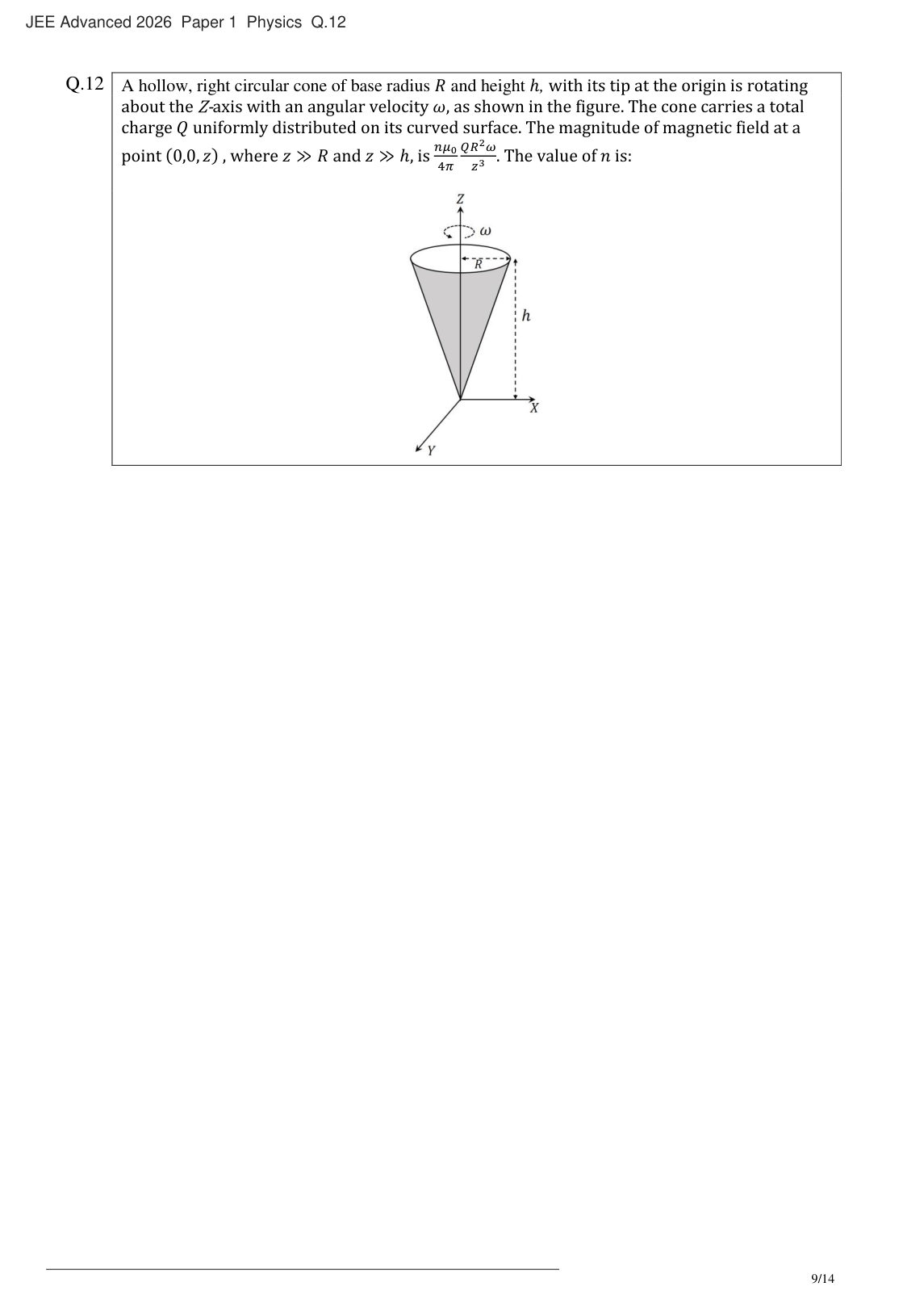
Far field of rotating charged cone: B = (μ₀/4π)(2m/z³), where m is the magnetic moment. Surface charge density σ = Q/(πR·L), L = √(R²+h²). Take a ring at radius r (distance along slant s, r = s R/L), width ds: charge dq = σ·2πr ds. Its magnetic moment dm = (dq·ω/2π)·πr² = (ω/2) r² dq. m = (ω/2)∫ σ 2π r³ ds = πσω ∫₀ᴸ (R/L)³ s³ ds = πσω (R³/L³)(L⁴/4) = πσω R³ L/4. With σ = Q/(πRL): m = QωR²/4. B = (μ₀/4π)(2m/z³) = (μ₀/4π)(QR²ω/(2z³)) → n = 1/2 = 0.5.
GPT 6 Astra
OpenAI
0.5
GPT 6 Astra reasoning
No written reasoning was returned for this item.
GPT 5.5
OpenAI
0.5
GPT 5.5 reasoning
**Evaluating magnetic field calculations** I'm considering the setup for calculating the magnetic field from a rotating charge distribution. It's important not to rush into conclusions. With the cone extending upward, I need to verify the correct formulation of the magnetic vector potential and the field magnitude. The flow of current appears azimuthally due to circular loops, and I’m integrating to find contributions from the charge. This means I’ll need to carefully work through the equations to ensure accuracy. **Finalizing JSON output** I figured out that the average ρ² is indeed R²/2, after verifying my calculations. So, the magnetic field expression simplifies to B = μ0 Q R² ω/(8π z³). That's great! Now, I need to ensure that the final output is only in JSON format. I’ll make sure there’s nothing extra after it, just the number 0.5 in a JSON object as required. Alright, let's focus on that clean output without any explanations!
Claude Sonnet 5
Anthropic
0.5
Claude Sonnet 5 reasoning
I need to find the magnetic dipole moment of the rotating charged cone, then match it to the given field formula B = nμ0QR²ω/(4πz³) to solve for n, using the on-axis dipole field expression. This requires computing m = ∫ dI·dA for rings of charge distributed over the cone's surface as it spins, with the cone tip at the origin and base at z=h. Setting up the ring at height z with radius r = Rz/h and slant length element ds proportional to dz, I calculate the charge dq on each ring, the resulting current dI = dq·ω/(2π), and the moment contribution dm = dI·πr². Integrating dm·z³ from 0 to h using surface charge density σ = Q/(πRL) gives me the total magnetic moment m = σπR³Lω/4, and substituting σ back in simplifies to m in terms of Q, R, ω. This gives m = QR²ω/4. Comparing B = μ0/(4π)·2m/z³ with the assumed form B = nμ0/(4π)·QR²ω/z³, I find n = 1/2, so n = 0.5. **Setting up the problem** The cone (tip at origin, height $h$, base radius $R$) rotates about its axis with angular velocity $\omega$, carrying uniform surface charge density $\sigma$ on its lateral surface. - Slant height: $L = \sqrt{R^2+h^2}$ - Total charge: $Q = \sigma \pi R L$ **Ring element** At height $z$ (from tip), the radius is $r = \dfrac{R}{h}z$, and the slant length element is $ds = \dfrac{L}{h}dz$. Charge on ring: $$dq = \sigma (2\pi r)\,ds = \sigma \cdot 2\pi \frac{Rz}{h}\cdot \frac{L}{h}dz = \frac{2\pi \sigma R L}{h^2}z\,dz$$ Current due to rotation: $$dI = \frac{\omega}{2\pi}dq = \frac{\sigma R L \omega}{h^2}z\,dz$$ Magnetic moment of ring: $$dm = dI\cdot \pi r^2 = \frac{\sigma R L\omega}{h^2}z\,dz \cdot \pi\left(\frac{Rz}{h}\right)^2 = \frac{\pi \sigma R^3 L \omega}{h^4}z^3\,dz$$ **Total magnetic moment** $$m = \frac{\pi \sigma R^3 L \omega}{h^4}\int_0^h z^3\,dz = \frac{\pi \sigma R^3 L \omega}{h^4}\cdot\frac{h^4}{4} = \frac{\pi \sigma R^3 L \omega}{4}$$ Substitute $\sigma = \dfrac{Q}{\pi R L}$: $$m = \frac{\pi R^3 L \omega}{4}\cdot \frac{Q}{\pi R L} = \frac{Q R^2 \omega}{4}$$ **Axial field (far dipole approximation)** For $z \gg R, h$, the cone behaves as a point magnetic dipole on its axis: $$B = \frac{\mu_0}{4\pi}\frac{2m}{z^3} = \frac{\mu_0}{4\pi}\cdot \frac{2\cdot \frac{QR^2\omega}{4}}{z^3} = \frac{\mu_0}{4\pi}\cdot\frac{QR^2\omega}{2z^3}$$ Comparing with $B = \dfrac{n\mu_0}{4\pi}\dfrac{QR^2\omega}{z^3}$: $$n = \frac{1}{2} = 0.5$$ ```json