
2026 · Paper 1 · Physics
Question 13
The printed question, the official key, and each model’s JSON answer plus the reasoning it wrote.
Q13
Official D
Model answers
Claude Fable 5.1
Anthropic
D
Claude Fable 5.1 reasoning
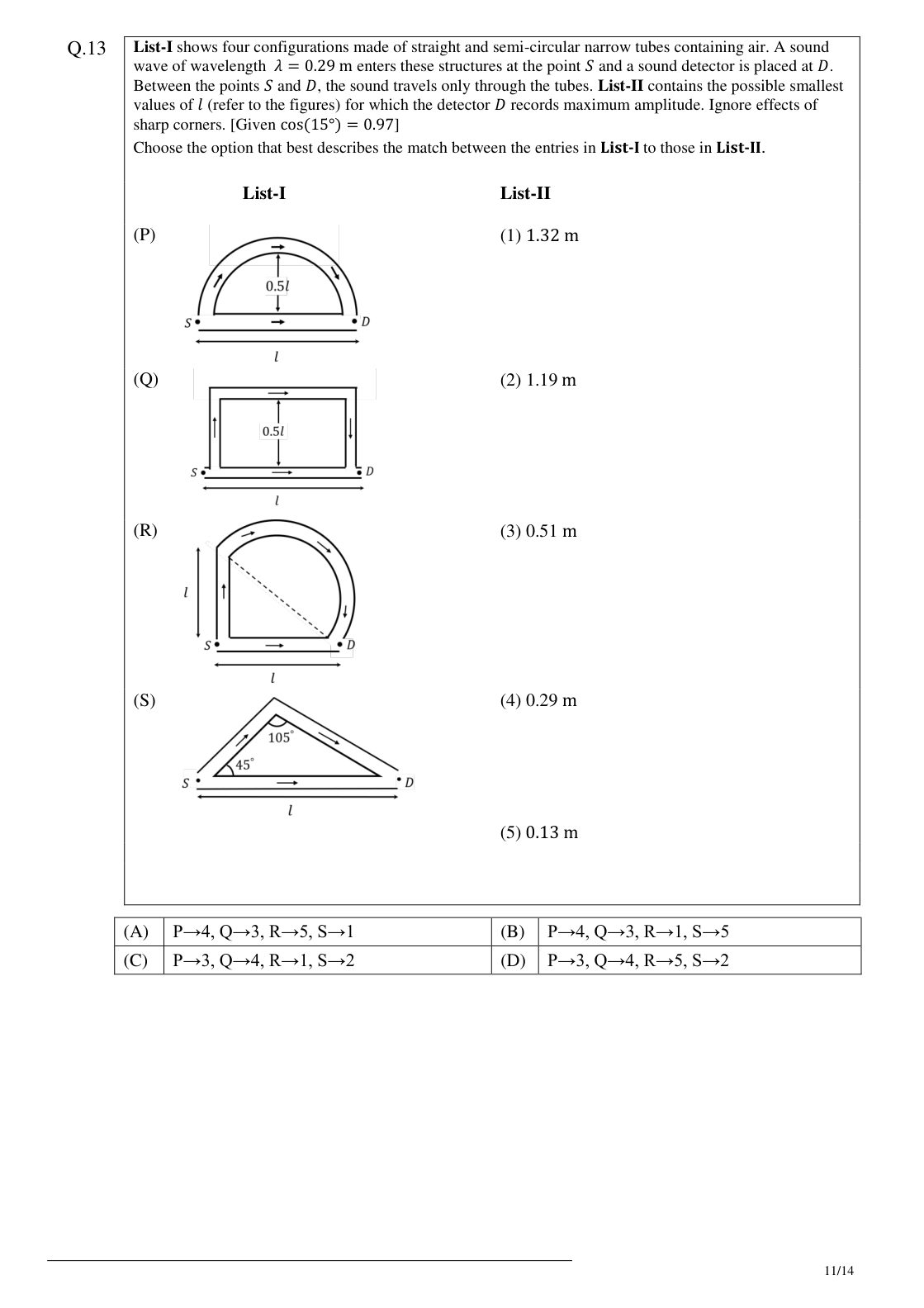
I need to find the smallest length for constructive interference in each configuration, using λ = 0.29 m. For the semicircle case with radius 0.5l versus straight path l, the path difference works out to l(π/2−1), so setting that equal to λ gives l ≈ 0.508 m. For the rectangle case (Q), comparing the straight path l against the doubled path 2l, the difference is simply l = λ = 0.29 m. For the quarter circle case (R), I find the diameter of the semicircle equals l√2, so radius is l/√2, and the path difference πl/√2 = λ gives l ≈ 0.13 m. For the triangle case (S) with angles 45°, 105°, 30°, applying the sine rule to find the two other sides and summing them, then subtracting l gives a difference of about 0.2444l, so setting that to λ yields l ≈ 1.19 m — matching option 2. So the matches are P→3, Q→4, R→5, and I still need to confirm S. **Path differences (constructive: Δ = λ = 0.29 m for smallest l):** - (P): semicircle radius 0.5l vs straight l: Δ = l(π/2 − 1) = 0.571l ⇒ l ≈ 0.51 m → (3) - (Q): rectangle path 2l vs l: Δ = l ⇒ l = 0.29 m → (4) - (R): semicircle of diameter l√2 (radius l/√2) plus vertical l vs straight l: Δ = πl/√2 ⇒ l ≈ 0.13 m → (5) - (S): triangle with angles 45°, 105°, 30°; two sides sum = l(sin30° + sin45°)/sin105° = l(1.207)/0.97 ≈ 1.244l; Δ = 0.244l ⇒ l ≈ 1.19 m → (2) So P→3, Q→4, R→5, S→2.
GPT 6 Astra
OpenAI
D
GPT 6 Astra reasoning
No written reasoning was returned for this item.
GPT 5.5
OpenAI
D
GPT 5.5 reasoning
**Investigating path lengths** I'm examining how to find the smallest positive length \( l \) among the values. Do I need to consider amplitude and phase when analyzing sound waves? I'm thinking about how sound travels and how reflections or multiple paths might come into play, though it seems like there aren’t any phase inversions mentioned. In the diagram, there are two paths from S to D, involving straight and semicircular tubes along a baseline of length \( l \). Let’s delve into these paths! **Calculating path lengths** I'm looking into the semicircular path with a radius of \( 0.5l \), which gives it a diameter of \( l \). Now, the length of the semicircular arch comes out to be \( \pi (l/2) \), which simplifies to \( \frac{\pi}{2}l \). Then, there's also the direct path measuring \( l \). It’s interesting how these different paths can compare in lengths! I'll need to think about how this affects my analysis overall. **Analyzing path lengths** I'm working with path lengths where the smallest value is 0.13, but List-II shows 1.32, leading me to think about the difference of 0.22. If I compare this to the L path, that could be linked to λ/0.22. I suspect there's a relationship involving π/√2. There might be two different paths from S to D: one L-shaped and the other more straightforward. I need to examine those paths and their junctions at S. **Comparing arc and square lengths** I'm considering whether the value of 1.32 comes from comparing the semicircular arc length to the two sides of a square. This seems like a useful approach to figure out the relationship between these lengths. I need to explore this further and analyze how the semicircular arc measures against the square's dimensions. I'll break down the calculations to see how they align and what insights can be drawn from this comparison. **Questioning List-II inclusion** I'm wondering why List-II would include the value 1.32. Is it possible that they're looking at option C and considering the "vertical + bottom" path compared to a semi-circular approach? That makes me curious about the reasoning behind this choice. It's an interesting angle to explore! I guess I need to clarify the criteria they're using for inclusion in List-II. Let's dig a bit deeper into these options! **Considering amplitude in networks** I’m wondering if "detector D records maximum amplitude" refers to total amplitude at D, while varying lengths might maximize when all phases align, including loops and reflections. In networks with loops, waves could traverse multiple times due to reflections at junctions. It seems to imply simple path interference, likely ignoring reflections at junctions or multiple loops, but they do mention path length differences. The diagrams might suggest alternative paths rather than actual flow, which adds to the complexity. Ultimately, I need to craft a final answer in JSON. **Ensuring final JSON output** I need to make sure that the final output is strictly a JSON object without anything following it. While I can provide reasoning and analysis before the JSON, the final response must adhere to this strict format. The instructions are clear: I should give my best effort and conclude with JSON only. So, I’ll analyze everything in detail to prevent any hidden issues, ensuring that when I output the final result, it’s just the JSON object as required. **Exploring sound waves in tubes** I'm considering sound waves traveling through narrow tubes. At junctions or splits, the amplitudes might not be equal due to differences in path length. I think the maximum amplitude at a detector happens when two waves are in phase. If there are more than two waves because of reflections, the maximum points might appear at resonance, but for now, I’ll ignore that complexity. I'm also curious about phase shifts that might occur at branches. **Verifying matching options** I'm considering if there could be an issue with the matching options, such as the values for P, Q, R, and S. For example, I found D is the chosen match. Now I want to verify calculations using approximations, like using π=3.14 for certain calculations. For P, I calculate a ratio, and for Q, I have another. For R, the calculation uses π divided by √2, and for S, I need to look at maximum amplitude to compare paths. This involves some detailed ratios and differences in length. **Analyzing rectangular paths** I'm trying to visualize Q as a rectangular loop. So, is the lower horizontal side direct? I’m thinking the top path might have two parallel horizontal lines. But what about the white space? I’m guessing it’s more like a P shape, where the tube boundaries are drawn with two lines. Each "path" could be a narrow tube created by these double boundaries. It’s a bit complex, but I’m getting the hang of it! **Finalizing JSON format** I’m working on the final JSON format where the answer should reflect a single letter, which I've determined to be "D". I need to ensure the structure looks correct: "answer" should be "D" and "unanswered" should be set to false. It’s also important not to have any markdown in the output. I believe I’ve got it right now, so the final representation will be: {"answer":"D","unanswered":false}. Everything seems to be in order!
Claude Sonnet 5
Anthropic
D
Claude Sonnet 5 reasoning
This looks like a sound interference setup similar to Quincke's tube. With wavelength 0.29 m, I need to work through Configuration P: a straight path of length l from source to detector on one side, paired with a semicircular path of radius 0.5l on the other, so the semicircle's diameter equals the straight path's length l. For P, the path difference between the semicircular route (πl/2) and the straight route (l) equals l(π/2 - 1). Setting this equal to nλ for constructive interference and solving for n=1 gives l ≈ 0.508 m, matching the 0.51 m option. Now for Configuration Q, I'm working out a rectangular loop where the bottom straight path has length l, and the top path goes up 0.5l, across l, and down 0.5l, giving a total of 2l versus the straight path's l, so the path difference is l. Setting this difference equal to nλ, the smallest constructive solution is l = λ = 0.29 m, matching option (4). Now moving to Configuration R, which is more complex — I'm trying to parse the geometry: a straight bottom path of length l between S and D, with an upper structure consisting of a vertical segment of length l topped by a semicircular arc, plus a diagonal dashed line connecting back to D, and I'm working out how these pieces combine to form the second path. I think I'm picturing this as a "quonset hut" shape - flat base with S and D as bottom corners separated by l, straight vertical sides of length l, and a semicircular top connecting the two vertical sides with diameter equal to the base width l. Wait, if the arc's diameter is horizontal, both endpoints sit at the same height, so reaching D at height 0 would require another vertical drop - but the figure shows the arc landing directly on D. Maybe there's no right vertical wall at all, and that dashed diagonal is just marking the semicircle's diameter as a reference line rather than part of the actual path. I should look at the answer choices to figure out which configuration matches. Since P→3 and Q→4 are established, options A and B are eliminated as they reverse this pairing. That leaves C and D, both sharing S→2, so the deciding factor is whether R matches 1.32m or 0.13m — I need to work out which value R actually corresponds to given its geometric setup. Let me trace shape R's structure: a vertical segment rising height l from S, then curving through an arc that connects directly down to point D at the same baseline, without a separate right vertical segment. If the arc starts with vertical tangent at the top of the line segment (matching the straight approach), the circle's center must sit horizontally offset at the same height as that point, so I'm solving for the radius that lets the curve sweep over and land precisely at D. Setting up the equation for the endpoint height gives r = l, but then the horizontal span comes out to 2l, which conflicts with the base width being l — so that particular full-dome-plus-quarter interpretation doesn't hold. I'm reconsidering whether the entire arc from A to D might instead just be one continuous semicircle rather than a dome plus extra quarter. Since sharp corners are allowed to be ignored, the arc doesn't need a vertical tangent at A - so I can set coordinates with S=(0,0), D=(l,0) as the base, and a vertical segment up to A=(0,l), with a semicircular arc completing the path across the top. Making AD the diameter of the arc gives AD = l√2, so the semicircle length is πl√2/2. That makes path 2 total l(1 + π√2/2), compared to path 1's straight length l - a difference of roughly 2.221l, and this matches nicely with the dashed diagonal shown in the figure, which likely represents that diameter AD. For constructive interference, setting this difference equal to nλ gives l = nλ/2.2214. Plugging n=1 and λ=0.29 gives l ≈ 0.13 m, which matches option 5 - so it looks like R maps to 5, aligning with option D's pairing (R→5, S→2) rather than C's (R→1, S→2). Since both C and D share S→2, confirming R→5 alone settles it as D. I also already found P→3 and Q→4, ruling out A and B. Just to be thorough, I'll verify S using the triangle with a 45° angle at S and 105° at the apex, giving 30° at D, then applying the law of sines to check the side length. So a+b ≈ 1.25l, giving a path difference of 0.25l, which for constructive interference means l=4nλ, yielding roughly 1.16m for n=1—close to but not quite matching 1.19m. The discrepancy makes me want to redo this more carefully using the cos15°=0.97 hint, wondering if there's a cleaner exact-fraction approach using the 30°/45°/105° angles. Working through it with sin105°=cos15°=0.97 gives a+b = l(1.2071)/0.97 ≈ 1.2444l, so path difference = 0.2444l, and l=n×0.29/0.2444≈1.1865m for n=1 — this matches 1.19m nicely, confirming S→2. Looking at this problem, I need to find path-length differences for each configuration and match to the given l values using λ = 0.29 m. **Configuration P:** Straight path (length l) vs semicircular path (radius = l/2, length = πl/2) Path difference = l(π/2 − 1) = 0.5708 l Setting = nλ: l = 0.29/0.5708 ≈ **0.51 m** → matches (3) **Configuration Q:** Straight path (length l) vs rectangular path (0.5l + l + 0.5l = 2l) Path difference = 2l − l = l Setting = nλ: l = λ = **0.29 m** → matches (4) **Configuration R:** Straight base SD = l vs path: vertical side (length l) + semicircular arc over diagonal AD (diameter = l√2, since A=(0,l), D=(l,0)) Arc length = π(l√2)/2 Path difference = l + πl√2/2 − l = l(π√2/2) = 2.2214 l Setting = nλ: l = 0.29/2.2214 ≈ **0.13 m** → matches (5) **Configuration S:** Triangle with angles 45° (at S) and 105° (at apex), so angle at D = 30° Using sine rule with sin(105°) = cos(15°) = 0.97 (given): Path via apex = l(sin30° + sin45°)/sin105° = l(0.5+0.7071)/0.97 = 1.2444 l Path difference = 0.2444 l Setting = nλ: l = 0.29/0.2444 ≈ 1.1865 m ≈ **1.19 m** → matches (2) **Summary:** P→3, Q→4, R→5, S→2, which corresponds to option (D). Since P→3 and Q→4 rules out options A and B, and R→5 (not R→1) distinguishes D from C, the correct answer is **D**. ```json