
2026 · Paper 1 · Physics
Question 14
The printed question, the official key, and each model’s JSON answer plus the reasoning it wrote.
Q14
Official A
Model answers
Claude Fable 5.1
Anthropic
A
Claude Fable 5.1 reasoning
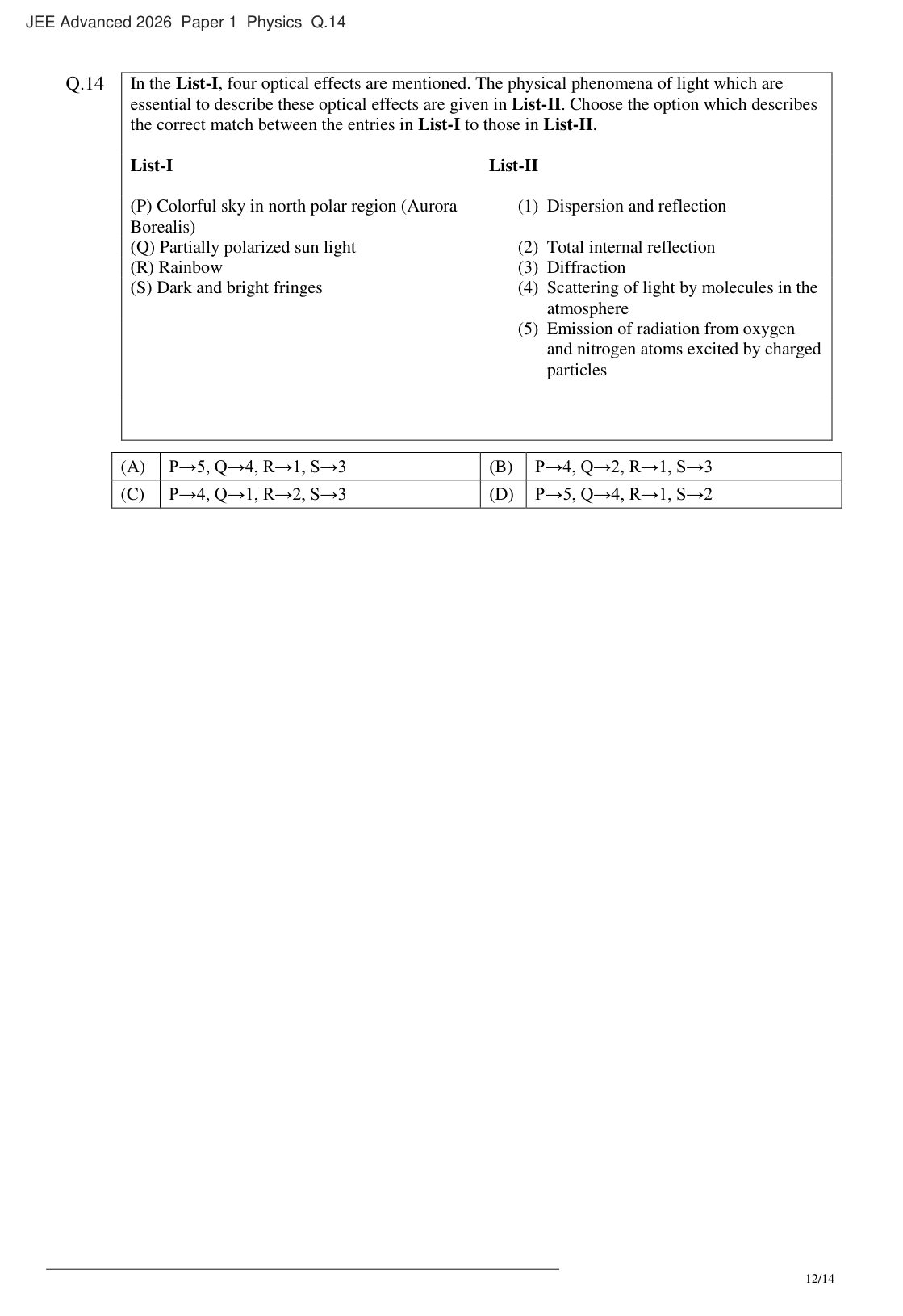
Aurora Borealis → emission from excited O and N atoms (5); partially polarized sunlight → scattering by atmospheric molecules (4); rainbow → dispersion and reflection (1); dark and bright fringes → diffraction (3).
GPT 6 Astra
OpenAI
A
GPT 6 Astra reasoning
**Finalizing JSON output** I need to focus on matching A clearly. It seems that having the final JSON will suffice, with specific details like Aurora 5, polarized sunlight 4, and rainbow1 fringes 3. There’s no need to provide additional rationale for the user; just a straightforward JSON shape will do. I’ll wrap it up by outputting the object in that formatted way for clarity.
GPT 5.5
OpenAI
A
GPT 5.5 reasoning
**Finalizing output logic** I’m thinking about dark and bright fringes and their relationship with interference and diffraction. There's a distinction between them, and it seems that only diffraction is mentioned in List-II. Based on this, I conclude that option A is the correct choice. I need to ensure I’m providing the final JSON output precisely. I’ll be careful to include only necessary details since the key concept revolves around the fundamental phenomena of light.
Claude Sonnet 5
Anthropic
A
Claude Sonnet 5 reasoning
Matching each up: Aurora comes from atomic emission, polarized sunlight from molecular scattering, rainbows from dispersion and reflection, and fringes from diffraction — giving P→5, Q→4, R→1, S→3, which is option A.