
2026 · Paper 2 · Chemistry
Question 5
The printed question, the official key, and each model’s JSON answer plus the reasoning it wrote.
Q05
Official C, D
Model answers
Claude Fable 5.1
Anthropic
C, D
Claude Fable 5.1 reasoning
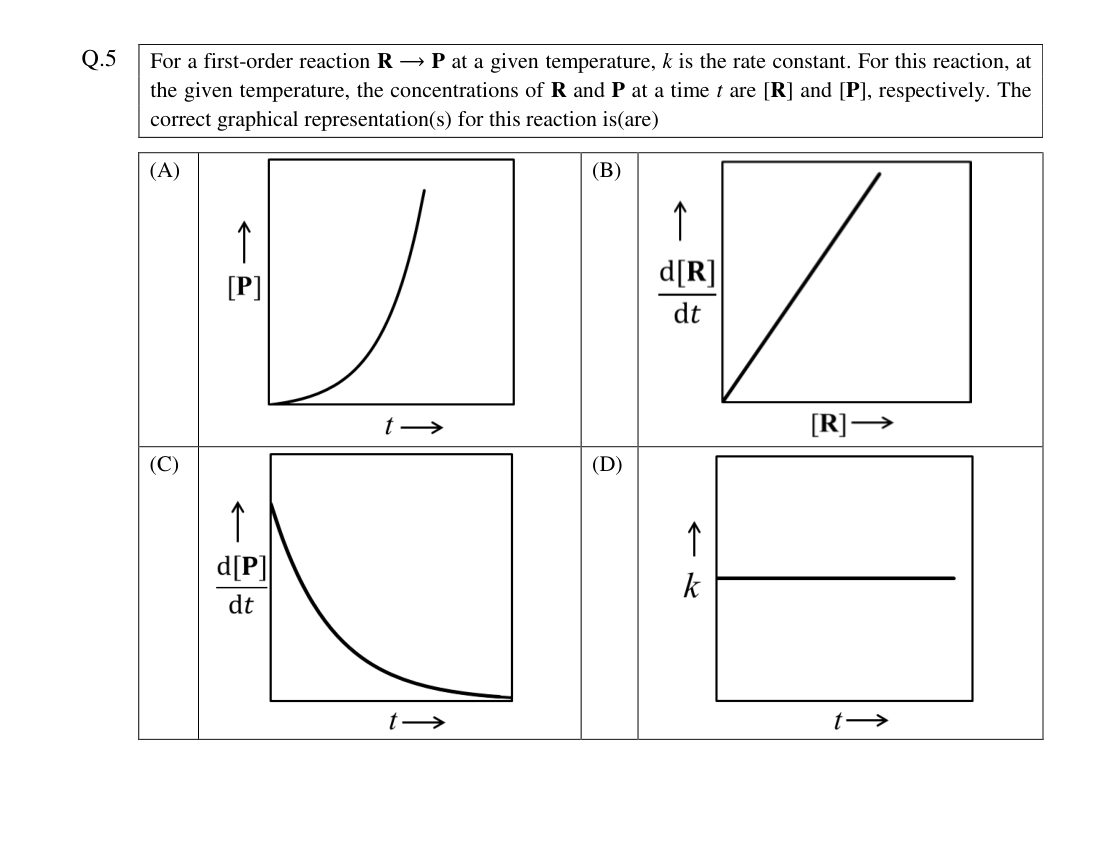
First-order reaction R → P: - [P] = [R]₀(1 − e^(−kt)) increases and saturates (concave down), not exponentially rising as in (A). So (A) is incorrect. - d[R]/dt = −k[R], which is negative and decreases linearly with [R]; graph (B) shows a positive slope through the origin, so (B) is incorrect. - d[P]/dt = k[R] = k[R]₀e^(−kt), decreasing exponentially with time — matches (C). Correct. - k is constant at a given temperature, independent of time — matches (D). Correct.
GPT 6 Astra
OpenAI
C, D
GPT 6 Astra reasoning
No written reasoning was returned for this item.
GPT 5.5
OpenAI
C, D
GPT 5.5 reasoning
**Evaluating reaction representation** I'm trying to figure out the correct graphical representation of a first-order reaction R -> P at a given temperature, with a rate constant k. The user needs a JSON response. Option A shows [P] vs. time, depicting an upward convex curve which seems incorrect for a first-order irreversible reaction. Initially, [P] is zero, and [P] grows but should approach a plateau, not resemble a continuous upward trend. Then there's option B, where the graph labeled d[R]/dt vs. [R] shows a straight positive line. For disappearing concentration, the slope should be negative, but the y-axis suggests a positive rise. **Analyzing reaction graphs** I’m considering the graph options for the first-order reaction R -> P. If I'm looking at d[R]/dt, it should indeed be negative, reflecting that [R] is decreasing, which contradicts the positive slope shown in option B. The label suggests it might mean the rate of disappearance instead. For option C, d[P]/dt decays exponentially to zero, which makes sense for first-order reactions. Option D shows k vs. t as a horizontal line, indicating a constant rate at a given temperature—seems correct too!
Claude Sonnet 5
Anthropic
C, D
Claude Sonnet 5 reasoning
For a first-order reaction, [P] should rise and level off toward a plateau, concave down since the rate slows as [R] depletes—so option (A), which shows an accelerating exponential-growth curve, has the wrong shape entirely. B) d[R]/dt vs [R] should be a line through the origin with negative slope since d[R]/dt = -k[R]; graph B shows a positive slope, so it's wrong. C) d[P]/dt vs t should decay exponentially since it equals k[R]₀e^(-kt), matching the curve shown - this one's correct. D) k vs t should be flat since the rate constant doesn't change with time at fixed temperature - also correct. So the right answers are C and D. Looking at this first-order reaction R → P: **Analysis of each option:** **(A)** [P] vs t: Since [P] = [R]₀(1 − e^(−kt)), this curve should rise steeply initially and then level off (concave down, approaching a plateau asymptotically) as [R] depletes. The graph shown is concave up (accelerating growth), which is incorrect for this reaction. **(B)** d[R]/dt vs [R]: Since −d[R]/dt = k[R], we get d[R]/dt = −k[R]. This is a straight line through the origin with a **negative** slope (since d[R]/dt is negative while [R] is positive). The graph shows a line with positive slope, which is incorrect. **(C)** d[P]/dt vs t: Since d[P]/dt = k[R] = k[R]₀e^(−kt), this quantity starts at a maximum value (k[R]₀) at t = 0 and decays exponentially toward zero as t increases. This matches the exponential decay curve shown — **correct**. **(D)** k vs t: For a given temperature, the rate constant k of a first-order reaction is independent of time and concentration — it remains constant throughout the reaction. This matches the horizontal line shown — **correct**. **Conclusion:** Options (C) and (D) are correct. ```json