
2026 · Paper 2 · Chemistry
Question 6
The printed question, the official key, and each model’s JSON answer plus the reasoning it wrote.
Q06
Official A, C, D
Model answers
Claude Fable 5.1
Anthropic
A, C, D
Claude Fable 5.1 reasoning
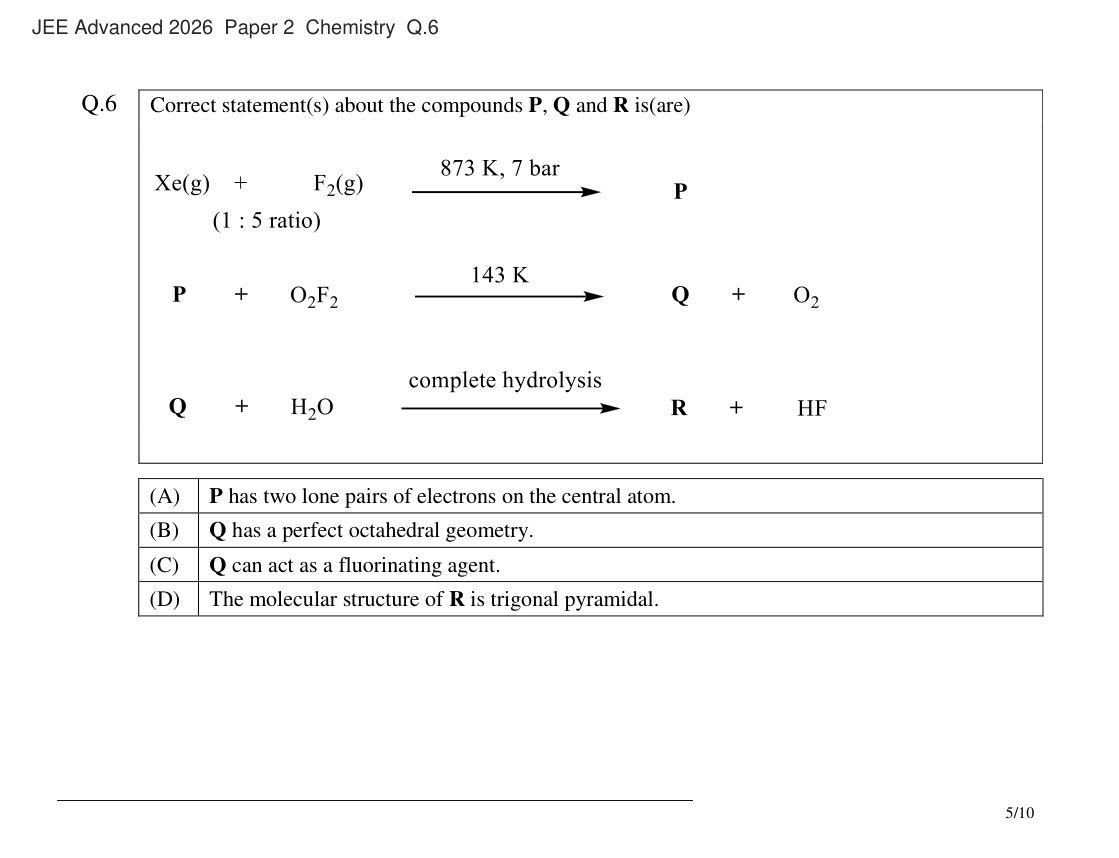
Xe + F₂ (1:5) at 873 K, 7 bar → XeF₄ (P). XeF₄ + O₂F₂ at 143 K → XeF₆ (Q) + O₂. XeF₆ complete hydrolysis → XeO₃ (R) + HF. (A) XeF₄: square planar with two lone pairs on Xe — correct. (B) XeF₆: distorted octahedral (one lone pair) — incorrect. (C) XeF₆ is a strong fluorinating agent — correct. (D) XeO₃: trigonal pyramidal — correct.
GPT 6 Astra
OpenAI
A, C, D
GPT 6 Astra reasoning
**Structuring chemical data** I need clear information on XeF4, XeF6, and XeO3 under specific conditions—873 K and 7 bar with a ratio of 1:5. For XeF4, the answer is yes. For XeF6, I need to check if distorted octahedral geometry is true; it seems false. For XeO3, it's trigonal pyramidal, which is confirmed as yes. I’ll gather this data in a JSON format as the final output.
GPT 5.5
OpenAI
A, C, D
GPT 5.5 reasoning
**Analyzing xenon compounds** I'm exploring the properties of xenon trioxide and related compounds. Xenon trioxide has a central Xe(VI) atom with three Xe=O bonds and one lone pair, resulting in a trigonal pyramidal shape. For the statements: (A) In XeF4, the central atom has two lone pairs, making its shape square planar—correct. (B) XeF6 has one lone pair and a distorted octahedral shape, so that's false. (C) XeF6 is indeed a strong fluorinating agent, validating my conclusion. (D) XeO3 does have a trigonal pyramidal structure—so final answers are A, C, and D. **Verifying xenon reactions** I need to ensure that Q might be XeOF4. I’m considering the reaction of XeF4 and O2F2 at 143 K. If P is XeF4, can O2F2 add oxygen? O2F2 is quite the strong fluorinating agent. The reaction XeF4 + O2F2 produces XeF6 and O2, so Q is XeF6. Its complete hydrolysis leads to XeO3. However, the claim about XeF6 having perfect octahedral geometry might be incorrect since it's actually distorted due to a lone pair. Finally, I’m preparing to present my findings in JSON format only, ensuring everything is accurate before finalizing.
Claude Sonnet 5
Anthropic
A, C, D
Claude Sonnet 5 reasoning
Reacting Xe with F2 in a 1:5 ratio at 873K and 7 bar gives XeF6 as product P. Checking its structure, XeF6 has 7 electron pairs around Xe (6 bonding + 1 lone pair), giving a distorted octahedral shape with just one lone pair, so the claim of two lone pairs is incorrect. Now I'm considering what happens when XeF6 reacts with O2F2 at 143K. I recall this specific reaction produces XeF8 along with O2 as byproduct, with XeF8 being unstable and known to decompose back to XeF6 and F2 above 200K. The octacoordinate XeF8 species (as seen in the XeF8²⁻ ion) adopts a square antiprismatic geometry. Then considering hydrolysis: Q + H2O → R + HF, with Q being XeF8, the product R is likely XeO4, since xenon tetroxide represents Xe in the +8 oxidation state and has a tetrahedral shape rather than trigonal pyramidal. Let me double-check option A now: P is XeF6, which has one lone pair giving it a distorted octahedral, seven electron domain geometry. So A's claim of two lone pairs is false, B's claim that Q has a perfect octahedral geometry is also false since XeF8 is square antiprismatic, and D's claim of trigonal pyramidal geometry fails since XeO4 is tetrahedral. That leaves C as the only correct statement, consistent with known chemistry where XeF8-type species act as strong fluorinating agents synthesized via oxidation with O2F2. Without a stabilizing cation, this species isn't isolable as a stable neutral compound above about -20°C, decomposing to XeF6 and F2, which fits with the "143 K" clue in the problem as the cold temperature needed to isolate compound Q temporarily. I'm also considering the hydrolysis pathway of XeF6, which is known to give XeO3 or XeOF4 depending on conditions, though the problem's Q is actually the oxidized product rather than XeF6 itself, so I need to reconsider what P actually represents. Looking again at the reaction conditions, I'm recalling the standard Xe/F2 ratios and pressures that produce each xenon fluoride: roughly 2:1 Xe:F2 at 400°C and 1 atm gives XeF2, while 1:5 ratios at higher pressure tend toward XeF4, and even higher F2 excess with greater pressure gives XeF6. Given the stated 1:5 ratio at 873K and 7 bar, I need to match this against those known preparation conditions to identify P correctly. This matches the XeF4 preparation conditions, so P is XeF4, which has square planar geometry with two lone pairs on xenon - making statement A correct. Now I move to the next step, considering how XeF4 reacts with O2F2 at 143K to form Q, recalling that this reaction typically produces XeF6 along with oxygen gas. Q as XeF6 then undergoes complete hydrolysis with water to give R plus HF, and I recall that XeF6 hydrolyzes completely to form XeO3, which has a trigonal pyramidal shape similar to ammonia due to one lone pair on xenon. So statement D checks out. For B, XeF6 isn't a perfect octahedron since the lone pair distorts it - it's better described as distorted or non-rigid octahedral, so B is false. For C, XeF6 does act as a fluorinating agent, reacting with glass and SiO2, so that's true. That leaves A, C, D as the correct answers, though I should double check option A regarding P. Looking at this problem: **Identifying P:** Xe + F₂ in 1:5 ratio at 873 K (600°C) and 7 bar are the classic conditions for XeF₄ formation. **P = XeF₄** — square planar molecule with **2 lone pairs** on Xe (sp³d² hybridization, 4 bonding pairs + 2 lone pairs). So **(A) is correct**. **Identifying Q:** O₂F₂ is a powerful fluorinating/oxidizing agent used at low temperatures (143 K) to convert XeF₄ to XeF₆ (a route used since direct F₂ fluorination of XeF₄ to XeF₆ is difficult): XeF₄ + O₂F₂ → XeF₆ + O₂ **Q = XeF₆** - XeF₆ has 7 electron pairs (6 bonding + 1 lone pair) around Xe, giving a **distorted (non-perfect) octahedral geometry** (fluxional structure), so **(B) is incorrect**. - XeF₆ is a well-known strong fluorinating agent (reacts with glass/SiO₂, fluorinates various substrates), so **(C) is correct**. **Identifying R:** Complete hydrolysis of XeF₆ gives XeO₃: XeF₆ + 3H₂O → XeO₃ + 6HF **R = XeO₃**, which has a **trigonal pyramidal** structure (3 bonding pairs + 1 lone pair, sp³ hybridization), so **(D) is correct**. ```json