
2026 · Paper 2 · Chemistry
Question 7
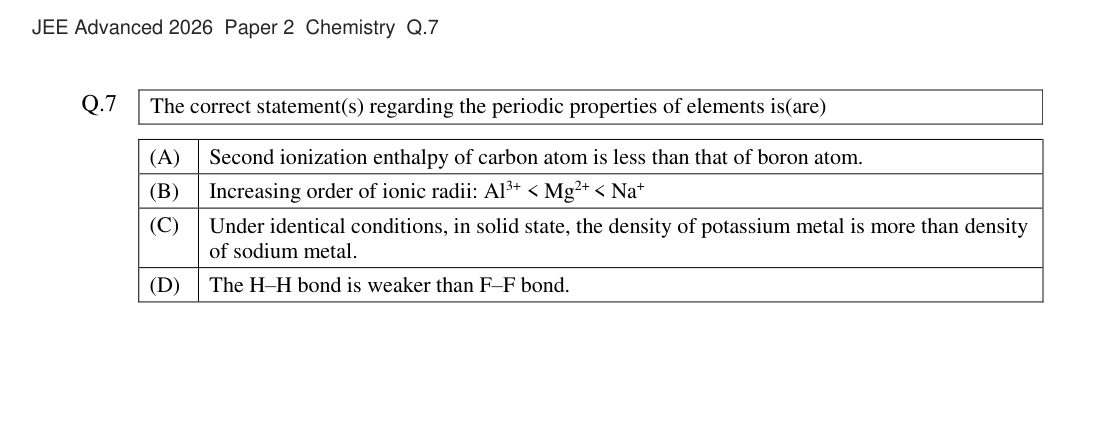
The printed question, the official key, and each model’s JSON answer plus the reasoning it wrote.
Q07
Official A, B
Model answers
Claude Fable 5.1
Anthropic
A, B
Claude Fable 5.1 reasoning
Checking option A confirms boron's second ionization energy exceeds carbon's due to boron's stable filled 2s2 configuration after losing one electron, so that statement holds true. Option B also checks out since the isoelectronic series follows the expected trend of decreasing radius with increasing nuclear charge: Al3+ < Mg2+ < Na+. Now I'm moving on to evaluate option C. (C) K's density (0.86) is actually less than Na's (0.97), so this statement is incorrect. (D) H–H bond energy (436 kJ/mol) is much stronger than F–F (159 kJ/mol), so this is also incorrect. So the correct answers are A and B. **(A)** B⁺ has a stable 2s² configuration, so its second ionization enthalpy (≈2427 kJ/mol) exceeds that of C⁺ (2s²2p¹, ≈2352 kJ/mol). Correct. **(B)** Isoelectronic ions: higher nuclear charge → smaller radius, so Al³⁺ < Mg²⁺ < Na⁺. Correct. **(C)** Density of K (0.86 g/cm³) is less than Na (0.97 g/cm³). Incorrect. **(D)** H–H bond energy (~436 kJ/mol) is much larger than F–F (~159 kJ/mol). Incorrect.
GPT 6 Astra
OpenAI
A, B
GPT 6 Astra reasoning
No written reasoning was returned for this item.
GPT 5.5
OpenAI
A, B
GPT 5.5 reasoning
**Analyzing chemical properties** I'm working through some chemical data here. For one, comparing B and C, I think C is less than B because of the stability of the electron configurations. Generally, ionization energy increases across a period, which supports my analysis on the transition from stable to easier electron removal. Next, looking at isoelectronic ions like Na+, Mg2+, and Al3+, I note that their radii decrease with increased nuclear charge. Then, when I compare the densities of K and Na, I confirm that potassium is indeed less dense than sodium, making the statement about K being denser false. Lastly, I realize the H-H bond is weaker than the F-F bond. **Finalizing JSON output** I’m analyzing some bond energy values, realizing that the F-F bond is weaker compared to H-H, which makes my statement false. I need to ensure that I produce a final JSON object without any extra explanations. The user wants the output to end specifically with just the JSON. So, I'll prepare the answer correctly with the format required, sticking to the letters ["A","B"] as requested, ensuring clarity. Let's finalize with that JSON. {"answer":["A","B"]}
Claude Sonnet 5
Anthropic
A, B
Claude Sonnet 5 reasoning
I'm working through the electron configurations for boron and carbon to compare their second ionization enthalpies, tracking how removing electrons from 2p versus 2s orbitals affects the energy required. For B+, removing a 2p1 electron leaves a stable filled 2s2 configuration, so the second ionization requires breaking that stability, making it higher than carbon's second IE - so statement A checks out. Then for ionic radii, since Al3+, Mg2+, and Na+ are all isoelectronic with 10 electrons, higher nuclear charge pulls electrons in tighter, giving the order Al3+ < Mg2+ < Na+, which confirms statement B. Now I'm moving on to check statement C about potassium having lower density than sodium in the solid state. Looking at each statement: **(A)** For carbon: C⁺ (1s²2s²2p¹) → C²⁺ removes a 2p electron, no special stability broken. For boron: B⁺ (1s²2s²2p⁰, stable filled 2s²) → B²⁺ requires breaking the stable 2s² configuration, making this ionization very difficult. Thus IE₂(B) is unusually high, so IE₂(C) < IE₂(B). **Correct.** **(B)** Na⁺, Mg²⁺, Al³⁺ are isoelectronic (10 electrons, Ne core) with increasing nuclear charge Na < Mg < Al. Higher nuclear charge pulls electrons in more tightly, so radius decreases with increasing charge: Al³⁺ < Mg²⁺ < Na⁺ (increasing order). **Correct.** **(C)** Actual solid-state densities: Na ≈ 0.97 g/cm³, K ≈ 0.86 g/cm³. Despite K having greater atomic mass, its much larger atomic radius (and looser packing) makes it less dense than Na. So density of K is **less than** density of Na — statement is **incorrect**. **(D)** Bond dissociation enthalpies: H–H ≈ 432 kJ/mol, F–F ≈ 158 kJ/mol (weakened by lone-pair–lone-pair repulsion in small F atoms). Thus H–H is stronger, not weaker, than F–F. **Incorrect.** ```json