2026 · Paper 2 · Chemistry
Question 13
The printed question, the official key, and each model’s JSON answer plus the reasoning it wrote.
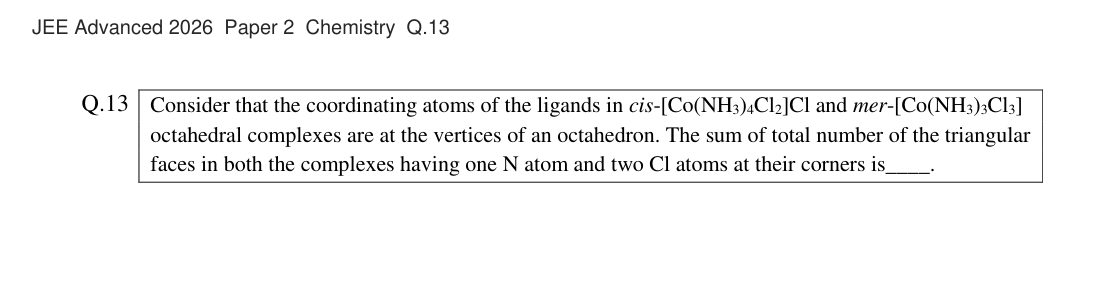
Q13
Official 6
Model answers
Claude Fable 5.1
Anthropic
6
Claude Fable 5.1 reasoning
An octahedron's 8 triangular faces each contain 3 mutually cis vertices. For cis-[Co(NH3)4Cl2]+, the shared edge between the two Cl atoms belongs to exactly 2 faces, each completed by an N, giving 2 faces with the composition N2Cl. I'm now working through the mer-[Co(NH3)3Cl3] isomer's arrangement similarly. For mer-[Co(NH3)3Cl3], placing Cl along +x, -x, and +z with N along -z, +y, -y, I need faces made of one vertex from each axis pair that yield exactly two Cl and one N — this happens when z=+z (Cl) and y is either ±y (N), regardless of x, giving 4 such faces. Adding these to the 2 from the cis isomer gives a total of 6 faces with the N2Cl composition. **cis‑[Co(NH₃)₄Cl₂]⁺:** The two Cl atoms occupy adjacent vertices (one edge). Each edge of an octahedron is shared by exactly 2 faces, and the third vertex of each such face is N. → 2 faces. **mer‑[Co(NH₃)₃Cl₃]:** Place Cl at +x, −x, +z and N at −z, +y, −y. Every face has one vertex from each axis pair. Faces with two Cl and one N need z = +z (Cl), x = ±x (Cl), y = ±y (N): (±x, ±y, +z) → 4 faces. Sum = 2 + 4 = 6
GPT 6 Astra
OpenAI
6
GPT 6 Astra reasoning
No written reasoning was returned for this item.
GPT 5.5
OpenAI
6
GPT 5.5 reasoning
**Calculating positions and faces** I’m analyzing the positions of Cl atoms, considering them at +x, -x, and +y, while N is at -y, +z, and -z. I need to count the faces with exactly two Cl atoms. Total faces can be determined by choosing one vertex from each of the x, y, and z axes, which gives me 8 combinations. It looks like the Cl positions will be at +x, -x, and +y. Let's keep this sorted! **Calculating triangular faces** I need to find the total number of triangular faces in both complexes by adding the counts from the cis and mer configurations. I calculated 6, but I want to ensure that’s the correct answer according to JEE standards. In the octahedron, there are 8 triangular faces. For cis-[M(A)4(B)2], the B positions are adjacent, impacting the counts of the triangular faces. For mer-[M(A)3(B)3], I believe there are 4 faces with the noted arrangement. Now, I need to count carefully. **Analyzing edges and vertices** I'm considering the edges involved in the structure. The top vertex T connects to all equatorial vertices, while the bottom vertex B also connects to the equatorial ones. The arrangement makes the equatorial vertices adjacent around a square configuration. I'm noting that T and B are opposite each other, as well as E1 to E3 and E2 to E4. If Cl is included, it occupies positions T, B, and E1. Now, I need to visualize this correctly.
Claude Sonnet 5
Anthropic
6
Claude Sonnet 5 reasoning
I'm setting up an octahedron model with six vertices along the axes, where each of its eight triangular faces picks one vertex from each opposite pair — then applying this to work out the cis isomer of [Co(NH3)4Cl2]Cl, placing the two chlorides adjacent at 90°. Checking systematically, only two faces can contain both Cl atoms, since any face with two chlorides must include both the +x and +y vertices where they sit, paired with either z-vertex. That gives exactly 2 faces with a 2-Cl/1-N composition for the cis isomer. Now I'm moving to the mer isomer of [Co(NH3)3Cl3], trying to place the three chlorides so two sit trans to each other and the third is cis to both, and working out which octahedron positions correspond to that meridional arrangement. Applying this to mer-[Co(NH3)3Cl3]: I place Cl at positions 1,2,3 (two trans plus one cis) and NH3 at 4,5,6 correspondingly. Now I need to enumerate the octahedron's faces by picking one vertex from each trans pair, then check how many faces contain exactly one NH3 and two Cl. Going through the eight combinations, faces (1,3,5) and (1,3,6) each give two Cl and one N, while faces (1,4,5) and (1,4,6) give one Cl and two N — I'm continuing through the remaining combinations to tally the full pattern. Four faces end up with 2Cl,1N. So the mer complex contributes 4 faces, giving a total sum of 2 + 4 = 6. Looking at this problem, I need to analyze octahedral vertex arrangements with axes pairs: (+x,-x), (+y,-y), (+z,-z), giving 8 triangular faces total (one vertex chosen from each pair). **For cis-[Co(NH₃)₄Cl₂]⁺:** Place Cl at +x and +y (cis, 90° apart), NH₃ at -x, -y, +z, -z. Since only +x and +y are Cl, any face with 2 Cl atoms must include both +x and +y. The third vertex (from ±z) is always NH₃ (N atom). This gives faces: - (+x, +y, +z) → 2Cl, 1N ✓ - (+x, +y, -z) → 2Cl, 1N ✓ **Total: 2 faces** with 1N + 2Cl. **For mer-[Co(NH₃)₃Cl₃]:** mer arrangement: Cl at +x, -x, +y (two trans + one cis), NH₃ at -y, +z, -z. Labeling: 1=+x(Cl), 2=-x(Cl), 3=+y(Cl), 4=-y(N), 5=+z(N), 6=-z(N) All 8 faces (combination of one vertex from each pair): - (1,3,5): Cl,Cl,N → 2Cl,1N ✓ - (1,3,6): Cl,Cl,N → 2Cl,1N ✓ - (1,4,5): Cl,N,N - (1,4,6): Cl,N,N - (2,3,5): Cl,Cl,N → 2Cl,1N ✓ - (2,3,6): Cl,Cl,N → 2Cl,1N ✓ - (2,4,5): Cl,N,N - (2,4,6): Cl,N,N **Total: 4 faces** with 1N + 2Cl. **Sum = 2 + 4 = 6** ```json