
2026 · Paper 2 · Chemistry
Question 14
The printed question, the official key, and each model’s JSON answer plus the reasoning it wrote.
Q14
Official 85018 – 85138.02
Model answers
Claude Fable 5.1
Anthropic
85018
Claude Fable 5.1 reasoning
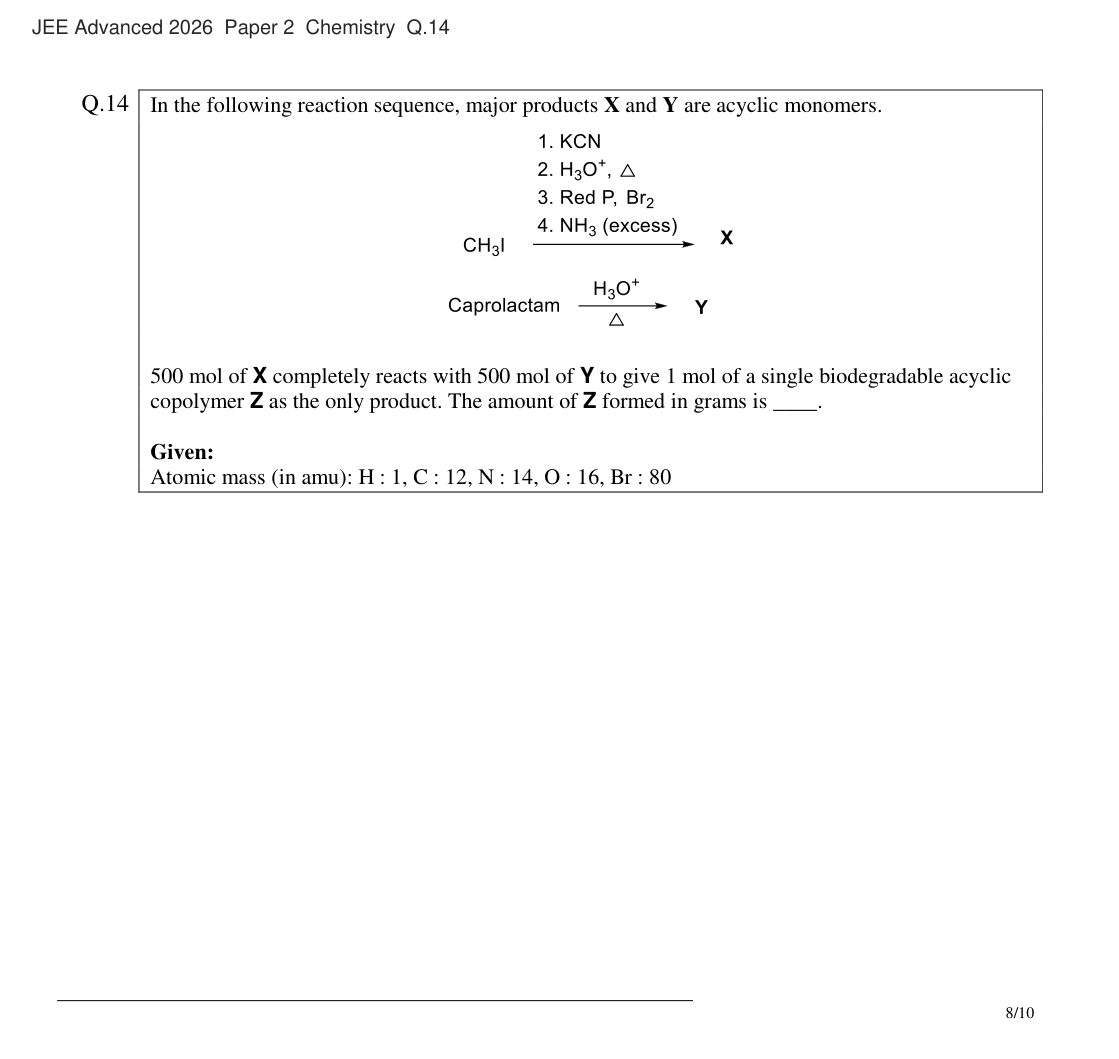
Tracing through the reaction sequence, I work out that X is glycine (C2H5NO2, MW 75) from methyl iodide via cyanide substitution, hydrolysis, alpha-bromination, and ammonolysis. Then Y comes from caprolactam hydrolysis, giving 6-aminohexanoic acid (C6H13NO2, MW 131), and I'm now setting up copolymer Z with 500 glycine units. Combining 500 glycine and 500 aminohexanoic acid units into a linear acyclic chain, I count 999 amide bonds forming, so 999 water molecules are lost. Calculating the mass: 500×75 + 500×131 − 999×18 = 37500 + 65500 − 17982 = 85018 g, which I settle on as the final answer since the chain is stated to be acyclic. **Step 1: Identify X** CH₃I → (KCN) CH₃CN → (H₃O⁺, Δ) CH₃COOH → (Red P, Br₂; HVZ) BrCH₂COOH → (excess NH₃) H₂N–CH₂–COOH (glycine) X = glycine, C₂H₅NO₂, M = 75 g/mol **Step 2: Identify Y** Caprolactam + H₃O⁺, Δ (hydrolysis) → H₂N–(CH₂)₅–COOH (6‑aminohexanoic acid) Y = C₆H₁₃NO₂, M = 131 g/mol **Step 3: Copolymer Z** 500 mol X + 500 mol Y → 1 mol of a single acyclic polyamide chain. 1000 monomer units joined linearly form 999 amide bonds, eliminating 999 mol H₂O. Mass of Z = 500(75) + 500(131) − 999(18) = 37500 + 65500 − 17982 = 85018 g
GPT 6 Astra
OpenAI
85018
GPT 6 Astra reasoning
No written reasoning was returned for this item.
GPT 5.5
OpenAI
85018
GPT 5.5 reasoning
**Verifying polymer details** I'm checking the mass of 85,018 g to see if it’s correct. I need to verify if there are any additional stoichiometric details regarding the copolymer, especially concerning the requirement for a 1000-mer. I’ll double-check the reaction sequence too. It starts with CH3I converting to ethanoic acid, leading to 2-aminopropanoic acid. I see it involves hydrolysis and the transformation of caprolactam. I think glycine is my amino acid monomer for polyglycine, while caprolactam can hydrolyze to an amine. **Exploring copolymer structure** I'm considering whether 500 units of each component could form an alternating copolymer. Since they have the same functional groups, there’s no strict requirement for alternation. A single copolymer could potentially have a repeating unit structure with X and Y connected head-to-tail. If I have 500 moles of X and 500 moles of Y, I wonder if the copolymer might consist of 500 repeat units rather than 1000 monomers. In that case, for a linear chain, there would be 999 peptide bonds if it’s acyclic. **Analyzing copolymerization reactions** I'm considering that the phrase "only product" could imply the reaction isn't a condensation with water. If water were formed, then Z wouldn't be the only product. In condensation polymerization, byproduct water is unavoidable, but they might be excluding isomeric products. Looking closely at the statement: "500 mol of X reacts with 500 mol of Y to give 1 mol of biodegradable copolymer Z." It's possible "only product" includes small molecule byproducts, but traditionally, water is a product in such reactions. They ask for Z’s amount, which involves mass conservation. I wonder if X/Y could be lactams instead? **Reassessing monomer X** I'm thinking X might not actually be an amino acid but rather an acyclic monomer. I should consider whether the reaction sequence from CH3I could produce an amino acid. Is it possible that X is a lactam instead? No, since we’re discussing acyclic monomers for a biodegradable polymer. It's interesting that X and Y might react without loss. Could X potentially be glycolic acid instead of glycine? I think I need to investigate CH3I further. **Exploring copolymer similarities** I'm thinking about whether "biodegradable acyclic copolymer" made from glycine and epsilon-aminocaproic acid resembles "poly(glycine-co-6-aminocaproic acid)." However, 6-aminocaproic acid homopolymer is nylon-6, which isn't biodegradable, being an aliphatic polyamide. I need to clarify the copolymer's structure: 500 mol of X reacts with 500 mol of Y to yield 1 mol of polymer. This means Avogadro's number of polymer molecules is formed, not just a single molecule. Let's calculate accurately! **Calculating molecular mass** I'm analyzing the molecular structure of Y, which is NH2(CH2)5COOH and can also be represented as C6H13NO2. The molecular mass calculation adds up like this: Carbon contributes 72, Hydrogen brings in 13, Nitrogen adds 14, and Oxygen totals 32. Altogether, that gives me a total molecular mass of 131. It’s a neat little exercise in chemistry, making sure I keep everything accurate! **Calculating polymer properties** I’m calculating the mass of a polymer. First, I find the mass of the components, which totals to 103,000. For the amide bonds' calculation, I determine that 999 amide bonds exist based on combined molecules. The water mass then comes to 17,982. I’m focusing on a result of Z mass being 85,018. If everything fits, I’ll provide the final answer as required. So, the final format should be: `{"answer":85018,"unanswered":false}`. **Analyzing polymer structure** I’m figuring out the implications of "acyclic" on the chain length. With one mole, it clearly affects my calculations: 999 for the amide bonds. Looking at the repeated unit of glycine and aminocaproic acid, I get a mass of 170, totaling 85,000 for 500 repeats. However, since we're dealing with an acyclic structure, I adjust for the extra water molecule, leading to a final mass of 85,018. The "only product" clause confuses me at first, but it seems water is still considered. **Understanding polymer structure** I'm examining the polymer structure, which includes repeating units of –NH–CH2–CO–NH–(CH2)5–CO–. It's prepared by heating glycine with aminocaproic acid, where each repeat unit has a molar mass of 170. For a polymer with 500 repeat units, the total mass would be 85,000, but the task specifies a single acyclic copolymer formed from 500 moles of each component. I should use the provided equation to derive the polymer's composition properly. **Clarifying polymer reactions** I’m thinking about a situation with 1000 acid groups and 1000 amine groups in an acyclic molecule. If they all reacted, it would be a cyclic molecule, which seems impossible. When I say "complete reaction," I mean incorporating all monomers, but terminal functional groups might stay unreacted. "Complete reacts" could imply all monomers are consumed, not all functional groups. Maybe considering "1 mol of a single copolymer Z" could just refer to one mole of polymer units?
Claude Sonnet 5
Anthropic
85018
Claude Sonnet 5 reasoning
Tracing through the synthesis: methyl iodide with KCN gives acetonitrile, which hydrolyzes to acetic acid; treating with red P/Br2 performs an HVZ bromination to bromoacetic acid, and then excess ammonia should displace the bromine to form glycine. So X is glycine (H2N-CH2-COOH), and Y comes from hydrolyzing caprolactam's ring to give 6-aminohexanoic acid, the nylon-6 monomer. Combining 500 mol of each into a single acyclic biodegradable polymer Z means condensation polymerization forming amide linkages, releasing water with each bond — for 1000 total monomer units joined into one chain, that's 999 amide bonds and 999 water molecules released. I'm now applying conservation of mass to find Z's mass: mass Z = mass X + mass Y - mass of released water, starting with glycine's molar mass of 75 g/mol. For 6-aminohexanoic acid at 131 g/mol, 500 mol each of X and Y gives 37500 g and 65500 g, totaling 103000 g before condensation. Since assembling 1000 monomers into one chain releases 999 water molecules (17982 g), Z's mass would be 85018 g -- though I need to check whether this represents one mole of polymer chain since 500 mol X and 500 mol Y combine to form just one mole of Z. So the single mole of Z represents one giant copolymer chain containing 500 glycine units and 500 amino hexanoic acid units, having lost 999 waters in forming those 999 peptide-type bonds. So mass of Z equals the combined mass of 500 mol glycine plus 500 mol aminohexanoic acid minus 999 mol water. Glycine's molar mass works out to 75 g/mol and aminohexanoic acid's to 131 g/mol, giving 500×75+500×131 = 103000, then subtracting 999×18=17982, leaving 85018 grams for Z. Looking at the synthesis: **Formation of X:** - CH₃I + KCN → CH₃CN (acetonitrile) - H₃O⁺, Δ → CH₃COOH (acetic acid, nitrile hydrolysis) - Red P/Br₂ (HVZ reaction) → BrCH₂COOH (bromoacetic acid) - Excess NH₃ → H₂N–CH₂–COOH (**Glycine**, X) - Molar mass = 2(12)+5(1)+14+2(16) = 75 g/mol **Formation of Y:** - Caprolactam + H₃O⁺/Δ → ring-opening hydrolysis → H₂N–(CH₂)₅–COOH (**6-Aminohexanoic acid**, Y) - Molar mass = 6(12)+13(1)+14+2(16) = 131 g/mol **Formation of Z:** Both X and Y are amino acids capable of undergoing condensation polymerization (amide bond formation with loss of water), giving a linear (acyclic), biodegradable polyamide copolymer — consistent with "single acyclic copolymer." Given 500 mol X + 500 mol Y → 1 mol Z, this means one polymer chain incorporates all 500 units of X and 500 units of Y (total 1000 monomer units) in a single linear chain. For a linear condensation polymer of 1000 monomer units, the number of amide bonds formed = 999, releasing 999 molecules of H₂O. **Mass balance:** Total mass of monomers: - Mass from X = 500 × 75 = 37500 g - Mass from Y = 500 × 131 = 65500 g - Total = 103000 g Mass of water released: - 999 × 18 = 17982 g **Mass of Z:** = 103000 − 17982 = **85018 g** ```json