
2026 · Paper 2 · Chemistry
Question 18
The printed question, the official key, and each model’s JSON answer plus the reasoning it wrote.
Q18
Official 2.33
Model answers
Claude Fable 5.1
Anthropic
2.33
Claude Fable 5.1 reasoning
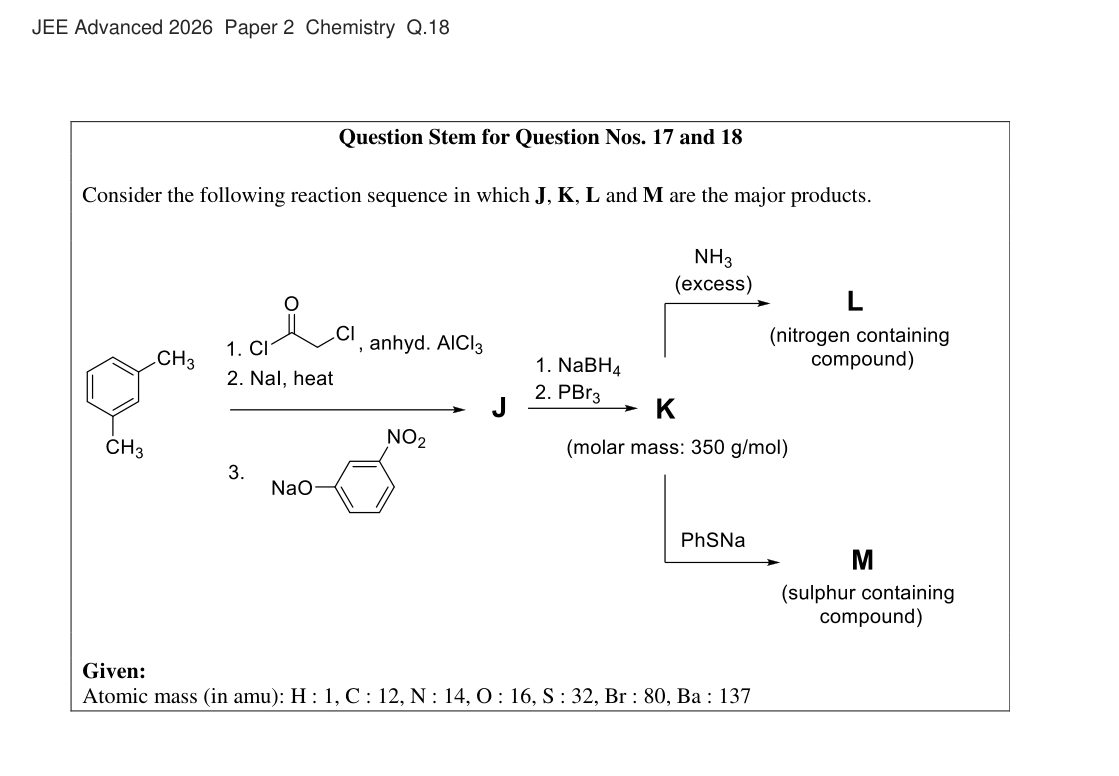
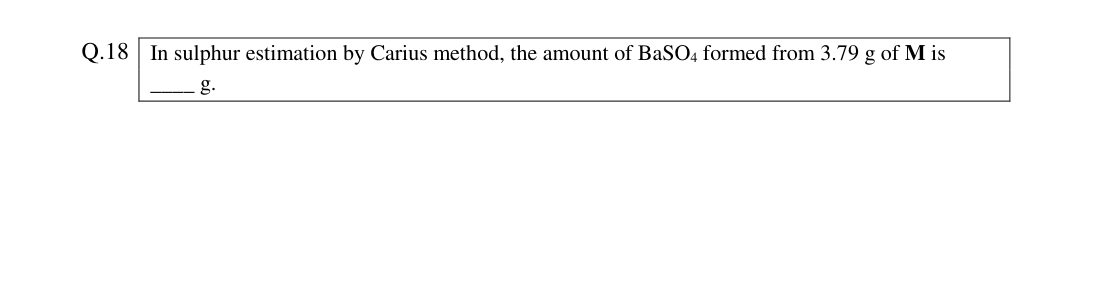
Working through the reaction sequence: m-xylene undergoes Friedel-Crafts acylation with chloroacetyl chloride/AlCl3 to give the 2,4-dimethylphenyl chloromethyl ketone, which then reacts with sodium iodide via Finkelstein substitution to form the iodomethyl ketone, and finally couples with 3-nitrophenoxide to form the aryl ether product. Then NaBH4 reduces the ketone to an alcohol and PBr3 converts it to a bromide, giving K with formula C16H16BrNO3 (molar mass 350, confirming the match). Reacting K with sodium thiophenolate displaces bromide to give sulfide M (C22H21NO3S, molar mass 379), so 3.79 g corresponds to 0.01 mol, yielding 0.01 mol BaSO4 at 233 g/mol — 2.33 g as the final answer. **Working out the structures** - Step 1: Friedel–Crafts acylation of m‑xylene with ClCH₂COCl gives ArCOCH₂Cl (Ar = 2,4‑dimethylphenyl). - Step 2: Finkelstein (NaI) → ArCOCH₂I. - Step 3: Williamson with 3‑nitrophenoxide → **J** = ArCOCH₂O–C₆H₄NO₂. - NaBH₄ then PBr₃ → **K** = ArCH(Br)CH₂O–C₆H₄NO₂ = C₁₆H₁₆BrNO₃, M = 192+16+80+14+48 = 350 g/mol ✓. - PhSNa substitutes Br → **M** = ArCH(SPh)CH₂O–C₆H₄NO₂ = C₂₂H₂₁NO₃S, M = 264+21+14+48+32 = 379 g/mol. **Carius estimation** Moles of M = 3.79/379 = 0.01 mol → 0.01 mol S → 0.01 mol BaSO₄ (233 g/mol) Mass of BaSO₄ = 0.01 × 233 = 2.33 g
GPT 6 Astra
OpenAI
2.33
GPT 6 Astra reasoning
No written reasoning was returned for this item.
GPT 5.5
OpenAI
2.33
GPT 5.5 reasoning
**Finalizing JSON output** I’m working through my calculations, which involve molecular masses and conversion factors. My answer comes out to 2.33, and I need to format it as a JSON object, making sure there are no trailing zeros and that it meets all criteria. I’m also mindful of ensuring there are no extra characters in my final output. The final JSON should look like this: { "answer": 2.33, "unanswered": false } It seems like I'm on the right track!
Claude Sonnet 5
Anthropic
2.33
Claude Sonnet 5 reasoning
I'm working through the synthesis starting from m-xylene, applying a Friedel-Crafts acylation with chloroacetyl chloride and AlCl3 to install a chloroacetyl group on the ring, taking advantage of the symmetry of the two methyl substituents to determine where this new group attaches. So J is ArCOCH2Cl with Ar = 2,4-dimethylphenyl. Then NaI performs a Finkelstein swap to give ArCOCH2I, and reaction with sodium 3-nitrophenoxide gives the Williamson ether product ArCOCH2-O-(3-nitrophenyl), which is J. Moving to J→K, the first step NaBH4 would reduce the ketone. For K, PBr3 then converts that resulting alcohol into the bromide, giving Ar-CHBr-CH2-O-(3-nitrophenyl). I want to verify K's molar mass comes out to 350 g/mol, so I'm tallying up the atoms across the dimethylphenyl group, the CHBr-CH2-O linker, and the nitrophenyl ring to get the full molecular formula. Adding up carbons, hydrogens, bromine, oxygens, and nitrogen gives C16H16BrNO3, and the mass calculation confirms 350 g/mol matches perfectly. Now I'm turning to the reaction of K with sodium thiophenolate to form M, which should proceed as a nucleophilic substitution at the carbon bearing bromine. The thiophenolate displaces bromide, giving M as the aryl-CH(SPh)-CH2-O-nitrophenyl compound. Swapping Br for SPh in the formula, I get C22H21NO3S, and the molar mass works out to roughly 379 g/mol. For the Carius sulfur estimation, 3.79 g of M is 0.01 mol, and since each mole of M contains one sulfur that converts fully to BaSO4, that gives 0.01 mol BaSO4 — mass 233×0.01 = 2.33 g. So the answer is 2. Looking at this problem, I need to trace through the synthesis: **Step 1 (→J):** m-Xylene undergoes Friedel-Crafts acylation with chloroacetyl chloride (at the position between the methyls is hindered, so acylation occurs at C4, giving 2,4-dimethylphenyl ketone) → ArCOCH₂Cl. Then Finkelstein reaction (NaI) converts Cl to I. Then Williamson ether synthesis with sodium 3-nitrophenoxide displaces iodide: **J** = (2,4-dimethylphenyl)-CO-CH₂-O-(3-nitrophenyl) **Step 2 (→K):** NaBH₄ reduces the ketone to a secondary alcohol, then PBr₃ converts -OH to -Br: **K** = (2,4-dimethylphenyl)-CHBr-CH₂-O-(3-nitrophenyl) Checking molar mass: C₁₆H₁₆BrNO₃ = 192+16+80+14+48 = **350 g/mol** ✓ (matches given value) **Step 3 (→M):** PhSNa performs SN2 displacement of Br⁻ by PhS⁻: **M** = (2,4-dimethylphenyl)-CH(SPh)-CH₂-O-(3-nitrophenyl) Molecular formula of M: C₂₂H₂₁NO₃S Molar mass = 22(12) + 21(1) + 14 + 3(16) + 32 = 264 + 21 + 14 + 48 + 32 = **379 g/mol** **Carius method calculation:** Moles of M = 3.79 g / 379 g/mol = 0.01 mol Since M contains exactly 1 sulfur atom, moles of BaSO₄ formed = 0.01 mol Mass of BaSO₄ = 0.01 mol × 233 g/mol (Ba=137, S=32, O₄=64) = **2.33 g** ```json