
2026 · Paper 2 · Chemistry
Question 17
The printed question, the official key, and each model’s JSON answer plus the reasoning it wrote.
Q17
Official 10
Model answers
Claude Fable 5.1
Anthropic
10
Claude Fable 5.1 reasoning
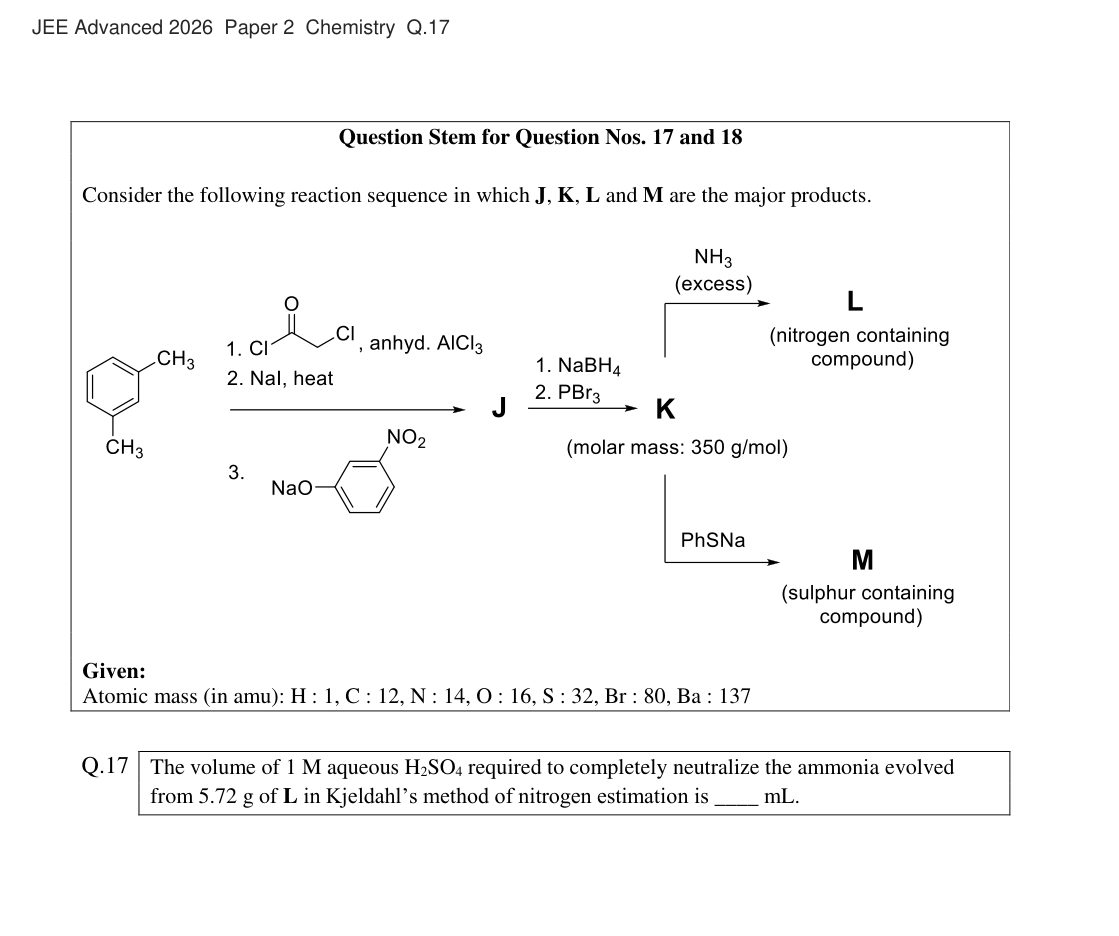
I'm mapping out the synthesis from m-xylene: Friedel-Crafts acylation with chloroacetyl chloride gives the aryl chloromethyl ketone, Finkelstein swaps chloride for iodide, then coupling with sodium 3-nitrophenoxide forms the ether linkage. Working through molecular formulas confirms each intermediate matches the given molar masses: J (285), K after NaBH4/PBr3 conversion (350), and L after amination (286). For the Kjeldahl analysis, only the amine nitrogen converts to NH3, not the nitro nitrogen, so 5.72 g of L gives 0.02 mol NH3, requiring 0.01 mol H2SO4 — that's 10 mL of 1 M acid. **Structures:** - Friedel–Crafts acylation of m‑xylene with ClCH₂COCl gives 2,4‑dimethylphenyl chloromethyl ketone; NaI gives the iodomethyl ketone; Williamson etherification with 3‑nitrophenoxide gives **J** = ArCO–CH₂–O–C₆H₄NO₂ (C₁₆H₁₅NO₄, 285 g/mol). - NaBH₄ then PBr₃ gives **K** = ArCH(Br)–CH₂–O–C₆H₄NO₂ (C₁₆H₁₆BrNO₃, M = 350 g/mol ✓). - Excess NH₃ gives **L** = ArCH(NH₂)–CH₂–O–C₆H₄NO₂ (C₁₆H₁₈N₂O₃, M = 286 g/mol). **Kjeldahl:** Only the amine nitrogen is converted to NH₃ (nitro N is not estimated). Moles of L = 5.72/286 = 0.02 mol → 0.02 mol NH₃. 2NH₃ + H₂SO₄ → (NH₄)₂SO₄ ⇒ H₂SO₄ needed = 0.01 mol = 10 mL of 1 M.
GPT 6 Astra
OpenAI
10
GPT 6 Astra reasoning
No written reasoning was returned for this item.
GPT 5.5
OpenAI
10
GPT 5.5 reasoning
**Considering ammonia calculations** I’m thinking about the situation where L has two moles of N. That would lead to a total of 0.04 moles. So, that means I’d have 0.04 moles of ammonia if I counted both. It seems like I'm just doing some straightforward calculations here, but I want to make sure I'm clear on how these quantities interact. Am I considering everything correctly? It feels a bit tricky! **Evaluating H2SO4 Neutralization** I’m working through the neutralization of H2SO4 with ammonia. I have 0.02 mol of H2SO4 and am trying to figure out the volume needed. If I consider only amino nitrogen, I might end up needing 10 or 20 mL. The question also references Kjeldahl's method of nitrogen estimation, where organic compounds are treated with conc H2SO4, converting nitrogen to (NH4)2SO4. I remember that certain nitrogen types can complicate this method. **Exploring Nitrogen Compounds** I'm thinking about whether the method applies to amines, amides, or cyanides, but it definitely doesn’t work for nitro, azo, diazo, or heterocyclic nitrogen. Since my compound L has both a nitro group and an amine, the method will probably only estimate amino nitrogen. The question seems to test my understanding of both the structure and limitations of Kjeldahl. I suspect they expect a 10 mL result, but I need to explore this further for clarity. What if there’s an alternative structure with different nitrogen types? **Evaluating neutralization volume** I need an answer in numeric format, considering the hypothetical context of the official JEE Advanced 2026 exam. The question specifies the volume of 1 M aqueous H₂SO₄ to neutralize ammonia from 5.72 g of substance L using Kjeldahl’s method. It's important to focus on the wording carefully, as they mention ammonia evolved specifically from L. Given the nitro nitrogen's presence, I suspect the answer may be 10 mL based on my calculations. **Ensuring stoichiometry in neutralization** I need to confirm the stoichiometry for neutralizing ammonia with 1M H₂SO₄, which has 2 acidic protons and neutralizes 2 moles of NH₃. So if I have 0.02 mol of NH₃, that means I'll need 0.01 mol of H₂SO₄, which is 10 mL. If I had 0.04 mol of NH₃, it'd be 20 mL. I have to consider potential variations in method limitations and accuracy related to the Kjeldahl digestion process. **Calculating a division** I'm doing a simple calculation here: dividing 5.72 by 286 gives me exactly 0.02. It's nice to see that when I multiply 286 back by 0.02, I get 5.72 again. That's pretty satisfying! I wonder if a result of 10 or 20 would also be interesting or nice in some way. Just a little thought on what different numbers could mean in this context! **Analyzing nitrogen estimation methods** I'm looking at nitrogen estimation with Kjeldahl’s method. There are details about the number of nitrogen atoms and acid volume. I think they may ask about neutralizing ammonia and figuring out nitrogen counts while excluding nitro. If they mention Kjeldahl, it suggests there’s a trick to it. I need to solve it thoroughly to ensure I’m considering all nitrogen counts. Also, I'm curious about the phenoxide reagent in the image; it might not be what I initially thought. **Examining reagent structure** I'm checking an image of a ring drawn as a tilted hexagon. There seems to be an O^-Na+ at the left-lower vertex and an NO2 at the top-right. I need to confirm if their positions are para. It might be sodium 2-nitrophenoxide, but I'm unsure. The key factor is the nitro count. It could also be sodium nitrite. I’m pondering if NaI with heat could convert phenacyl chloride to another compound, possibly through a rearrangement or reduction. The next reaction with sodium nitrophenoxide may involve a Williamson ether. The formula aligns with the mass given! **Evaluating acid volume for nitrogen estimation** I'm evaluating the acid volume with one amine nitrogen. The formula for compound L is C16H18N2O3, and its molecular weight is 286. From this, I calculate the moles of L, which comes to approximately 0.020 mol. I need to keep in mind that in the Kjeldahl method, nitro-N is not converted. It's only the -NH2 nitrogen that produces ammonia, so it seems like the ammonia moles end up being zero. **Exploring Kjeldahl's method** I'm considering how organic matter could affect nitro compounds, but not consistently. The official guidelines state that Kjeldahl's method doesn't work for nitrogen in nitro and azo groups, or in certain ring structures like pyridine. Although, maybe some amines like primary amine nitrogen behave like aniline? I wonder if the nitro group could produce ammonia under certain conditions with a reducing agent present, but it doesn’t seem standard. It looks like there are potential issues with how ammonia is neutralized during the process. **Clarifying ammonia neutralization** I'm thinking about how ammonia reacts with sulfuric acid. It seems that the equation NH3 + H2SO4 produces ammonium bisulfate (NH4HSO4) in a 1:1 ratio if there's just one equivalent of each. But the question arises: what happens if the acid is in excess? Would that lead to complete neutralization of the acid, or am I missing something important here? It feels like there’s more to consider regarding the reactions in different scenarios. **Evaluating ammonia neutralization** Neutralizing ammonia means protonating NH3 fully. One H2SO4 molecule can give away two protons, allowing ammonia to neutralize both, forming ammonium sulfate. For complete stoichiometry, two NH3 are needed per H2SO4. However, does ammonium bisulfate count as fully neutralizing ammonia? In an acid-base titration, each H2SO4 can donate two protons, affecting the equivalent weight. It looks like I can confirm JEE treats one mole of H2SO4 as neutralizing two moles of NH3. In summary, complete neutralization leads to ammonium sulfate. **Preparing final JSON answer** I'm focusing on the requirements for the JEE Advanced 2026. It seems like previous patterns suggest numerical answers are usually integers, but they might accept decimals too. So the final JSON could just use 10 or 10.0. The user wants just one number as the answer in JSON format, without any extra explanations. I’m ensuring the final output looks like this: { "answer": 10, "unanswered": false } I need to double-check that there’s no text before or after this JSON object, as instructed!
Claude Sonnet 5
Anthropic
10
Claude Sonnet 5 reasoning
I'm identifying the starting material as m-xylene and working through the first step, a Friedel-Crafts acylation using chloroacetyl chloride with anhydrous AlCl3. This gives an aryl chloromethyl ketone that then undergoes a Finkelstein reaction to swap chlorine for iodine, followed by a Williamson ether synthesis with sodium m-nitrophenoxide displacing the iodide to form compound J. From J, I'm reducing the ketone with NaBH4 to an alcohol, then converting that alcohol to a bromide with PBr3 to get K, and now I'm checking whether K's molar mass matches the expected 350 g/mol. Working out the molecular formula piece by piece: dimethylphenyl (C8H9), CHBr, CH2, O, C6H4, and NO2 combined, tallying up carbons, hydrogens, bromine, oxygens, and nitrogen to confirm the total mass lines up. This gives molecular formula C16H16BrNO3 with molar mass 350, matching K's given value and confirming the structure as the 3,5-dimethylphenyl compound with a CHBr-CH2-O linkage to a nitrophenyl group. Now I'm thinking about the K to L step, where excess ammonia substitutes the bromine to form a primary amine via SN2, with the excess ammonia helping favor the primary amine over further alkylation. This gives L as the amino compound with an NH2 group replacing bromine, still bearing the nitro group on the aromatic ring. I'm now wrestling with the Kjeldahl nitrogen estimation question, since L technically contains two nitrogens (the amine and the nitro group), but nitro nitrogen isn't converted to ammonia by standard Kjeldahl digestion unless a reduction step is included—so I need to figure out whether the problem wants only the amine nitrogen counted or some modified approach. Working out the formula: removing Br from K (C16H16BrNO3) and adding NH2 gives L as C16H18N2O3. Let me verify the hydrogen count atom by atom - the aryl group with methyl substituents contributes 9 H, the CHBr carbon 1 H, the CH2 group 2 H, and the nitrophenoxy ring 4 H, totaling 16 H in K, which checks out with 16 carbons and one Br and one N from the nitro group. This gives K = C16H16BrNO3 with molecular weight 350, matching the expected value. Converting to L involves SN2 substitution where Br leaves and NH2 replaces it, so carbon count stays fixed at 16, hydrogens increase to 18, and nitrogen count rises to 2 (one from the original nitro, one from the new amine), giving L = C16H18N2O3 with MW 286 - consistent with my earlier calculation. Now I need to think through the Kjeldahl method for nitrogen estimation. The classical Kjeldahl method fails for nitro-nitrogen since digestion with sulfuric acid doesn't convert nitro groups to ammonium sulfate the way it does amine nitrogen - nitro and azo compounds need special reductive treatment first. Since this looks like a standard numerical problem, I'll assume only the amine nitrogen gets estimated via Kjeldahl, so each mole of L yields one mole of NH3, and I can proceed to calculate moles from the given 5.72 g sample using MW 286. Since Kjeldahl doesn't detect nitro or ring nitrogen, only the amine nitrogen counts, confirming 0.02 mol NH3 and thus 10 mL of 1M H2SO4 — checking the arithmetic, 5.72/286 does equal 0.02 exactly, so that's the answer. Looking at this problem, I need to trace through the synthesis to identify compound L. **Synthesis pathway:** 1. **m-Xylene** undergoes Friedel-Crafts acylation with ClCOCH₂Cl/AlCl₃ to give a ring-substituted aryl chloromethyl ketone: Ar–CO–CH₂Cl (Ar = 3,5-dimethylphenyl) 2. **NaI, heat** (Finkelstein): converts –CH₂Cl to –CH₂I → Ar–CO–CH₂I 3. **Sodium m-nitrophenoxide**: Williamson ether synthesis displaces iodide: **J = Ar–CO–CH₂–O–C₆H₄–NO₂** (m-nitrophenoxy ether) **J → K:** - NaBH₄ reduces ketone to alcohol: Ar–CH(OH)–CH₂–O–C₆H₄–NO₂ - PBr₃ converts OH to Br: **K = Ar–CHBr–CH₂–O–C₆H₄–NO₂** Checking molar mass of K (C₁₆H₁₆BrNO₃): - C: 16×12 = 192 - H: 16×1 = 16 - Br: 80 - N: 14 - O: 3×16 = 48 - Total = 350 g/mol ✓ (matches given value, confirming structure) **K → L (excess NH₃):** SN2 substitution of Br by NH₂ gives: **L = Ar–CH(NH₂)–CH₂–O–C₆H₄–NO₂** Formula: C₁₆H₁₈N₂O₃ Molar mass = 192 + 18 + 28 + 48 = **286 g/mol** **Kjeldahl Analysis:** L contains two nitrogen atoms: one as a primary amine (–NH₂) and one as a nitro group (–NO₂). **Key point:** The classical Kjeldahl method fails to estimate nitrogen present in nitro (–NO₂), azo, or ring nitrogen — only amine-type nitrogen is quantitatively converted to (NH₄)₂SO₄ during digestion with conc. H₂SO₄. Thus, only the **1 nitrogen atom from the –NH₂ group** is estimated. **Calculation:** Moles of L = 5.72 g / 286 g/mol = 0.02 mol Since only 1 N (amine) is converted to NH₃: Moles of NH₃ evolved = 0.02 mol Neutralization reaction: $$2NH_3 + H_2SO_4 \rightarrow (NH_4)_2SO_4$$ Moles of H₂SO₄ required = 0.02/2 = 0.01 mol Volume of 1 M H₂SO₄ = 0.01 mol / 1 mol/L = 0.01 L = **10 mL** ```json