2026 · Paper 2 · Mathematics
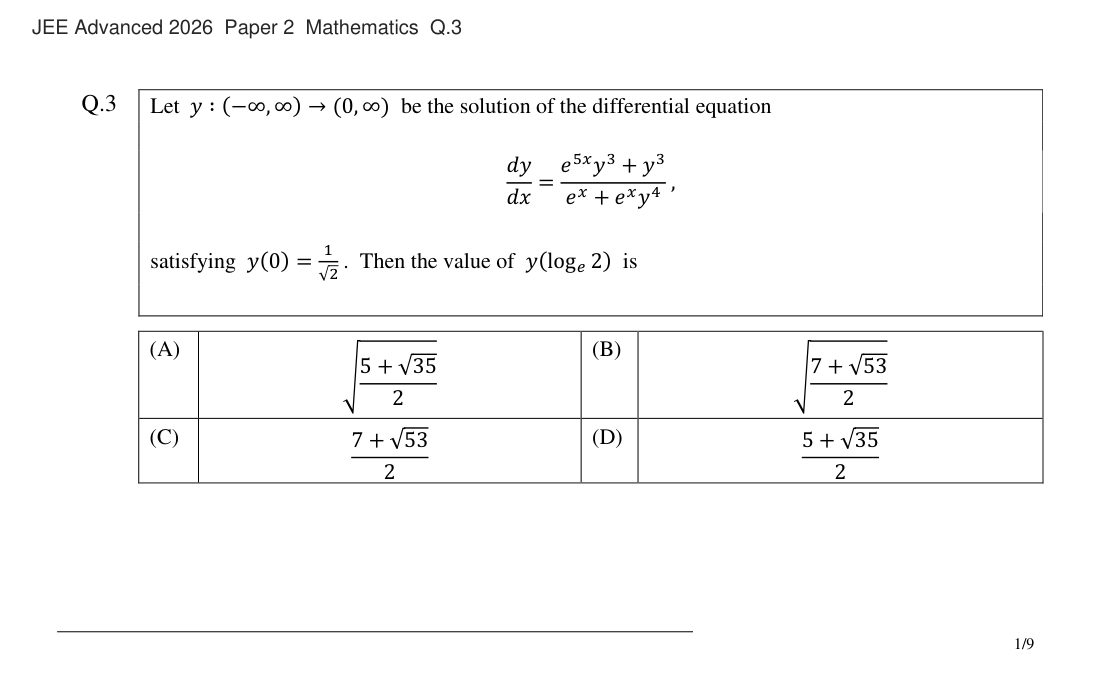
Question 3
The printed question, the official key, and each model’s JSON answer plus the reasoning it wrote.
Q03
Official B
Model answers
Claude Fable 5.1
Anthropic
B
Claude Fable 5.1 reasoning
I can separate variables here: rewriting the equation as (1+y⁴)/y³ dy = (e⁴ˣ+e⁻ˣ)dx, then integrating both sides gives -1/(2y²) + y²/2 on the left and e⁴ˣ/4 - e⁻ˣ + C on the right. Using the initial condition y=1/√2 at x=0, I find C=0. Then plugging in x=ln2, I solve the resulting equation y⁴-7y²-1=0 for y², getting y = √((7+√53)/2), which matches answer B. **Solving:** $$\frac{dy}{dx} = \frac{y^3(e^{5x}+1)}{e^x(1+y^4)} \implies \frac{1+y^4}{y^3}\,dy = (e^{4x}+e^{-x})\,dx$$ Integrating: $$-\frac{1}{2y^2} + \frac{y^2}{2} = \frac{e^{4x}}{4} - e^{-x} + C$$ At $x=0$, $y^2 = \tfrac12$: LHS $= -1 + \tfrac14 = -\tfrac34$, RHS $= \tfrac14 - 1 + C$, so $C = 0$. At $x = \ln 2$: RHS $= \tfrac{16}{4} - \tfrac12 = \tfrac72$, so $$y^2 - \frac{1}{y^2} = 7 \implies y^4 - 7y^2 - 1 = 0 \implies y^2 = \frac{7+\sqrt{53}}{2}$$ Hence $y(\ln 2) = \sqrt{\dfrac{7+\sqrt{53}}{2}}$.
GPT 6 Astra
OpenAI
B
GPT 6 Astra reasoning
No written reasoning was returned for this item.
GPT 5.5
OpenAI
B
GPT 5.5 reasoning
No written reasoning was returned for this item.
Claude Sonnet 5
Anthropic
B
Claude Sonnet 5 reasoning
I separate variables to get (1+y⁴)/y³ dy = (e⁴ˣ+e⁻ˣ) dx, then integrate each side: the left becomes -1/(2y²) + y²/2, and the right gives e⁴ˣ/4 minus the antiderivative of e⁻ˣ. Using the initial condition x=0, y=1/√2, I find both sides equal -0.75, so the constant C works out to zero. Plugging in x=ln2 gives e⁴ˣ=16 and e⁻ˣ=1/2, so the right side becomes 3.5, and substituting u=y² turns the equation into u²-7u-1=0. Solving with the quadratic formula and keeping the positive root gives u=(7+√53)/2, so y=√((7+√53)/2), matching option B. Looking at this problem, I need to solve the differential equation: $$\frac{dy}{dx} = \frac{y^3(e^{5x}+1)}{e^x(1+y^4)}$$ **Separating variables:** $$\frac{1+y^4}{y^3}dy = \frac{e^{5x}+1}{e^x}dx = (e^{4x}+e^{-x})dx$$ **Integrating the left side:** $$\int\left(\frac{1}{y^3}+y\right)dy = -\frac{1}{2y^2}+\frac{y^2}{2}$$ **Integrating the right side:** $$\int(e^{4x}+e^{-x})dx = \frac{e^{4x}}{4}-e^{-x}+C$$ So the general solution is: $$-\frac{1}{2y^2}+\frac{y^2}{2} = \frac{e^{4x}}{4}-e^{-x}+C$$ **Applying initial condition** $y(0)=\frac{1}{\sqrt2}$, so $y^2=\frac12$: Left side: $-\frac{1}{2(1/2)}+\frac{1/2}{2} = -1+\frac14 = -\frac34$ Right side at $x=0$: $\frac14 - 1 + C = -\frac34+C$ This gives $C=0$. **The particular solution:** $$\frac{y^2}{2}-\frac{1}{2y^2} = \frac{e^{4x}}{4}-e^{-x}$$ **Evaluating at** $x=\ln 2$: Then $e^x=2$, so $e^{4x}=16$ and $e^{-x}=\frac12$. RHS: $\frac{16}{4}-\frac12 = 4-\frac12 = \frac72$ Let $u=y^2$: $$\frac{u}{2}-\frac{1}{2u} = \frac72$$ Multiplying by $2u$: $$u^2 - 1 = 7u \implies u^2 - 7u - 1 = 0$$ Solving: $$u = \frac{7\pm\sqrt{49+4}}{2} = \frac{7\pm\sqrt{53}}{2}$$ Since $u=y^2>0$, we need $u = \frac{7+\sqrt{53}}{2}$ (taking the positive root, as the negative root gives negative value). Therefore: $$y = \sqrt{\frac{7+\sqrt{53}}{2}}$$ This matches option **(B)**. ```json