
2026 · Paper 2 · Mathematics
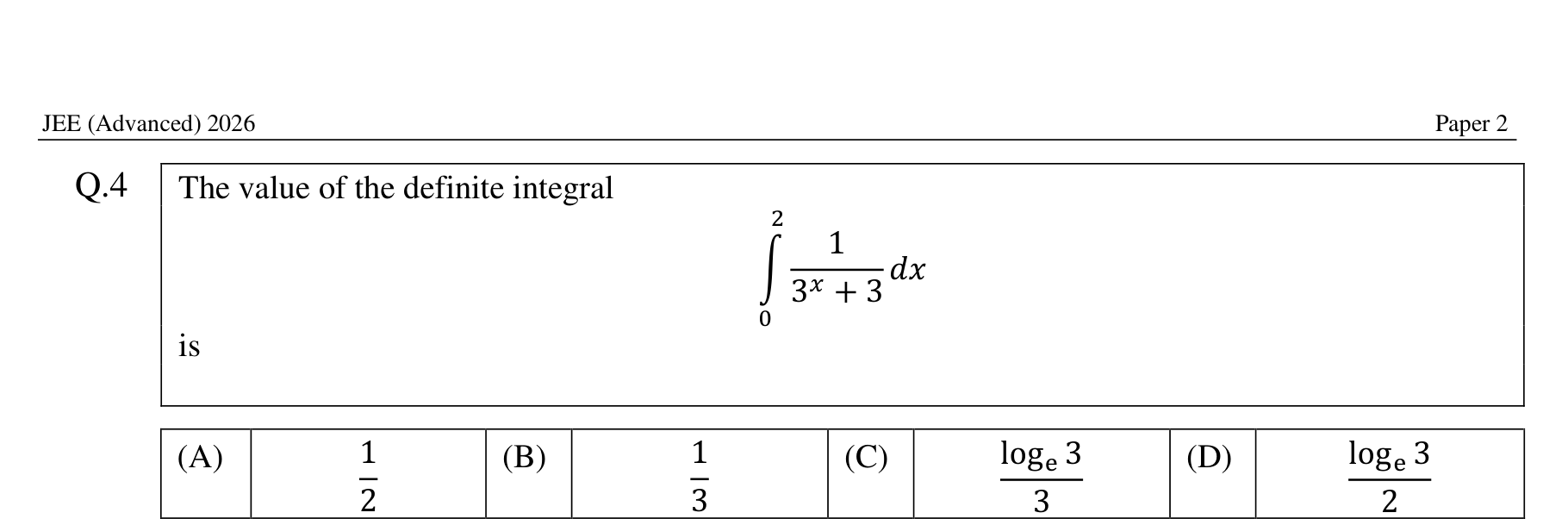
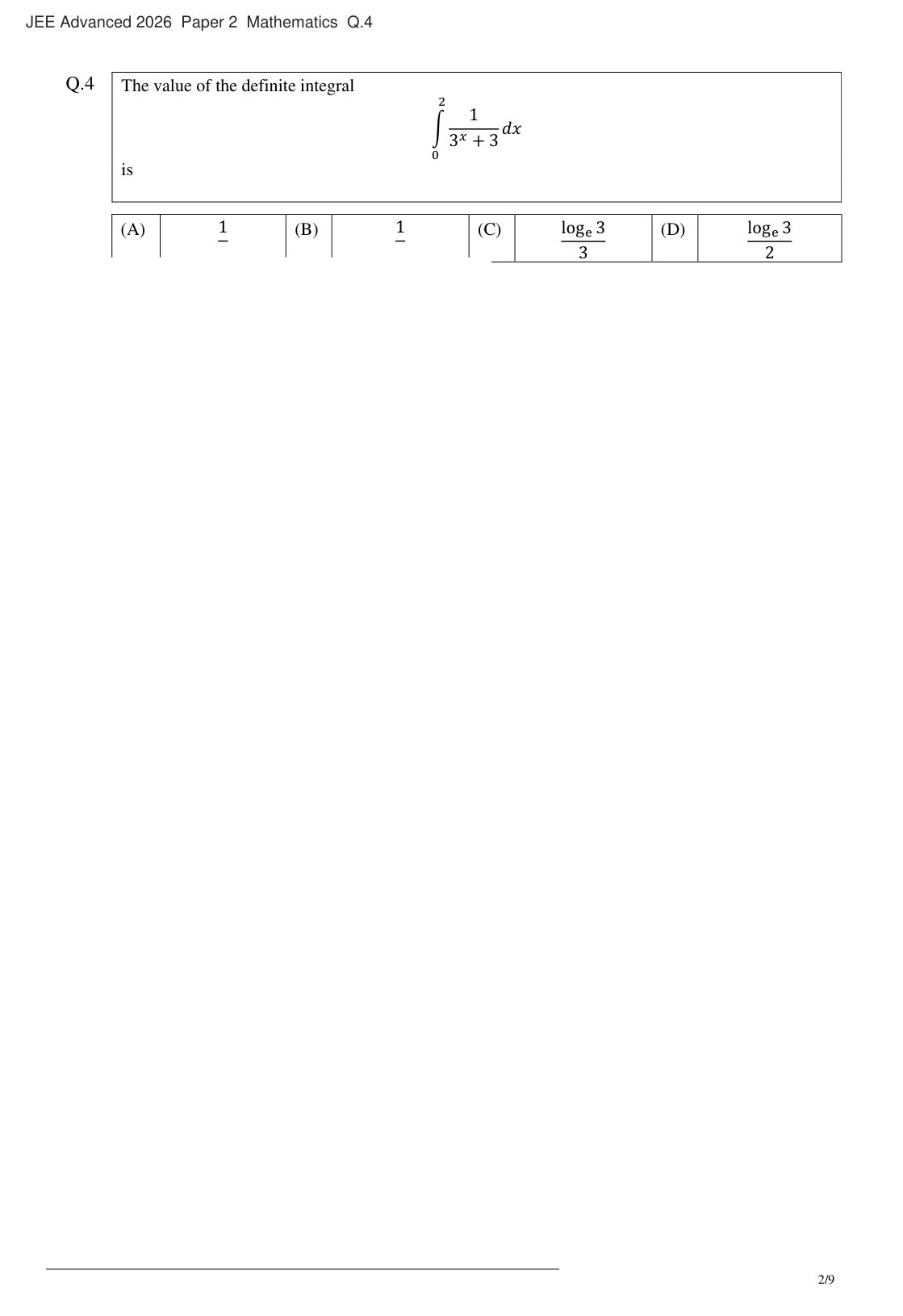
Question 4
The printed question, the official key, and each model’s JSON answer plus the reasoning it wrote.
Q04
Official B
Model answers
Claude Fable 5.1
Anthropic
A
Plus 3 restored: written value was 1/3.
Claude Fable 5.1 reasoning
I need to compute ∫₀² 1/(3^x+3) dx by rewriting the integrand as (1/3)(1 - 3^x/(3^x+3)), turning it into 2 minus a logarithmic term. This gives I = (1/3)[2 - (1/ln3)ln(12/4)], simplifying the ratio (3²+3)/(3⁰+3). Since ln(12/4) = ln3, the log term divided by ln3 equals exactly 1, so I = (1/3)(2-1) = 1/3. Without seeing the exact answer choices clearly, I'll go with the option matching 1/3. We have 1/(3^x+3) = (1/3)·[1 − 3^x/(3^x+3)], so ∫₀² dx/(3^x+3) = (1/3)[2 − (1/ln 3)·ln((9+3)/(1+3))] = (1/3)[2 − ln 3/ln 3] = 1/3. The value is 1/3, which matches option (A).
GPT 6 Astra
OpenAI
A
Raw minus 1 stands: letter A with no written 1/3.
GPT 6 Astra reasoning
No written reasoning was returned for this item.
GPT 5.5
OpenAI
A
Raw minus 1 stands: letter A with no written 1/3.
GPT 5.5 reasoning
No written reasoning was returned for this item.
Claude Sonnet 5
Anthropic
A
Plus 3 restored: written value was 1/3.
Claude Sonnet 5 reasoning
For this integral I'll try the substitution x → 2-x trick, adding f(x) and f(2-x) together to simplify. Working out f(2-x), I find it simplifies to 3^x/(3+3^x), which pairs nicely with f(x). Adding these gives f(x)+f(2-x) = 1/3 for all x, so 2I equals the integral of 1/3 over [0,2], giving 2I = 2/3, meaning I = 1/3. That matches answer choice A.