
2026 · Paper 2 · Mathematics
Question 11
The printed question, the official key, and each model’s JSON answer plus the reasoning it wrote.
Q11
Official 99 – 101
Model answers
Claude Fable 5.1
Anthropic
100
Claude Fable 5.1 reasoning
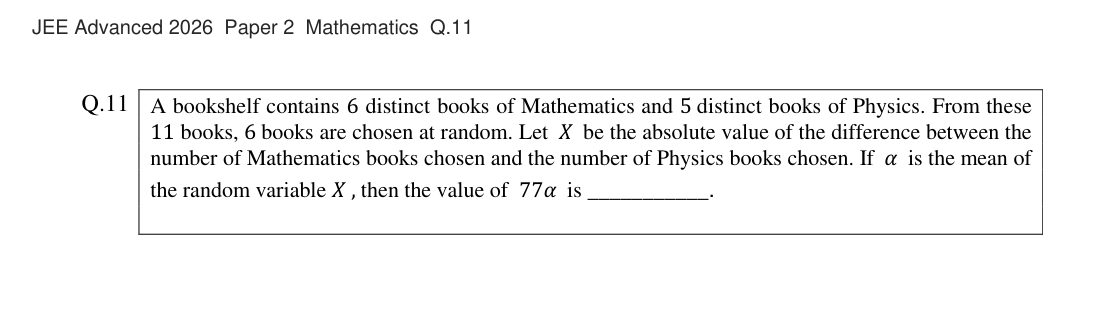
Choose 6 from 11 (6 Math, 5 Physics). Let m = number of Math books, p = 6 − m, with m from 1 to 6. X = |m − p| = |2m − 6|. Total ways: C(11,6) = 462. - m=1: C(6,1)C(5,5)=6, X=4 - m=2: C(6,2)C(5,4)=15·5=75, X=2 - m=3: C(6,3)C(5,3)=20·10=200, X=0 - m=4: C(6,4)C(5,2)=15·10=150, X=2 - m=5: C(6,5)C(5,1)=6·5=30, X=4 - m=6: C(6,6)C(5,0)=1, X=6 Sum of X·count = 6·4 + 75·2 + 0 + 150·2 + 30·4 + 1·6 = 24 + 150 + 300 + 120 + 6 = 600. α = 600/462 = 100/77, so 77α = 100.
GPT 6 Astra
OpenAI
100
GPT 6 Astra reasoning
**Solving the total weight problem** I need to parse the data for a straightforward solution that involves choosing 6 from the total of 462. I'll calculate the weights for each category: m1 to m6, using weights like C6m and C5,6 minus the differences. My total will include the proper numerical calculations to ensure accuracy. After that, I'll format everything into a safe JSON structure that meets the user's request. So, let's make sure the final result aligns perfectly and includes only the necessary information in the JSON format.
GPT 5.5
OpenAI
100
GPT 5.5 reasoning
**Computing final JSON** I need to focus on solving this math problem. It involves selecting books and calculating the absolute difference in chosen numbers. My ultimate goal is to get a final JSON response with a computed value of 100. I’ve worked through the calculations based on varying values of k, and I’ve confirmed that all combinations are equally likely. Now, I’ll make sure the final output is strictly in JSON format and only the resulting number. I'll avoid any distractions in the response.
Claude Sonnet 5
Anthropic
100
Claude Sonnet 5 reasoning
With 6 Math and 5 Physics totaling 11 students choosing 6, I'm setting m as the number of math students selected, ranging from 1 to 6, and defining X as |2m-6| to measure the imbalance. I'm now computing the count C(6,m)*C(5,6-m) for each value of m against the total C(11,6)=462. These counts (6,75,200,150,30,1) sum correctly to 462, giving weighted sum 600, so E[X] = 600/462 = 100/77, meaning alpha times 77 equals 100. **Solution:** With 6 Math (M) and 5 Physics (P) books, choosing 6 books total, let m = number of Math books chosen. Since m ranges from max(0,6-5)=1 to min(6,6)=6, we have p = 6-m Physics books, and X = |2m-6|. Computing probabilities (denominator C(11,6)=462): - m=1: C(6,1)C(5,5)=6, X=4 - m=2: C(6,2)C(5,4)=75, X=2 - m=3: C(6,3)C(5,3)=200, X=0 - m=4: C(6,4)C(5,2)=150, X=2 - m=5: C(6,5)C(5,1)=30, X=4 - m=6: C(6,6)C(5,0)=1, X=6 Sum of counts = 462 ✓ E[X] = [6(4)+75(2)+200(0)+150(2)+30(4)+1(6)]/462 = [24+150+0+300+120+6]/462 = 600/462 = 100/77 So α = 100/77, and 77α = 100. ```json