
2026 · Paper 2 · Mathematics
Question 10
The printed question, the official key, and each model’s JSON answer plus the reasoning it wrote.
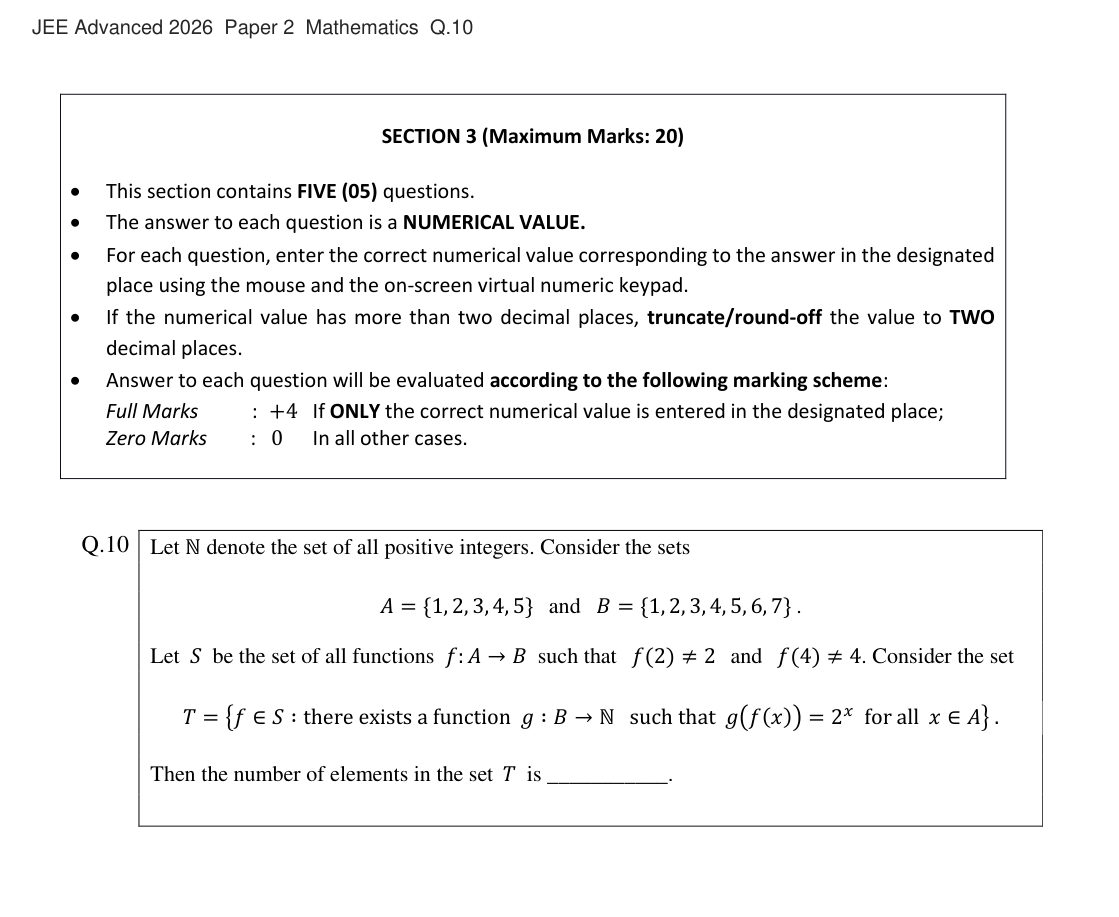
Q10
Official 1860
Model answers
Claude Fable 5.1
Anthropic
1860
Claude Fable 5.1 reasoning
I realize since 2^x values are all distinct, g(f(x))=2^x forces f to be injective, and any injective f works by defining g appropriately. So I need to count injective functions from a 5-element set to a 7-element set with the constraints f(2)≠2 and f(4)≠4, starting from the total count of 7·6·5·4·3 = 2520. Using inclusion-exclusion: fixing f(2)=2 gives 6·5·4·3=360, same for f(4)=4, and fixing both gives 5·4·3=60. So the answer is 2520 − 720 + 60 = 1860. **Key observation:** Since the values $2^x$ for $x\in A$ are all distinct, the condition $g(f(x)) = 2^x$ forces $f$ to be injective (if $f(x_1)=f(x_2)$ with $x_1\ne x_2$, then $2^{x_1}=2^{x_2}$, contradiction). Conversely, if $f$ is injective, define $g(f(x)) = 2^x$ and $g$ arbitrarily elsewhere. So $T$ = set of injective $f:A\to B$ with $f(2)\neq 2,\ f(4)\neq 4$. - Total injective maps: $7\cdot6\cdot5\cdot4\cdot3 = 2520$ - With $f(2)=2$: $6\cdot5\cdot4\cdot3 = 360$; with $f(4)=4$: $360$ - Both: $5\cdot4\cdot3 = 60$ By inclusion–exclusion: $2520 - 360 - 360 + 60 = 1860$.
GPT 6 Astra
OpenAI
1860
GPT 6 Astra reasoning
No written reasoning was returned for this item.
GPT 5.5
OpenAI
1860
GPT 5.5 reasoning
No written reasoning was returned for this item.
Claude Sonnet 5
Anthropic
1860
Claude Sonnet 5 reasoning
For g to exist, f must be injective, since g(f(x))=2^x forces distinct inputs to map to distinct f-values. So T consists of injective functions A→B avoiding f(2)=2 and f(4)=4, and I need to count these, starting with the total injective count P(7,5)=7·6·5·4·3. That gives 2520 total injective functions. Using inclusion-exclusion: fixing f(2)=2 leaves 360 ways for the rest, same for f(4)=4, and fixing both gives 60. So the answer is 2520 - 360 - 360 + 60 = 1860. **Reasoning:** For $g\circ f(x)=2^x$ to be well-defined as a function of $x$, whenever $f(x_1)=f(x_2)$ we'd need $2^{x_1}=2^{x_2}$, forcing $x_1=x_2$. So $f$ must be **injective**, and conversely any injective $f$ allows defining $g$ appropriately (assign $g(f(x))=2^x$ on the image, and arbitrary values elsewhere in $B$). So $T$ = injective functions $f:A\to B$ with $f(2)\neq 2$, $f(4)\neq 4$. Total injective functions $A\to B$: $P(7,5)=7\cdot6\cdot5\cdot4\cdot3=2520$. Let $X$: injective with $f(2)=2$. Fixing $f(2)=2$, remaining 4 elements map injectively into remaining 6 values: $P(6,4)=360$. Let $Y$: injective with $f(4)=4$: similarly $360$. $X\cap Y$: $f(2)=2, f(4)=4$ fixed, remaining 3 elements into remaining 5 values: $P(5,3)=60$. By inclusion-exclusion: $$|T| = 2520 - 360 - 360 + 60 = 1860.$$ ```json