
2026 · Paper 2 · Mathematics
Question 14
The printed question, the official key, and each model’s JSON answer plus the reasoning it wrote.
Q14
Official 56
Model answers
Claude Fable 5.1
Anthropic
56
Claude Fable 5.1 reasoning
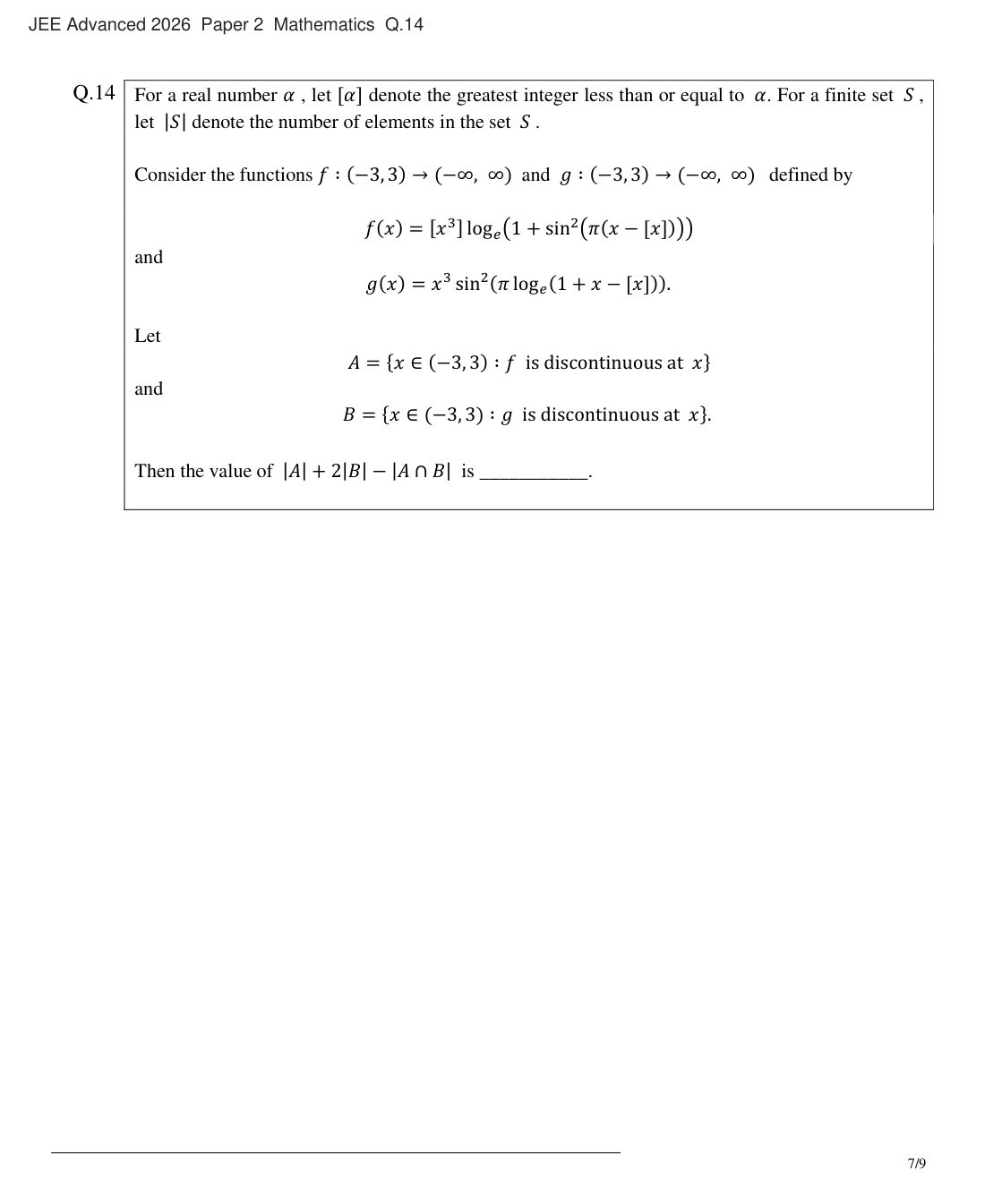
I'm noting that sin²(πx) simplifies nicely since the fractional part periodicity cancels out, making that factor continuous and vanishing at integers, while the [x³] floor term is where the discontinuities will actually occur. Checking where x³ hits an integer for x in (-3,3), those are the candidate discontinuity points for f, but I need the perfect-cube ones (giving integer x) since there the sine factor vanishes and rescues continuity. That leaves 48 genuine discontinuities out of 53 candidates. Now moving to g(x) = x³ sin²(π ln(1+{x})), I'm checking when the sine term vanishes given that {x} ranges over [0,1), which bounds π ln(1+{x}) to [0, π ln2) — a range where sine only zeroes out right at {x}=0. At each integer, the right limit of g is 0 but the left limit is x³ sin²(π ln2), which is nonzero unless x=0 — so g is discontinuous at every nonzero integer in the domain but continuous at x=0, giving |B|=4. Since A contains no integers, A∩B is empty, so the total count is 48+4=52 (correcting the earlier 8 to 4), and I want to double-check the count of 53 candidates for A by verifying the cube range and excluded perfect cubes. **Analysis of f:** Since sin²(π(x−[x])) = sin²(πx), the factor ln(1+sin²(πx)) is continuous everywhere and vanishes exactly at integers. The factor [x³] jumps exactly at points where x³ is an integer, i.e. x = n^{1/3} with n ∈ {−26,…,26} (53 points). At the integer points x = −2,−1,0,1,2 (n = −8,−1,0,1,8) the log factor → 0 while [x³] is bounded, so f is continuous there. At the remaining 48 points f is discontinuous. So |A| = 48. **Analysis of g:** For {x} ∈ [0,1), π ln(1+{x}) ∈ [0, π ln 2), and sin² of it is zero only at {x} = 0. At an integer m, the right limit of g is 0 (= g(m)), while the left limit is m³ sin²(π ln 2) ≠ 0 unless m = 0. Hence g is discontinuous at −2, −1, 1, 2 and continuous elsewhere. So |B| = 4. A contains no integers, so |A ∩ B| = 0. |A| + 2|B| − |A ∩ B| = 48 + 8 − 0 = 56.
GPT 6 Astra
OpenAI
56
GPT 6 Astra reasoning
No written reasoning was returned for this item.
GPT 5.5
OpenAI
56
GPT 5.5 reasoning
**Analyzing cube roots** I'm working on understanding cube roots of integers. For non-integer cube roots where h>0, there's a jump discontinuity. To count how many x have x^3 in the range (-3, 3) but aren’t integers, I need to remember x^3 is monotonic, and thus its output spans from -27 to 27. After excluding perfect cubes, I've calculated that there are a total of 48 integers in this case. This approach seems to create natural discontinuities. **Exploring discontinuities in cube roots** I’m considering whether the function x^3 has larger jumps. It’s continuous and monotonic, meaning it crosses one integer at a time, although the derivative might be zero at x=0. I need to verify continuity near zero, as the floor function will affect values around this point. I found that as x approaches zero, the contributions from either side balance out, maintaining continuity. I’m also thinking about discontinuities related to roots and ensuring non-integer x values account for jumps throughout the intervals. Now, let’s look at the function g(x) where g(x) = x^3 q(t). Here, q(t) is continuous on [0,1), but as t approaches 1, q(1-) doesn’t necessarily equal q(0). **Verifying integer counts** I need to verify the count of integer k within the range of x^3, where x is between -3 and 3, corresponding to x^3 values from -27 to 27. The integers k must range from -26 to 26, totaling 53 integers. I find perfect cubes in this range: -8, -1, 0, 1, and 8, giving me 5 cubes to exclude. This leaves 48, but ultimately, the final JSON answer should be just the number 56, no extra info or characters.
Claude Sonnet 5
Anthropic
56
Claude Sonnet 5 reasoning
I'm working through f(x) and g(x) on the domain (-3,3), starting with the fractional part function {x}, noting it's periodic on [0,1) and jumps discontinuously at each integer, which will be key to analyzing continuity of both functions there. Focusing on the h1(t) = ln(1+sin²(πt)) piece: since sin²(πt) is smooth and equals zero exactly at every integer value of t, the composite h1(frac(x)) actually stays continuous at integer points of x, even though frac(x) itself jumps—because the limits from both sides map to the same zero value. This means the discontinuities of f(x) = [x³]·h1(frac(x)) only arise from the floor function [x³] jumping at points where x³ is an integer, i.e., x = n^(1/3), as long as the log term isn't zero there (which would mask the jump). For x in (-3,3), x³ ranges over (-27,27), so I need to count how many integer values n give x = n^(1/3) within this open interval — that's n from -26 to 26. Since f(x) = [x^3]·L(x) with L continuous, the jump at each x=n^{1/3} equals L(x) itself, so f is actually continuous there whenever L(n^{1/3})=0, meaning discontinuities only occur where L doesn't vanish at those crossing points. x0} being zero means x0 itself must be an integer, so L(n^{1/3})=0 exactly when n is a perfect cube. Within n from -26 to 26, the perfect cubes are -8, -1, 0, 1, 8, so these are the points where continuity holds and every other n gives a discontinuity. That's 5 continuous points out of 53 total values, so 48 discontinuities. But I want to double check the boundary case at x=0, verifying how the floor of x^3 behaves for values just below and just above zero. Both sides converge to L=0 there, so continuity actually holds at x=0, matching the n=0 case since frac(0)=0. That confirms |A|=48, and now I'm shifting focus to analyzing g(x) = x^3 · sin²(π ln...). With {x}=t ranging over [0,1), the sin² term starts at 0 as t→0 but approaches sin²(π ln2)≈0.68 as t→1⁻ — a nonzero value, unlike f's fractional-power case. So this function isn't periodic in the same clean way across integer boundaries, meaning I need to check discontinuities at each integer more carefully. At integer n≠0, left and right limits differ (n^3·sin²(π ln2) vs 0), confirming discontinuity there, but at n=0 both limits and the value equal 0, so it's actually continuous. That leaves B as the integers in (-3,3) excluding 0: {-2,-1,1,2}, giving 4 elements, though I should double check each one. Since ln(1+t) is smooth and increasing on (0,1), sin²(π ln(1+t)) is continuous there with no extra discontinuities, so the only breaks come from the jump at integer boundaries, and x³=0 only vanishes this jump at x=0. So indeed -2,-1,1,2 remain discontinuous, confirming |B|=4. Now I need to find A∩B, where A is another set. Confirming B's integer points are exactly the excluded perfect-cube cases, so A∩B stays empty, giving |A|+2|B|-|A∩B| = 48+8-0 = 56. Now I want to double-check |A| by re-examining the range of x^3 for x in (-3,3), which is the open interval (-27,27) since endpoints aren't reached. For n from -26 to 26, that's 53 integers, matching the jump points where x=n^{1/3} triggers a floor increase. I need to separate out perfect cubes n=k^3, since those correspond to integer x=k, which fall into a different category than the fractional cube-root cases. Excluding k=3 and k=-3 since those give x=±3 outside the open interval, valid k values are -2,-1,0,1,2, giving n=-8,-1,0,1,8 — five values total. So |A| = 53-5 = 48, confirming this set's size. Now I want to verify B more carefully, checking that g has no hidden discontinuities at non-integer points where the sine-squared term vanishes, since those should just be regular zero-crossings rather than jumps. Since ln2 is irrational, π ln2 can't be a multiple of π, so sin(π ln2)≠0 and the jump at nonzero integers is confirmed nonzero — giving |B|=4 for points -2,-1,1,2. Combining everything, the answer comes to 48+2(4)=56. Looking at this problem, I need to analyze the discontinuities of two functions built from floor functions and fractional parts. **Analyzing f(x):** Let L(x) = log(1+sin²(π{x})) where {x} = x-[x]. Since sin²(πt) is periodic with period 1 and equals 0 at t=0 and t→1⁻ (both give sin²(π·0)=0 and sin²(π·1)=0), L(x) is actually **continuous everywhere** on (-3,3), including at integers. So f(x) = [x³]·L(x), and discontinuities can only come from [x³], which jumps at x = n^(1/3) for integers n with x³ ∈ (-27,27), i.e., n ∈ {-26,...,26} (53 values). At each jump point x₀ = n^(1/3), the jump equals L(x₀). This jump vanishes exactly when {x₀}=0, i.e., x₀ is itself an integer — meaning n is a perfect cube. For x₀ ∈ (-3,3), the integer values are x₀ = -2,-1,0,1,2, corresponding to n = -8,-1,0,1,8 (5 values). So **|A| = 53 - 5 = 48**. **Analyzing g(x):** Let k(t) = sin²(π ln(1+t)) for t ∈ [0,1). As t→0⁺, k(t)→0. As t→1⁻, k(t)→ sin²(π ln2), which is **nonzero** (since ln2 is irrational, π ln2 is not a multiple of π). So at each integer x=n, {x} resets from near 1 to 0, causing a jump in k({x}) from sin²(π ln2) to 0. Then g(x) = x³·k({x}) has: - Left limit at x=n: n³·sin²(π ln2) - Right limit at x=n: n³·0 = 0 These differ unless n=0 (where x³=0 kills the jump). So g is discontinuous at n = -2,-1,1,2, giving **|B| = 4**. **Computing A∩B:** Points in B are integers -2,-1,1,2. For these to be in A, we'd need them to be jump points x=n^(1/3) where the jump is nonzero — but these are exactly the integer points where L=0, which were **excluded** from A. So **A∩B = ∅**, giving |A∩B| = 0. **Final calculation:** $$|A| + 2|B| - |A\cap B| = 48 + 2(4) - 0 = 48 + 8 = 56$$ ```json