
2026 · Paper 2 · Mathematics
Question 15
The printed question, the official key, and each model’s JSON answer plus the reasoning it wrote.
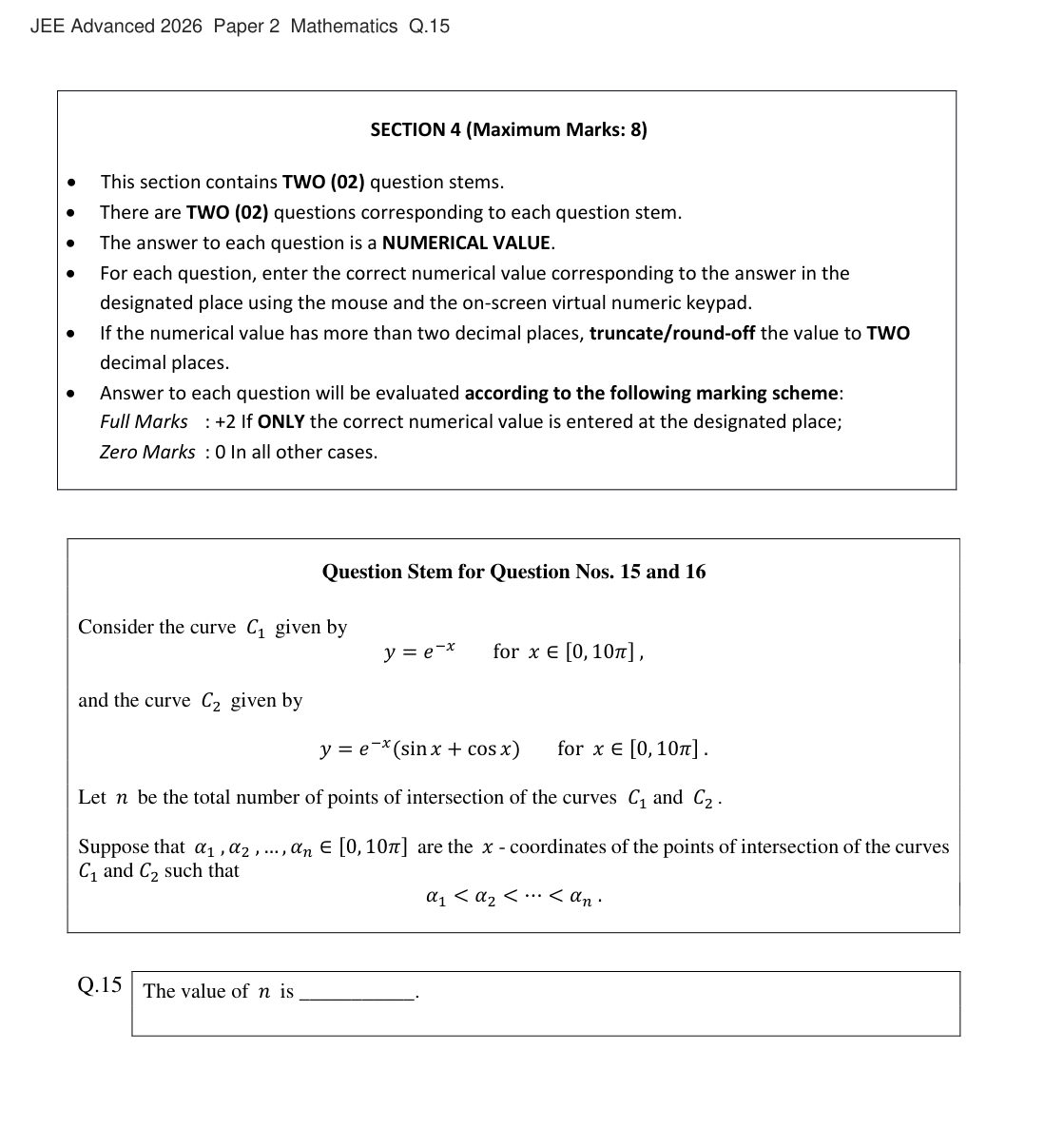
Q15
Official 11
Model answers
Claude Fable 5.1
Anthropic
11
Claude Fable 5.1 reasoning
Intersection requires sin x + cos x = 1, i.e., √2 sin(x + π/4) = 1, so sin(x + π/4) = 1/√2, giving x + π/4 = π/4 + 2kπ or 3π/4 + 2kπ, i.e., x = 2kπ or x = π/2 + 2kπ. In [0, 10π]: x = 0, 2π, 4π, 6π, 8π, 10π (6 points) and x = π/2, 5π/2, 9π/2, 13π/2, 17π/2 (5 points). Total n = 11.
GPT 6 Astra
OpenAI
11
GPT 6 Astra reasoning
**Calculating intersections for sine and cosine** I'm figuring out the intersection points for the equation sin(x) + cos(x) = 1 within the range from 0 to 10π. The families of solutions are defined as 2kπ for k from 0 to 5, which gives me six solutions. Then there's also pi/2 + 2kπ for k from 0 to 4, resulting in five more solutions, totaling eleven. I’ll present the final result in JSON format only, as requested.
GPT 5.5
OpenAI
11
GPT 5.5 reasoning
**Formulating final JSON** I need to solve the question from the image, focusing solely on providing the final JSON without explanation. For Q15, the intersections of curves \( C_1 \) and \( C_2 \) must be determined by solving \( e^{-x} = e^{-x}(\sin x + \cos x) \). After equating and analyzing, I've counted the distinct points in the range [0, 10π]. The total points calculated are 11. Therefore, the final answer in JSON format is: {"answer":11,"unanswered":false}. **Finalizing JSON** I need to confirm the final counts at the endpoints, specifically checking if both 0 and 10π are included. Yes, at \( x = 10π \), the equation \( \sin(0) + \cos(1) \) holds true. I already determined there are a total of 11 points, including these endpoints. To wrap it up, I will present the final answer in JSON format without any additional strings: {"answer":11,"unanswered":false}.
Claude Sonnet 5
Anthropic
11
Claude Sonnet 5 reasoning
This simplifies to sinx+cosx=1, which gives √2 sin(x+π/4)=1, so sin(x+π/4)=1/√2, yielding x=2kπ or x=π/2+2kπ. Now I need to count these solutions within [0,10π]. For x=2kπ: k=0..5 gives 6 values (0,2π,...,10π). For x=π/2+2kπ: k must satisfy 2kπ≤19π/2, so k=0..4, giving 5 values. Total count n=11. Looking at this problem, I need to find where $e^{-x} = e^{-x}(\sin x + \cos x)$ for $x \in [0, 10\pi]$. **Setting up the equation:** Since $e^{-x} \neq 0$ for all $x$, I can divide both sides: $$1 = \sin x + \cos x$$ **Solving the trigonometric equation:** Using the identity $\sin x + \cos x = \sqrt{2}\sin\left(x + \frac{\pi}{4}\right)$: $$\sqrt{2}\sin\left(x + \frac{\pi}{4}\right) = 1 \implies \sin\left(x + \frac{\pi}{4}\right) = \frac{1}{\sqrt{2}}$$ This gives: $$x + \frac{\pi}{4} = \frac{\pi}{4} + 2k\pi \quad \text{or} \quad x + \frac{\pi}{4} = \frac{3\pi}{4} + 2k\pi$$ So the solutions are: $$x = 2k\pi \quad \text{or} \quad x = \frac{\pi}{2} + 2k\pi$$ **Finding solutions in $[0, 10\pi]$:** **Case 1:** $x = 2k\pi$ Need $0 \le 2k\pi \le 10\pi \implies 0 \le k \le 5$ This gives $k = 0,1,2,3,4,5$: solutions $x = 0, 2\pi, 4\pi, 6\pi, 8\pi, 10\pi$ — **6 solutions** **Case 2:** $x = \frac{\pi}{2} + 2k\pi$ Need $0 \le \frac{\pi}{2} + 2k\pi \le 10\pi \implies -\frac{1}{4} \le k \le \frac{19}{4} = 4.75$ This gives $k = 0,1,2,3,4$: solutions $x = \frac{\pi}{2}, \frac{5\pi}{2}, \frac{9\pi}{2}, \frac{13\pi}{2}, \frac{17\pi}{2}$ — **5 solutions** **Checking for overlap:** The two families $2k\pi$ and $\frac{\pi}{2}+2k\pi$ never coincide since they differ by $\frac{\pi}{2}$ (mod $2\pi$). **Total count:** $$n = 6 + 5 = 11$$ ```json