
2026 · Paper 2 · Mathematics
Question 16
The printed question, the official key, and each model’s JSON answer plus the reasoning it wrote.
Q16
Official 2.4 – 2.6
Model answers
Claude Fable 5.1
Anthropic
2.5
Claude Fable 5.1 reasoning
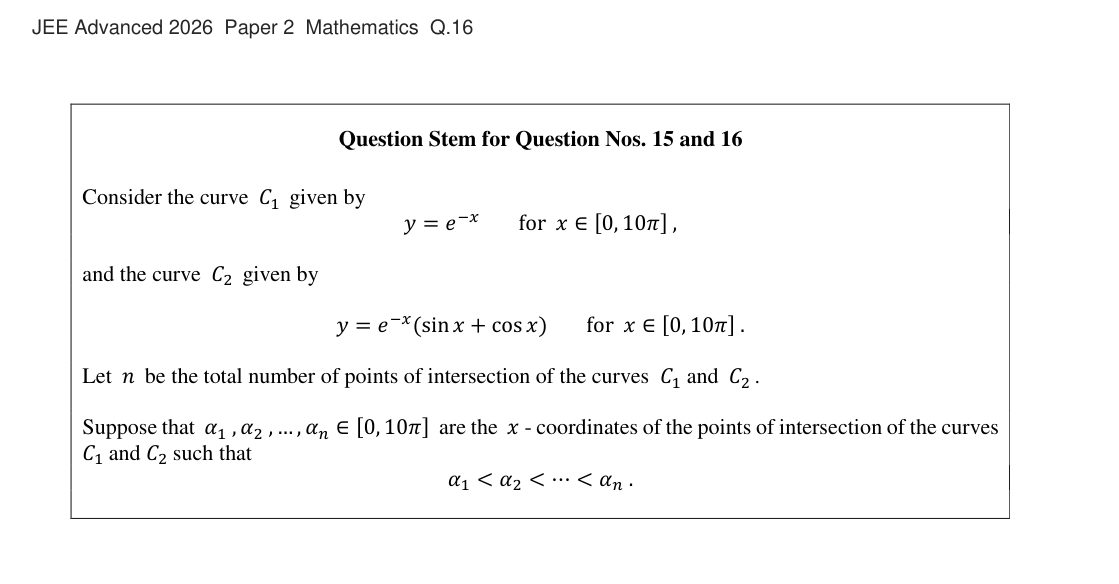
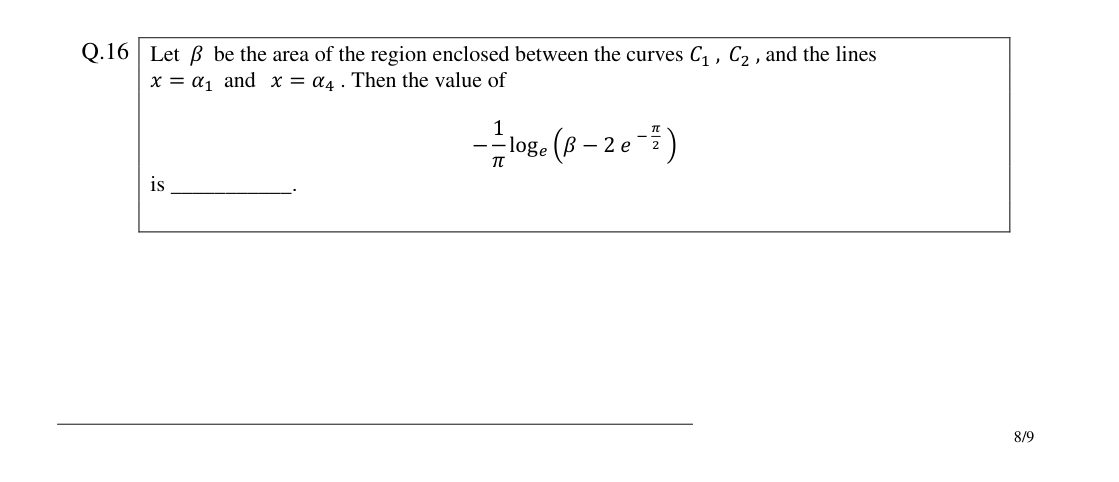
Setting the two expressions equal, I get sin x + cos x = 1, which simplifies to sin(x+π/4) = 1/√2, giving solutions x = 2kπ or x = π/2 + 2kπ. Now I'm listing which of these fall within [0, 10π]. For the intersection points I identify α1=0, α2=π/2, α3=2π, α4=5π/2, and I set up the integral for the enclosed area using |sin x + cos x - 1| weighted by e^{-x}, checking the sign of that expression on each subinterval. I find that the antiderivative of e^{-x}(sin x + cos x - 1) works out neatly to e^{-x}(1 - cos x), which I'll use to evaluate the area piece by piece. Adding up the three segments gives β = 2e^{-π/2} + e^{-5π/2}, so β - 2e^{-π/2} = e^{-5π/2}, meaning -1/π · log of that ratio equals 2.5. **Intersections:** $e^{-x}=e^{-x}(\sin x+\cos x)\Rightarrow \sin x+\cos x=1\Rightarrow x=2k\pi$ or $x=\tfrac{\pi}{2}+2k\pi$. In $[0,10\pi]$: $\alpha_1=0,\ \alpha_2=\tfrac{\pi}{2},\ \alpha_3=2\pi,\ \alpha_4=\tfrac{5\pi}{2}$ (total $n=11$). **Area:** $\beta=\int_0^{5\pi/2} e^{-x}\,|\sin x+\cos x-1|\,dx$. Antiderivative: $\int e^{-x}(\sin x+\cos x-1)\,dx = e^{-x}(1-\cos x)=F(x)$. - $[0,\tfrac{\pi}{2}]$: $F(\tfrac{\pi}{2})-F(0)=e^{-\pi/2}$ - $[\tfrac{\pi}{2},2\pi]$ (integrand negative): $-(F(2\pi)-F(\tfrac{\pi}{2}))=e^{-\pi/2}$ - $[2\pi,\tfrac{5\pi}{2}]$: $F(\tfrac{5\pi}{2})-F(2\pi)=e^{-5\pi/2}$ So $\beta=2e^{-\pi/2}+e^{-5\pi/2}$, hence $\beta-2e^{-\pi/2}=e^{-5\pi/2}$ and $$-\frac{1}{\pi}\log_e\left(e^{-5\pi/2}\right)=\frac{5}{2}=2.5$$
GPT 6 Astra
OpenAI
2.5
GPT 6 Astra reasoning
**Solving the equation** I need to solve for where sin and cos equal 1, which happens at roots like 0, pi/2, 2pi, and 5pi/2. I differentiate g, which is e^-x(sin + cos - 1). The anti-derivative F is e^-x(1 - cos x) since its derivative checks out as e^-x[-1 + cos + sin]. Evaluating F at each point shows specific values, particularly that beta equals 2e^-pi/2 + e^-5pi/2. The final expression reduces to 2.5. Now, I should just provide the final answer in JSON format as requested. ```json 2.5 ```
GPT 5.5
OpenAI
2.5
GPT 5.5 reasoning
**Solving math problem** I need to solve a math problem involving the curves C1: y=e^{-x} and C2: y=e^{-x}(sin x + cos x) over the interval [0,10π]. The intersections happen when sin x + cos x = 1. I need to identify the first four intersection x-coordinates, labeled α1 to α4. Then I’ll compute the area β enclosed between the curves C1 and C2 and the vertical lines at x=α1 and x=α4, which will lead to the final expression for the area. **Calculating intersection points** I’m working through the equation √2 sin(x+π/4) = 1, which simplifies to sin(x+π/4) = 1/√2. This gives me general solutions of x+π/4 = π/4 + 2kπ or 3π/4 + 2kπ. From this, I derive specific values of x in the interval [0, 10π]. I find the total of 11 solutions: 0, π/2, 2π, 5π/2, 4π, and so on, ultimately needing to calculate the area between the curves from x=0 to x=5π/2. **Evaluating integrals for signs** I'm working through an equation where I need to determine signs across intervals. Letting f equal \(1 - \sin x - \cos x\), I find that at \(x = 0\), \(f = 0\) and approach \(f\) for small \(x\). Given approximations, I calculate where \(f\) changes signs, specifically between \(0\) to \(2\pi\). I also need to compute an integral, noted as β, and simplify my approach with the antiderivative. There’s much to untangle here, but I’m progressing! **Computing integrals** I’m working through some integrals now. The basic integral \(\int e^{-x} dx\) gives me \(-e^{-x}\). For \(\int e^{-x} \sin x dx\), I need to check if the formula \(\frac{e^{-x}(-\sin x - \cos x)}{2}\) is correct. Deriving it feels right, as I get back to \(\sin x\). Moving to cosine, I find \(\int e^{-x} \cos x dx\) yields \(\frac{e^{-x}(\sin x - \cos x)}{2}\) too, confirming my process. It’s nice to verify these! **Considering enclosed area** I need to ensure the region I’m talking about is correctly enclosed between the curves and the lines at x=α1 and x=α4. It’s possible this doesn't cover the entire interval. I’m thinking about how to define the area of the region enclosed by curves C1 and C2 along with these vertical lines. I wonder if this could be interpreted as the area of a union, particularly when their paths cross inside. **Examining the JSON output** I need to provide just a JSON output for the final answer. It has to be a single number, like 2.5 instead of 5/2. I also need to make sure there are no hidden traps in this problem, considering it's related to "JEE Advanced 2026." Let’s check the intersection points and areas enclosed between the curves. I’ll double-check the ordered solutions within the range [0,10π] to ensure accuracy. Alright, let’s get this right! **Checking integrals and areas** I'm thinking about checking sign intervals systematically using the function g=sin+cos-1. In the first quadrant, g is positive, which suggests C2 is higher. I’m evaluating the area using the integral of e^{-x}g and figuring out the antiderivative. It looks like the evaluations may need adjustments if I'm misinterpreting the area enclosed by curves. There's something confusing about whether the total area is properly defined by the curves involved. Let's clarify that before concluding! **Finalizing the integral** I'm considering how to compute the integral from 0 to 5π/2. It looks like using absolute values might not apply here since I can't have a signed area, especially regarding C1. So, I need to confirm the area calculation is correct. Now, I think I'm at the stage where I just need to finalize the JSON. Let's make sure everything is structured properly in the output!
Claude Sonnet 5
Anthropic
2.5
Claude Sonnet 5 reasoning
I need to find where the two curves intersect, so I set e^{-x} equal to e^{-x}(sin x + cos x), which simplifies to sin x + cos x = 1. Rewriting this as √2 sin(x + π/4) = 1 gives sin(x + π/4) = 1/√2, so I'm solving for the values of x satisfying this. This yields x = 2kπ or x = π/2 + 2kπ, and checking these within [0, 10π], I count 6 values from the first family (0, 2π, ..., 10π) and 5 values from the second (π/2, 5π/2, ..., 17π/2), giving n = 11 total intersections, with the first four being α1=0, α2=π/2, α3=2π, α4=5π/2. Now for the area between the curves from α1 to α4, I'm checking the sign of sin x + cos x - 1 on each subinterval: it's positive on [0, π/2], negative on [π/2, 2π], and positive again on [2π, 5π/2], so I set up the area as a sum of three integrals with appropriate signs. I find that e^{-x}(sin x + cos x) has antiderivative -e^{-x}cos x, and e^{-x} has antiderivative -e^{-x}, so the difference C2-C1 integrates to F(x) = e^{-x}(1-cos x). Using this, the first piece evaluates to e^{-π/2}, and I'm now computing F(π/2)-F(2π) for the second piece. Since cos(5π/2)=0, F(5π/2)=e^{-5π/2}, giving the third piece also e^{-π/2}+e^{-5π/2} combined appropriately, so summing all three pieces gives β = 2e^{-π/2} + e^{-5π/2}. This means β - 2e^{-π/2} = e^{-5π/2}, and taking -1/π times the natural log of that yields 5/2, so the answer is 2.5. Looking at this problem, I need to find intersection points, then compute the area for Q.16. ## Setting Up Intersections Setting C1 = C2: e^{-x} = e^{-x}(sin x + cos x), giving **sin x + cos x = 1**. This simplifies to √2 sin(x + π/4) = 1, so sin(x + π/4) = 1/√2. This gives x + π/4 = π/4 + 2kπ or x + π/4 = 3π/4 + 2kπ, meaning: - x = 2kπ (k = 0,1,2,3,4,5) → x = 0, 2π, 4π, 6π, 8π, 10π - x = π/2 + 2kπ (k = 0,1,2,3,4) → x = π/2, 5π/2, 9π/2, 13π/2, 17π/2 **Ordering the roots**: α₁ = 0, α₂ = π/2, α₃ = 2π, α₄ = 5π/2 ## Computing the Area β I need β = area between C1, C2 from x = α₁ = 0 to x = α₄ = 5π/2. **Finding antiderivative of (C2 - C1):** Since d/dx[-e^{-x}cos x] = e^{-x}cos x + e^{-x}sin x = e^{-x}(sin x + cos x), and ∫e^{-x}dx = -e^{-x}: $$F(x) = \int (C_2 - C_1)\,dx = e^{-x}(1 - \cos x)$$ **Checking sign of (C2 - C1) on subintervals:** - On [0, π/2]: at x=π/4, sin+cos = √2 > 1, so C2 ≥ C1 - On [π/2, 2π]: at x=π, sin+cos = -1 < 1, so C1 ≥ C2 - On [2π, 5π/2]: at x=2π+π/4, sin+cos = √2 > 1, so C2 ≥ C1 **Computing each piece using F(x):** $$\int_0^{\pi/2}(C_2-C_1)\,dx = F(\pi/2)-F(0) = e^{-\pi/2}(1-0) - e^0(1-1) = e^{-\pi/2}$$ $$\int_{\pi/2}^{2\pi}(C_1-C_2)\,dx = F(\pi/2)-F(2\pi) = e^{-\pi/2} - e^{-2\pi}(1-1) = e^{-\pi/2}$$ $$\int_{2\pi}^{5\pi/2}(C_2-C_1)\,dx = F(5\pi/2)-F(2\pi) = e^{-5\pi/2}(1-\cos(5\pi/2)) - 0 = e^{-5\pi/2}(1-0) = e^{-5\pi/2}$$ **Total area:** $$\beta = e^{-\pi/2} + e^{-\pi/2} + e^{-5\pi/2} = 2e^{-\pi/2} + e^{-5\pi/2}$$ ## Final Computation $$\beta - 2e^{-\pi/2} = e^{-5\pi/2}$$ $$-\frac{1}{\pi}\log_e\left(e^{-5\pi/2}\right) = -\frac{1}{\pi} \cdot \left(-\frac{5\pi}{2}\right) = \frac{5}{2}$$ ```json