
2026 · Paper 2 · Physics
Question 4
The printed question, the official key, and each model’s JSON answer plus the reasoning it wrote.
Q04
Official A
Model answers
Claude Fable 5.1
Anthropic
A
Claude Fable 5.1 reasoning
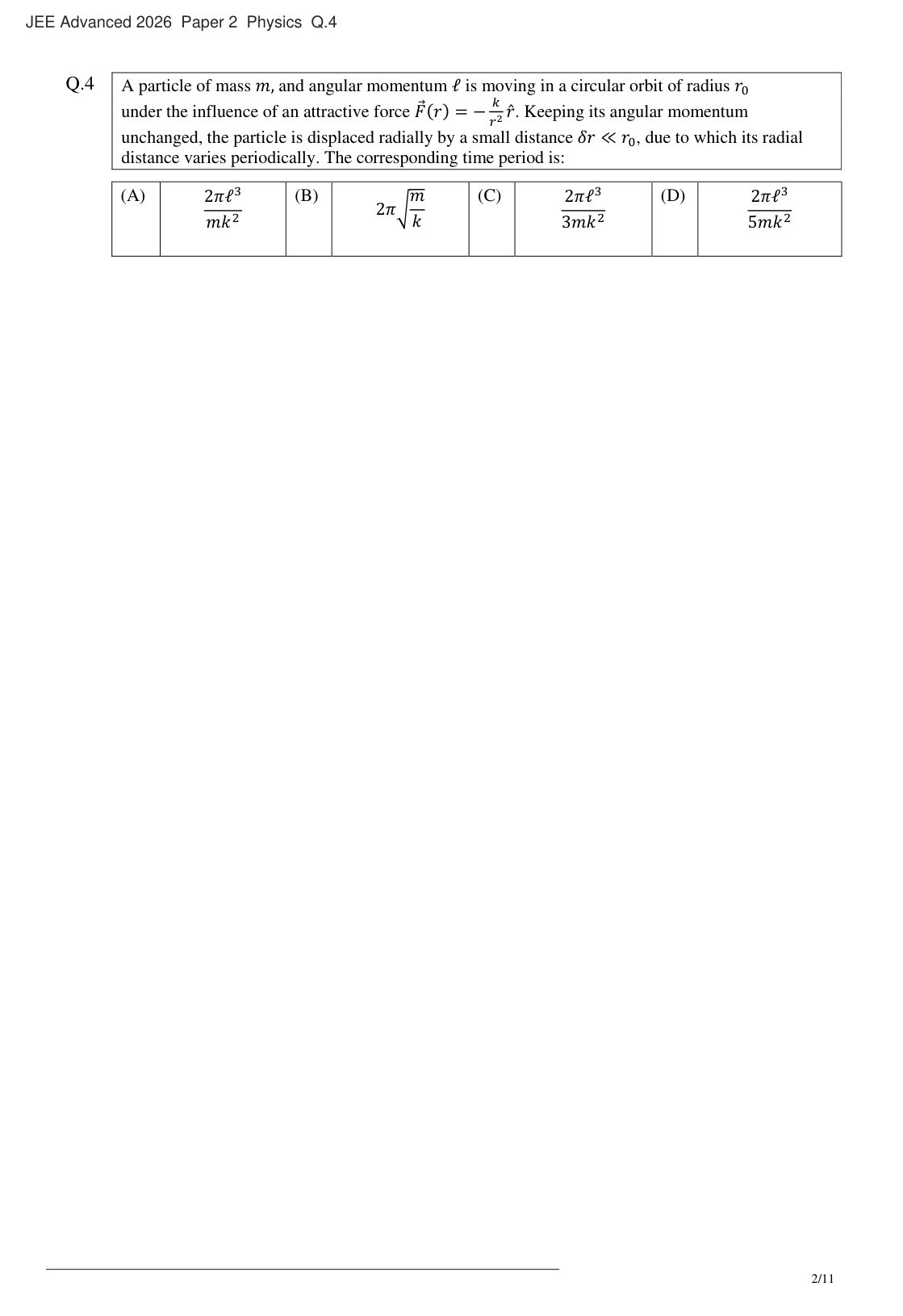
Effective potential: U_eff = -k/r + ℓ²/(2mr²). Circular orbit: k/r₀² = ℓ²/(mr₀³) → r₀ = ℓ²/(mk). U_eff'' = -2k/r₀³ + 3ℓ²/(mr₀⁴) = (1/r₀³)(-2k + 3k) = k/r₀³. ω = √(k/(m r₀³)) = √(k · m³k³/(m ℓ⁶)) = mk²/ℓ³. T = 2πℓ³/(mk²).
GPT 6 Astra
OpenAI
A
GPT 6 Astra reasoning
**Finalizing calculations** I want to solve something straightforward involving the inverse of r squared and effective potential. I have a fixed L and I know how to define r0 based on L. Also, I'm thinking about the formula for radial omega and the period T. It seems I need to concentrate on creating a final JSON object for the user and remember to present it simply without extra details. I'll aim to deliver just the JSON object as requested.
GPT 5.5
OpenAI
A
GPT 5.5 reasoning
No written reasoning was returned for this item.
Claude Sonnet 5
Anthropic
A
Claude Sonnet 5 reasoning
I'm setting up the effective potential for the orbit, finding the equilibrium radius r0 where the centrifugal and attractive forces balance, giving l² = mkr0. Now I need to find the small oscillation frequency by taking the second derivative of the effective potential at r0. Working through the algebra, the second derivative simplifies to k/r0³, giving ω² = k/(mr0³). Substituting r0 = l²/(mk), I get ω = mk²/l³, so the period is T = 2πl³/(mk²) — matching option A. Looking at this problem, I need to find the period of small radial oscillations for a particle in an attractive force field F(r) = -k/r². ## Setting Up the Effective Potential With angular momentum ℓ conserved, the effective potential governing radial motion is: $$V_{eff}(r) = \frac{\ell^2}{2mr^2} - \frac{k}{r}$$ The equation of motion for r is: $$m\ddot{r} = -\frac{dV_{eff}}{dr} = \frac{\ell^2}{mr^3} - \frac{k}{r^2}$$ ## Finding the Circular Orbit Radius For a stable circular orbit at r₀, the net radial force is zero: $$\frac{\ell^2}{mr_0^3} = \frac{k}{r_0^2}$$ This gives: $$\ell^2 = mkr_0 \quad \Rightarrow \quad r_0 = \frac{\ell^2}{mk}$$ ## Small Oscillations Analysis For small displacements δr from r₀, I expand the effective potential to second order. The effective "spring constant" is: $$\left.\frac{d^2 V_{eff}}{dr^2}\right|_{r_0} = \frac{3\ell^2}{mr_0^4} - \frac{2k}{r_0^3}$$ Using the equilibrium condition ℓ²/(mr₀³) = k/r₀², I can write: $$\frac{\ell^2}{mr_0^4} = \frac{k}{r_0^3}$$ Substituting this in: $$\left.\frac{d^2 V_{eff}}{dr^2}\right|_{r_0} = 3\cdot\frac{k}{r_0^3} - \frac{2k}{r_0^3} = \frac{k}{r_0^3}$$ ## Angular Frequency of Oscillation The angular frequency of small oscillations satisfies: $$\omega^2 = \frac{1}{m}\left.\frac{d^2V_{eff}}{dr^2}\right|_{r_0} = \frac{k}{mr_0^3}$$ Substituting $r_0 = \ell^2/(mk)$: $$r_0^3 = \frac{\ell^6}{m^3k^3}$$ $$\omega^2 = \frac{k}{m}\cdot\frac{m^3k^3}{\ell^6} = \frac{m^2k^4}{\ell^6}$$ $$\omega = \frac{mk^2}{\ell^3}$$ ## Time Period $$T = \frac{2\pi}{\omega} = \frac{2\pi \ell^3}{mk^2}$$ This matches option **(A)**. ```json