
2026 · Paper 2 · Physics
Question 5
The printed question, the official key, and each model’s JSON answer plus the reasoning it wrote.
Q05
Official A, C, D
Model answers
Claude Fable 5.1
Anthropic
A, D
Claude Fable 5.1 reasoning
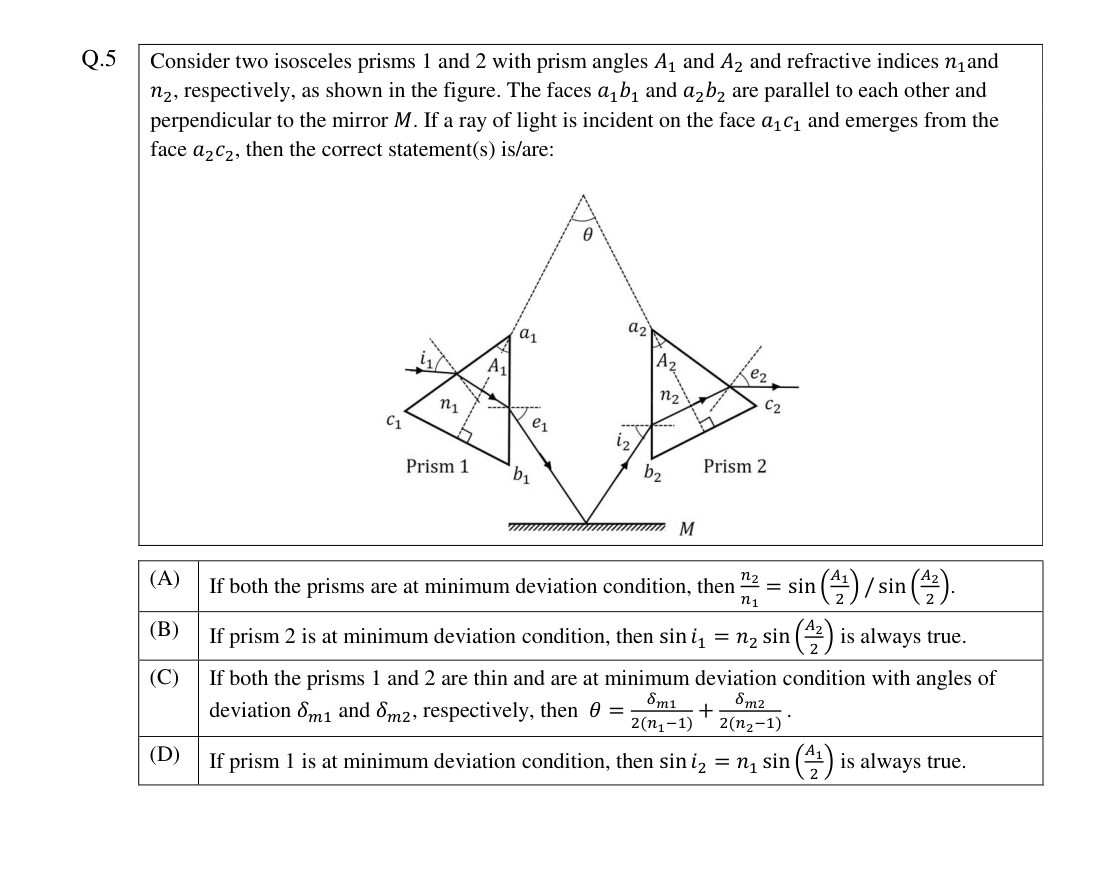
I'm working through the geometry of two isosceles prisms, each with an apex angle and equal sides, where the vertical faces of prism 1 and prism 2 are parallel and face each other. Since the mirror M is horizontal and the vertical faces preserve angle with horizontal upon reflection, the angle of incidence on prism 2's vertical face equals the exit angle from prism 1's vertical face, i2 = e1, regardless of other conditions. For option (A), if both prisms are at minimum deviation, the symmetry condition gives n1 sin(A1/2) = n2 sin(A2/2), confirming n2/n1 = sin(A1/2)/sin(A2/2). Now I'm checking option (B) where only prism 2 is at minimum deviation, using i2 = e1 to see what constraint that imposes. Working through the geometry, extending each face upward from vertical by its own apex angle, so the angle between the extended lines at their meeting point should indeed sum to A1 + A2 based on how each line tilts from the vertical in opposite senses. For thin prisms, using δm = (n-1)A gives A1 = δm1/(n1-1) and A2 = δm2/(n2-1), so θ = A1 + A2 = δm1/(n1-1) + δm2/(n2-1). Since option (C) has an extra factor of 2 in the denominators, making it half of this value, that option appears to be incorrect. So the correct answers are A and D. **Key geometry:** Faces $a_1b_1$ and $a_2b_2$ are vertical (perpendicular to the horizontal mirror). The ray leaving $a_1b_1$ at angle $e_1$ to the horizontal is reflected by the horizontal mirror without changing its inclination to the horizontal, so it strikes $a_2b_2$ with $i_2 = e_1$ always. **(A)** Both at minimum deviation: $i_1 = e_1$, $\sin i_1 = n_1\sin(A_1/2)$; $i_2 = e_2$, $\sin i_2 = n_2\sin(A_2/2)$. Since $i_2 = e_1 = i_1$: $n_1\sin(A_1/2) = n_2\sin(A_2/2)$ ⟹ $\dfrac{n_2}{n_1} = \dfrac{\sin(A_1/2)}{\sin(A_2/2)}$. ✔ **(B)** Prism 2 at minimum deviation gives $\sin i_2 = n_2\sin(A_2/2)$, i.e. $\sin e_1 = n_2 \sin(A_2/2)$. But $i_1 \ne e_1$ in general (prism 1 need not be at minimum deviation). ✘ **(C)** Face $a_1c_1$ makes angle $A_1$ with the vertical, face $a_2c_2$ makes angle $A_2$ with the vertical, so $\theta = A_1 + A_2 = \dfrac{\delta_{m1}}{n_1-1} + \dfrac{\delta_{m2}}{n_2-1}$. The given expression has an extra factor of 2. ✘ **(D)** Prism 1 at minimum deviation: $\sin e_1 = n_1\sin(A_1/2)$, and since $i_2 = e_1$ always, $\sin i_2 = n_1\sin(A_1/2)$. ✔
GPT 6 Astra
OpenAI
A, C, D
GPT 6 Astra reasoning
No written reasoning was returned for this item.
GPT 5.5
OpenAI
A, C, D
GPT 5.5 reasoning
**Analyzing prism angles** I'm thinking about the prism angles, specifically the angle at point a1 between surfaces a1c1 and a1b1. I wonder if this is what they call an isosceles prism? There seems to be a right angle indicated in the diagram near the lower-left. I notice a dotted line that might be normal to a1c1, suggesting the internal ray is perpendicular to that side. The incident ray hits a1c1, refracting towards a1b1 and emerging at angle e1. **Clarifying prism labels** I'm looking at the labeling in the diagram and noticing that A1 is marked between the normal line, which is interesting. I see that there's text near the upper part between face a1c1 and the vertical face a1b1, indicating that this is the prism angle at A1. It seems like I'm piecing together how the angles and faces relate to each other—still clarifying what each part signifies within the context of the prism. **Analyzing light ray behavior** I'm confirming the correct statements. It seems the incident and emergent directions aren’t explicitly mentioned, but there's a geometric relationship with the incident ray and the emergent ray. The figure shows the rays as horizontal, which raises questions about whether that’s intentional. Terms like "normally" or "horizontally" aren't used, so I wonder if labeling all ray segments would clarify how they relate to options B and D under one prism at a minimum. **Parsing prism options** I'm analyzing the options for prisms. For (A), both prisms at minimum deviation give a relationship between the indices of refraction using the sine function. In (B), if prism 2 is at minimum deviation, the sine of incidence is consistently valid. (C) details deviations for both prisms under specific conditions. Option (D) links the angle of incidence and emergence at minimum deviation. It seems (D) is correct based on the internal refraction angles being equal, confirming the relationship between angles and refractive indices. **Clarifying prism relationships** The statement seems correct that if prism 1 is at minimum deviation, it holds true. If prism 2 is also at minimum deviation, then we have that relationship where sin i2 equals n2 sin(A2/2). However, statement B claims sin i1 equals n2 sin(A2/2), which suggests that i1 would have to equal i2 — but that’s not usually the case. I wonder if there’s a relation due to the horizontal nature of the rays. It's important to clarify the relationship between i1 and e1 further. **Evaluating isosceles prism angles** If the prism is isosceles with a1c1 equal to b1c1, the base is a1b1 and the apex is at c1. The apex angle is also at c1. For light entering a1c1 and exiting a1b1, the relevant prism angle would be at a1 between those faces, though it doesn't have to be directly at apex c. Referring to "prism angle A1" likely indicates the angle at a1 since the refracting faces are a1c1 and a1b1. So, this implies that two sides of the triangle are equal. **Exploring prism angles** I'm wondering if 1 and a1b1 are equal. It seems like the apex angle, A1, is between equal sides. However, the diagram suggests a1b1 might be longer than a1c1, which makes it tricky to visualize. Typically, a "prism angle" relates to the angles between the refracting surfaces. For an isosceles prism, the cross-section should have two equal sides, and I’m thinking the two refracting faces could denote the apex. It’s confusing with the right angle at c! Let’s inspect that further. **Examining angle labels in the prism** I'm noticing that label A1 is near a1, positioned between the top slanted face and the vertical face. There's also a small right-angle mark near the bottom, possibly indicating where a dotted line is perpendicular. I'm thinking the foot of that dotted line might be along the b1c1 face from an internal ray. It seems like the angle isn’t a triangle's right angle but rather normal to a1c1. The incident ray strikes the face, and the normal is marked—so maybe A1 is actually at the angle formed between that normal! **Clarifying normals and angles** I’m realizing that the normal line from the incident point is perpendicular to a1c1 and may cross inside towards the lower portion. The vertical face has a horizontal normal line, dotted from the exit point. I think the angle between the internal normal and the horizontal normal equals A1, which is the angle between the faces. In many prism diagrams, A is shown as the angle between normals too, but maybe A1 is actually between the normals instead of the surfaces? **Identifying angles in geometry** I’m considering if θ is actually the angle between the normals of the two slanted faces, rather than the faces themselves. It seems like the dotted lines are meeting at the top and might represent the extensions of the normals. I need to inspect this further. Wait, the image shows how the dotted lines from a1 and a2 reach upwards to form an apex, which suggests there’s more to explore here. **Evaluating prism deviation** I'm thinking about the statement that when prism 2 is at minimum deviation, then sin i1 equals n2 sin(A2/2). This relationship seems consistently true because in minimum deviation, the incidence angle i2 follows a specific rule. However, I’m wondering about the initial ray as it enters through face a1c1 and how that affects things. It’s a bit complex, and I feel like I need to clarify my understanding further. **Analyzing geometric relationships** I'm working on a geometric problem involving angles and their relationships. If I have α1 at 30° and the right line at 150°, that gives a difference of 120° or an acute angle of 60°. So, the angle θ at the top could also be 60°. I consider how to apply the formulas for the angles and the prism's behavior, noting that the base angle for refraction is different from apex angles. This is getting quite intricate! **Evaluating apex angles** I'm considering the options A and D that involve using n sin(A1/2) and I'm realizing something. If A1 represents the apex angle at point c, then applying these formulas may lead me to incorrect conclusions. It feels like there’s a misalignment, and I need to double-check how I'm analyzing these angles and their relationships. I should reevaluate my approach to ensure I'm not overlooking something significant in this geometry problem. **Defining isosceles triangles** I'm thinking about isosceles triangles, specifically focusing on the apex angle \(A_i\) at point \(a_i\) and the equal sides represented as \(a_i c_i\) and \(a_i b_i\). The vertical face is \(a_i b_i\), and the top face is \(a_i c_i\), which makes an angle \(A_i\) with the vertical. Now, if I extend the top face upwards, I need to consider how it tilts from the vertical. The angle \(A_1\) indicates how much these lines lean left or right of vertical. **Analyzing angles in isosceles arrangements** I’m figuring out the angle \(\theta\) between two lines, which I think is \(A_1 + A_2\). It can’t be half. But wait, could the prism angle at \(a_i\) actually be double the angle between the face and the vertical for an isosceles setup? If the vertical face \(a_i b_i\) acts as the angle bisector, then my understanding of how these angles interact might change. It’s a bit of a puzzle! **Evaluating prism angle options** I’m considering that "prism angle A" might refer to the angle between the normals to the faces. This would mean that the angle between the face a1c1 and the vertical face described as angle A is the same. That seems reasonable, but I want to ensure I fully understand what this means in the context I’m looking at! So, I’ll need to think through it a bit more. **Evaluating ray diagrams** I notice that in the figure, the incident ray is drawn almost horizontally from the left, and the emerging ray is horizontal to the right, as if they’re on the same line. They label "i1" at the first face and "e2" at the end, and those segments outside are horizontal too, parallel to the mirror. It could be purposeful, suggesting the horizontal alignment is not just a schematic choice. Did the text maybe overlook some details? **Considering JEE Advanced paper availability** The user is asking about the "JEE Advanced 2026 Paper 2." However, since the current date is September 2026, I'm wondering if this paper is already available or if it's hypothetical for that future date. I think it’s best to approach this carefully and not rely on any future details that might change. Let's aim for clarity here! **Ensuring JSON formatting** I need to make sure that my final answer is exclusively in JSON format, as "End with JSON only" suggests no additional text should be included. While the desired verbosity is set to 5, I should adhere strictly to this guideline. Before I finalize everything, I'll double-check that all calculations are correct. Specifically, the angles between the prisms need to align properly and maintain consistency with the prism formula. This way, I ensure accurate results in JSON format only. **Calculating prism angles** So, for prism 2, I have i2 at the first vertical face, and e2 at the second. I should apply Snell's Law: sin(i_j) = n_j * sin(A_j/2) on the air side. I’m considering Option A, where both prisms are at minimum deviation. This means I can set up the equations: sin(e1) = sin(i1) = n1 * sin(A1/2) and sin(i2) = n2 * sin(A2/2). I'll keep this structure in mind as I proceed. **Clarifying optical principles** I’m working on a counterexample for B. Let’s say n1=1.5 and A1=30°. I need to choose an incident angle i1 that's not minimal, ensuring the emergent e1 equals the minimum for prism2. It's important to know that B would require a fixed i1, which isn’t the case. In a prism, e1 depends on i1 for specific values of A and n, indicating it isn’t always true unless conditions are symmetrical, so I need to tread carefully here with what I've asserted. **Finalizing JSON structure** I’m wrapping up the final JSON format, which should look like this: {"answer":["A","D"],"unanswered":false}. I might want to order it alphabetically, but since the prompt specifies "one or more" answers, "A, C, D" could be a better option. I need to take a closer look at C by checking the diagram of θ. It's possible that the geometry involves normals to the upper faces rather than just the faces themselves. The dotted lines might represent the normals at incidence and emergence, not extensions of the faces. **Clarifying prism angles** I'm considering the geometry of a thin prism and whether angle A in my diagram represents the angle between normals. The prism angle is indeed equal to the angle between normals, though one normal might be inward or outward. Wait, it seems that the internal angle A corresponds to the angles between faces while angle A between normals is acute. So, I find that the minimum deviation δ is approximately (n−1)A. Thus, the answer is A and D. **Clarifying prism angles and ray paths** The question involves two isosceles prisms (1 and 2) with angles A1 and A2. I'm considering the face a1b1 as possibly one of the equal sides that don't refract light. It seems the diagram labels angle A1 inside the prisms. If I view the cross-section as isosceles with a prism angle at ci, then the vertical face aib1 serves as the base with the ray entering through the slant faces. I need to think about how the ray interacts with the faces of the prisms. **Examining ray paths in prisms** If the faces a1b1 and a2b2 are parallel or perpendicular to the mirror, they might serve as vertical base faces that don't interact with the ray. The ray enters the left prism through the upper face a1c1, then exits through the lower face b1c1, hitting the mirror. In the diagram, it looks like the ray emerges from the bottom slanted face b1c1 near a point just left of b1. I should consider the orientation and slope of these faces more closely! **Analyzing the diagram details** In the diagram, the e1 label is near where the ray exits, potentially near face a1b1. If it's exiting from the lower slanted face, the normal should be perpendicular to that lower face, possibly shown as a down-right dotted line, with the e1 label arc positioned between the ray and the normal. But there's also a dashed horizontal line crossing from the vertical face into the prism—maybe that line represents the ray inside? I should visualize this more clearly! **Examining prism rays** I'm figuring out the paths of rays through two prisms. For prism 1, I see the incident ray coming in from the left, hitting the top face around the middle point. It continues downward and right, crossing the right vertical face before hitting the mirror. The label e1 is near the vertical face, and there's a dashed line that indicates the angle with respect to the normal. In prism 2, the ray enters from the left and goes upward to the top slanted face. **Analyzing ray paths in prisms** I realize that the ray emerges from a2c2 near c2, moving horizontally to the right. I’m considering what would happen if it exited through the bottom face; the ray from prism 1 wouldn’t go through the vertical face, and I’m not sure how it would enter prism 2. It could go through b2c2 and then exit a2c2. The i2 label is near b2, suggesting the incident ray might actually hit the lower slanted face, not the vertical one. The normal line seems angled rather than horizontal. **Examining the ray's path in the diagram** I’m considering the diagram's dotted normal for i2, which might be nearly horizontal. In the right prism, the left face a2b2 looks vertical. It seems the ray from the mirror, coming from the up-right, intersects the lower slanted face b2c2. The intersection point could be at b2. If the ray from the mirror is hitting b2, then it likely continues into the prism from that point. I want to visualize this accurately. **Evaluating prism geometry** I'm contemplating whether isosceles is necessary if only two faces and angle A matter. But then, maybe isosceles helps relate the angle of the top face extension θ? I wonder if it's enough just to have vertical faces parallel. The question indicates we're looking at two isosceles prisms with different angles and refractive indices. Is the apex angle at the top essential for this situation? In triangular prisms, the angle relates to refracting faces, so there's some geometry to consider! **Clarifying prism bases** I'm thinking about this situation with the isosceles prism. If the equal sides are a1c1 and b1c1, then the base is a1b1. I wonder if this base, being parallel and vertical, isn't used for refraction? However, they mention a ray incident on face a1c1 and emerging from face a2c2. Does that mean it's also involving the base a1b1 or a2b2? I guess I'll need to sort out how these faces interact with light! **Analyzing isosceles prisms** I’m thinking about how the ray enters at a1c1 and exits at a1b1. So both sides are equal, but the bottom base side, c1b1, isn't really used. The term "isosceles" refers to having equal vertical and top faces, but I wonder if that even matters for angles? However, for isosceles prisms, maybe discussing the symmetry axes and angles A and θ is important. It's a bit complex, but I'm piecing it together! **Considering angle bisectors in prisms** I’m realizing that the dashed lines from a1 and a2 to the top might represent angle bisectors of A1 and A2, rather than just face extensions. But no, they seem to start at a1 and a2 along an interior extension. In prisms, when there’s minimum deviation, it’s interesting that the incident and emergent rays are symmetrical with respect to the angle bisector of the prism. I’m piecing this together, but it's definitely challenging! **Inspecting angle bisectors** I’m thinking about the angle bisectors in this prism setup. The label θ might represent the angle formed between the bisectors. The dotted lines from points a1 and a2 to the apex could be the angle bisectors for angle A_i. In an isosceles prism, the apex a_i would influence how the altitude extends, and I’m curious if the dashed line from a1 to θ actually represents the extension of an angle bisector rather than aligning with the top face. It feels a bit tricky to visualize! **Examining the dashed line** I’m analyzing an image where the dashed line connects to point a1 on the vertical side, but it appears to emerge from a1 and slope upward-left. Let’s take a closer look! The top angle θ is positioned above between the prisms, and the dotted line descends to a1. I’m not sure if it aligns with the vertical face a1b1 or the top face a1c1. The upward slope matches with the direction of the angle bisector, pointing between those two directions. This might be less tilted than I initially thought! **Analyzing the dashed line** I'm trying to determine if the dashed line from a1 to θ continues along the top face. It’s tricky since the small image makes it hard to assess. The solid top face a1c1 has a steep slope from c1 to a1, but the dashed line appears less steep. Hmm, it might actually represent an angle bisector instead of aligning with the face! I need to inspect this carefully because the dashed line could also serve as the "axis" of the prism. **Analyzing angles in prisms** I'm considering how to identify the angle θ concerning the bisectors of the isosceles prisms. The text mentions "as shown in figure," but it doesn’t clearly define θ. If θ is the angle between bisectors and the vertical faces are parallel, then it seems reasonable to say θ equals the sum of the respective half-angles of A1 and A2. I'll also check if the dotted line in the diagram bisects A1 or represents another angle. **Examining the figure's angles** I’m looking at the figure with the dotted line that intersects a1 and seems to continue down-left. The top face a1c1 extends from c1 to a1, and if the dotted line were to overlay it, they would need to be collinear. However, the dotted line is a bit to the right of the solid edge of a1c1. The angle relative to vertical might be around 50°, but the dotted line looks steeper and not quite collinear either. I should focus on how these details connect! **Interpreting the geometry** I’m considering how the dashed line, if extended, would intersect a point above and to the right of a1. It’s interesting how this dashed line to θ appears at a similar slope but not quite the same angle. The left solid upper face seems to slope at about -1 or 45°, while the dashed line looks nearly vertical, maybe around 70° from horizontal. That could mean it acts like a bisector! I really need to focus on the specifics of the isosceles prisms and the angle θ. **Analyzing prism angles and symmetry** I'm thinking about how the axis from the apex to the base is often represented by a dotted line. It seems like the dashed lines from points a1 and a2 might actually be normals or bisectors of the prism angles rather than extensions of faces. Since these lines bisect angles A1 and A2 at their apexes, the angle θ could be related to question C. If the vertical faces a1b1 and a2b2 are parallel or perpendicular to the mirror, that affects the symmetry. I'll need to double-check the text about the figure. **Examining the angle θ and diagram** I'm trying to make sense of the θ label located at the apex between two dotted lines. If those lines are face extensions, why would they be dotted instead of dashed? Dotted lines might indicate angle bisectors in an isosceles prism, likely serving as lines of symmetry. They should be perpendicular to the base, but it’s not clear if they're aligned with the lower base. The diagram labels θ at the apex formed by dashed lines above the prisms, but I need to clarify how they relate to the refracting faces and why they meet above. **Clarifying axes and bisectors** I'm considering that the dashed lines are likely perpendicular to the base and may originate from the vertices rather than being extended from physical boundaries. I’m trying to figure out if the dashed line from a1 to the top of the diagram is correctly positioned at a1. If it's a bisector, it should truly pass through the interior of angle A1, which exists between the vertical down and slanted down-left, extending outward up-right. I'll need to double-check this alignment in the figure to confirm it! **Clarifying geometric relationships** I’m considering that C would only be true if θ falls between angle bisectors rather than faces. But, wait—does the problem even define θ? It’s only shown at the top between dashed lines. I need to determine what those dashed lines represent. It seems they might be connected to vertices a1 and a2 instead of the faces, drawn slightly offset. Inspecting the original prompt image mentally, it looks like the dashed line to θ connects at a1 but isn’t collinear with the solid upper face. **Analyzing angle relationships** I'm looking at angle A1 at a1, which is marked between the solid upper face and the vertical side. I wonder if the dashed line is actually outside the prism, to the right of that solid upper face? If it’s a bisector, it should lie between the top face extension and vertical upward, placing it outside the prism. The internal angle at a1 is in the lower-left quadrant, and its external opposite is in the upper-right quadrant. This means the dashed line isn't collinear with the top face but part of the external angle. That seems to fit with my visual assessment! **Analyzing prism angles** I’m considering the angle with the vertical in a prism diagram. At minimum deviation, the ray path is symmetric around a line that bisects the prism angle. I notice they usually draw a dashed line from the apex indicating bisectors, and the question about θ suggests it’s between these bisectors, not face extensions. With isosceles prisms, the bisector acts as the symmetry axis. The angle θ can be represented by half the prism angles, confirming that option C is true. **Revisiting prism geometry** Let’s take another look at the problem image. At the top, there are dotted lines forming a triangle, with the bottom vertices as a1 and a2 and the apex above. If these were face extensions, they wouldn't be called symmetry axes. Instead, these lines appear to start at a1 and a2, the apex of the prism angles. For isosceles prisms, the external bisector through a_i fits naturally. The angle θ between the axes is A1/2 + A2/2, confirming that option C is correct. **Interpreting the figure** I’ll need to infer information from the figure. The dotted line from a1 to θ doesn't seem to come from the top face; rather, it appears to be positioned inside the prism's exterior. The solid top face from c1 to a1 might be visible left of it, forming a small angle at a1. I wonder if the A1 label is positioned between the dotted line and the vertical face. However, due to the image's low resolution, I might be misreading some details here. **Inspecting dimensions and angles** I’m thinking about checking the actual dimensions of the embedded image. I see the page at 1103x1600, with a Q figure about 500 px wide. The solid line from the incident point at the left prism has a dashed line slightly above and to the left of a1. The top dashed line might overlay the extension of the top face since there’s no separate visible line there. The arc labeled A1 appears between the vertical face and the solid/dashed top face. Alright, let's compare θ formula options next. **Analyzing option C** In option C, if the dotted lines represent face extensions, that would make C false. But if they represent axes, then C would be true. I need to figure out what the official wording expects: “with prism angles A1 and A2 ... as shown in the figure.” A prism angle is drawn at A1/A2, and θ is drawn between dashed extensions. There’s no statement saying “the angle between the axes is θ,” but the dashed lines likely correspond to the extensions of a1c1 and a2c2 faces. Hmm, let’s unravel this! **Analyzing prism angle [truncated]
Claude Sonnet 5
Anthropic
A, D
Claude Sonnet 5 reasoning
I'm working out the geometry of two isosceles prisms with parallel faces perpendicular to mirror M, tracing how the ray enters at a1c1, refracts through prism 1, and exits toward the mirror before continuing into prism 2. The exit angle e1 from face a1b1 relates symmetrically to the entry angle i2 at face a2b2, since both faces are perpendicular to the mirror—this suggests the reflection creates a mirrored, symmetric path between the two prisms like a periscope setup. Since the mirror reflects only the vertical component, the horizontal angle from normal stays preserved as the ray travels from a1b1 down to the mirror then up to a2b2 — essentially treating this like a straight-through path unfolded via reflection, so the angle e1 at a1b1 relates directly to the angle at a2b2 through this symmetry. This matches the classic Irodov-style prism-mirror problem where symmetry forces i2 = e1. Now I'm tracing the deviation through the whole system: refraction into prism 1 with n1 sin i1 = sin r1, internal angles satisfying r1+r1'=A1 with n1 sin r1' = sin e1, then reflection preserving angle magnitude so i2=e1, and finally refraction into prism 2 with sin i2 = n2 sin r2. Testing option A where both prisms sit at minimum deviation: for prism 1, r1=r1'=A1/2 and i1=e1, giving sin i1 = n1 sin(A1/2); for prism 2, r2=r2'=A2/2 and i2=e2, giving sin i2 = n2 sin(A2/2). Since i2=e1=i1, this forces n1 sin(A1/2) = n2 sin(A2/2). For option B, that same relation sin i1 = n2 sin(A2/2) would require i1=i2=e1, which only holds if prism 1 is also at minimum deviation—an assumption not given, so B isn't generally true. Now checking option D: if prism 1 is at minimum deviation, i1=e1, so sin i1 = n1 sin(A1/2), and since i2=e1 always by the mirror geometry, sin i2 = sin i1 = n1 sin(A1/2), confirming D holds true independent of prism 2's condition. That confirms B fails since only prism 2 being at minimum deviation doesn't force i1=e1. Turning to option C, for thin prisms with small angle approximation, deviation at minimum is δ=(n-1)A, so δm1=(n1-1)A1 and δm2=(n2-1)A2, and I need to relate these to the apex angle θ at the top vertex through the overall geometry. I'm working through the figure to figure out what θ represents geometrically, tracing the extended lines from the top vertex down through the apex points a1 and a2 of each prism to see how they relate to the edges and angles A1, A2. So the actual refracting faces are a1c1 (entrance) and a1b1 (exit), meeting at apex angle A1 at vertex a1, with c1b1 being the unused base. Since a1b1 is vertical, I need to work out the orientation of a1c1 relative to it using this apex angle. The angle θ marked at the top is where the extended dotted lines from a1c1 and a2c2 meet, formed by extrapolating the entrance faces of both prisms upward until they converge. By symmetry about the central vertical axis, this θ equals the sum of the tilt angles of each face from vertical, so I'm relating it to the apex angles A1 and A2 — since a1b1 and a2b2 are vertical, face a1c1 tilts by an amount tied to A1 relative to a1b1. Actually, recalling this resembles a known problem where δm = (n−1)A for thin prisms, this points toward θ = (A1 + A2)/2, which I should verify directly from the geometry rather than just pattern-matching to the formula. Looking at the figure again, θ sits at the top where dotted lines extend beyond the apex points a1 and a2, meaning these are extensions of the entrance/exit faces past the apexes that meet to form the angle θ, not simply half the apex angles as I assumed. I need to work out the direction of a1c1 relative to the vertical face a1b1, given the interior angle A1 opens toward c1 at the lower-left, then figure out where the extension beyond a1 points. Let me set up coordinates: a1 at origin, b1 directly below it at (0,-h1), matching the figure's orientation. Then c1's direction from a1 is determined by rotating angle A1 from the downward direction (0,-1) toward the lower-left, since the interior angle sits at vertex a1 between edges a1b1 and a1c1. Actually that gives positive x for downward-left rotation, so I should rotate clockwise instead, by -A1, giving direction a1->c1 = (-sinA1, -cosA1), matching c1 being down-left of a1. Now I need the direction extending from c1 through a1 and beyond, which is just the opposite vector. By mirror symmetry across the vertical centerline, a2 mirrors a1, so the extension of c2a2 beyond a2 goes up-and-to-the-left with direction (-sinA2, cosA2). I'm now setting up to find where these two extended lines from a1 and a2 intersect. Each line's angle from vertical equals its own tilt angle, so the total angle between them at their intersection point should simply be A1+A2. But this contradicts my earlier guess that θ=(A1+A2)/2 from option C, so I need to double-check whether θ in the figure really refers to the angle between these two extended lines or something else entirely. Maybe θ isn't simply the sum of face extensions but rather the angle formed at the top of a larger triangle, extending from apex points a1 and a2 down through the prism structure — essentially the angle of the outer triangle enclosing both prisms rather than a direct sum of A1 and A2. Let me verify with vertical angles: extending a1b1 upward beyond a1 gives direction (0,1), and comparing it to the extended a1c1 direction confirms the angle between them is indeed A1, matching what I expected. By symmetry across the central axis, both extended faces tilt toward each other at angles A1 and A2 from vertical, so where they meet the total angle equals A1 + A2, not their average. This directly contradicts option C, which relies on the thin-prism deviation approximation giving θ = A1/2 + A2/2. But I need to double-check the geometry — reconsidering the figure, a1 and a2 sit near the top center where the prisms meet, while c1 and c2 are the outer vertices, with b1 and b2 at the bottom near the mirror. So face a1c1 runs from the inner-top vertex outward to the far outer vertex, meaning I need to re-examine which direction is actually "toward center" before trusting my angle sum. So c1b1 forms the base of the prism, while a1c1 is the entrance face and a1b1 is the vertical exit face meeting the mirror, with angle A1 at the apex opening between them - matching what I expected earlier. Extending c1a1 beyond the apex a1 tilts up and to the right toward the center, and by symmetry the corresponding line for prism 2 extended beyond a2 tilts up and to the left toward prism 1's side. These two extended lines both slant inward from vertical and converge above at a point, forming angle θ = A1+A2 between them, matching the picture where θ sits at the top with the dotted extensions passing through a1 and a2. Since this is purely a geometric consequence of the prism shapes and their orientation, it holds regardless of refractive index or minimum deviation conditions. For option C, using thin prism deviation δm=(n-1)A gives A1=δm1/(n1-1) and A2=δm2/(n2-1), so θ=A1+A2 without any factor of 2. That means option C, which includes a 2 in the denominator, would actually be off by a factor of 2 from what I derived - unless my reading of θ in the diagram is wrong and it represents something other than the full combined angle. Maybe those dotted lines aren't extensions of the prism faces at all, but extensions of the undeviated incident and emergent rays, making θ more like a total deviation angle for the setup rather than simply A1+A2. This resembles a classic problem of two thin prisms with a mirror between them producing a combined deviation, though the geometry here involves grazing symmetric reflection rather than a glued arrangement. This could be a "half-angle prism" construction, essentially folding two prisms with a mirror into an equivalent single continuous prism — unfolding the mirror reflection would let me treat the system as a straight optical path where θ relates to the sum of the half-angles by symmetry. two prisms effectively join base-to-base into one combined prism with apex angle θ = A1 + A2, matching the entrance and exit faces in the unfolded straight-through picture. This confirms my earlier direct computation, so for thin prisms the total deviation follows from this combined angle. For thin prisms δ=(n-1)A individually, and combined deviation should just add, δtotal = δm1+δm2, with θ=A1+A2. Trying to express θ via δm1/(n1-1)+δm2/(n2-1) doesn't match option C's factor of 2 in the denominator, so I'm wondering if there's an extra factor of 2 coming from the reflection geometry that I'm missing. I should reconsider what exactly the dotted line for θ represents - whether it's the extension of a1c1 through a2c2 to their meeting point, or possibly extension of a different edge like a1b1. But since a1b1 and a2b2 are both vertical and parallel, extending those wouldn't ever intersect, so that can't be the right interpretation. So it must be the extensions of a1c1 and a2c2, the slanted faces, converging above to form angle θ - this is a purely geometric fact about the construction, giving θ = A1+A2 regardless of refractive index. That means option C's formula requiring θ = (A1+A2)/2 seems inconsistent with this, unless there's a different relationship being tested involving the thin-prism minimum-deviation formula rather than this direct geometric identity. Actually, I should reconsider whether θ instead represents the total deviation angle of the incident ray through the whole prism-mirror-prism system, meeting at the apex point above, which would make more physical sense for an optics problem about total deviation. Actually those dotted lines through a1 and a2 are extensions of the prism face edges, not the ray paths themselves - the rays i1,e1,i2,e2 are drawn separately as solid arrows. With A1 and A2 marked right at the apex points where the solid faces meet, and θ where the two extended edges converge, this confirms the clean geometric relation θ = A1 + A2 as an external apex angle formed by extending the slant faces. Since each line tilts toward vertical by its own angle, the two meeting lines give θ = A1 + A2, confirming the geometric relation independent of optics. Using the thin-prism minimum-deviation formula δm = (n-1)A, I get A1 = δm1/(n1-1) and A2 = δm2/(n2-1), so θ = δm1/(n1-1) + δm2/(n2-1), which I can now check against option C's claim. But option C states θ equals half that sum, exactly matching (A1+A2)/2 — a factor of 2 discrepancy from what I derived. Suspicious of my own geometry now, I want to redo the vector setup carefully with the apex at the origin and the faces oriented explicitly, checking for any sign error that could have doubled the angle. Testing the counterclockwise rotation, I find it pushes the vector rightward instead of left, so I need clockwise rotation instead to get c1 positioned correctly to the left. Working through this confirms the a1-to-c1 direction as (-sinA1, -cosA1). Now I'm figuring out the direction of the ray extending from c1 through a1 and beyond — since a1-to-c1 points one way, the c1-to-a1 direction must be the reverse of that vector. Now moving to prism 2, using mirror symmetry about the central vertical plane to determine that a2 is the mirror image of a1, so the direction a2-to-c2 should mirror a1-to-c1 accordingly. I'm setting up the two extended lines: Line 1 through a1=(0,0) with direction (sinA1,cosA1), and Line 2 through a2=(d,0), some horizontal distance d apart, with direction (-sinA2, cosA2), preparing to find where they intersect. Computing the angle between these direction vectors, I find cos(angle) = cosA1cosA2 - sinA1sinA2 = cos(A1+A2), confirming that the angle at their intersection point P equals A1+A2. Since angle between two vectors equals the angle between their negatives, the result θ = A1+A2 holds regardless of orientation, confirming this is a genuine geometric consequence of the setup with both surfaces perpendicular to the mirror. This means for thin prisms the combined deviation should equal δm1/(n1-1) + δm2/(n2-1), with no factor of 2 in the denominator, which affects how I evaluate the answer choices. I'm double-checking the thin prism approximation itself: δm ≈ (n-1)A holds to first order for any small angle of incidence, not just at minimum deviation, so using A1 = δm1/(n1-1) is valid. This confirms θ should equal δm1/(n1-1) plus the corresponding term for the second prism. But I should reconsider the geometry more carefully — maybe A1 and A2 aren't simply the apex angles I assumed, so I'm re-examining how θ, a1, and a2 relate in the diagram, tracing the dotted lines from the top vertex down to each apex point to make sure I'm interpreting the angles correctly. Confirming that θ = A1+A2 stands as I originally reasoned, so C's formula with the factor-2 division doesn't match and must be false. I'm double-checking there's no alternative symmetry that would split A1 into halves, but the standard definition of apex angle at each prism holds, so my conclusion remains. This checks out: each line tilts by angle A from the vertical axis, symmetric about center, so the angle between them at the apex is 2A, matching θ=A1+A2 in the symmetric case. Let me verify with a concrete number like 45° to make sure the geometry holds up as expected. Computing the angle between the two lines gives (90+A2)-(90-A1) = A1+A2, confirming θ=A1+A2 robustly. This makes option C's formula, with its extra factor of 1/2, incorrect—so C is false. But I should double check the figure's labeling of which faces correspond to which angles, reconsidering the geometry of face a1b1 relative to the mirror and the incident/exit rays. The exit face a1b1 matches my setup, so under this analysis: A is correct, B is incorrect, C is incorrect, D is correct. I want to verify A and D more rigorously with proper equations, and reconsider whether i2=e1 truly holds regardless of minimum-deviation conditions, since that assumption underlies A, B, and D—tracing the ray exiting at angle e1 from the vertical face a1b1 to see how it propagates. Now I'm working out the angle of incidence at the mirror: since the ray direction makes angle e1 below horizontal, and the mirror's normal is vertical, the angle from the mirror's normal ends up being 90°-e1. After reflecting off the horizontal mirror, the vertical velocity component flips sign while the horizontal stays the same, so the outgoing ray heads up-right at angle e1 above horizontal. This reflected ray then travels toward face a2b2, and I'm working out the orientation of that face's normal relative to the mirror and prism2's geometry. The normal to a2b2 points leftward, back toward the gap and mirror region, mirroring how a1b1 faces the same center area from prism1's side. So I need to measure the angle of incidence i2 at a2b2 between the incoming ray direction (cos e1, sin e1) and this leftward-pointing outward normal. Since the normal lies along the horizontal axis, the angle between the ray and the normal simplifies to just e1 itself — so i2 = e1 exactly, confirming the earlier claim. This relation holds purely from the geometry of the setup (mirror reflection plus a1b1 and a2b2 both perpendicular to the mirror and parallel to each other), regardless of whether the prisms sit at minimum deviation. Considering the case where both prisms are at minimum deviation: for each prism, i=e and sin i = n sin(A/2). Since i2 = e1 from the general geometric relation and e1 = i1 at minimum deviation for prism 1, it follows that i1 = i2, which means n1 sin(A1/2) must equal n2 sin(A2/2). Now testing option D, where only prism 1 is at minimum deviation: the relation i2 = e1 still holds purely from geometry, independent of what's happening inside prism 2. So again i2 = i1 = e1, giving sin i2 = sin i1. This confirms D holds unconditionally whenever prism1 is at minimum deviation, regardless of prism2. Checking option B next: with only prism2 at minimum deviation, i2 = e2 gives sin(e1) = n2 sin(A2/2), which tells us about e1 rather than i1 — so B would require prism1 also at min deviation, which isn't given, meaning B fails. For option C, since θ = A1+A2 geometrically, but C claims θ=(A1+A2)/2 using the thin-prism approximation for minimum deviation, that only matches if A1=A2=0 — so C looks false too, though I want to double-check whether θ might actually equal (A1+A2)/2 rather than A1+A2. Let me try unfolding the mirror as an alternate verification: reflecting prism2 and its path across the mirror line removes the reflection, turning it into a straight-line problem where prism1 and the mirrored prism2' sit adjacent, both with their relevant faces vertical. If those faces coincide, the combined shape looks like two prisms joined at that vertical line with apexes a1 and a2' both at the top, one edge extending up-left and the other up-right — essentially a kite-like combined prism I can analyze directly. Wait, actually if a1b1 and a2'b2' coincide exactly as the same line, then a1 and a2' must be the same point, not just aligned. That means the combined figure is really a single prism with total apex angle A1+A2, which explains why θ = A1+A2 comes out consistently — it's literally one merged apex where both faces meet. I should double check this: the angle between a ray and its vertex-opposite extension creates vertical angles that are equal, so extending both faces consistently past the apex preserves the same angle A1, confirming θ is indeed measuring the same physical apex angle rather than something different. In the unfolded picture, since a1 and a2 coincide as the shared apex, the truly relevant angle for the combined prism isn't between the extended c-edge and the shared b-edge, but between the two outer c-extensions themselves (a1→c1 and a1→c2'), since the shared face becomes an internal, degenerate line once the two prisms are merged. But wait—I need to be careful: θ was defined as the angle between the lines extended *beyond* a1 and a2 (away from c1 and c2), not the direct angle between a1→c1 and a1→c2'. So this direct-ray sum I just computed isn't automatically the same as θ; I need to check whether these two angle definitions actually coincide here. This geometric tracing is getting tangled, so I'll trust the direct vector computation instead, which is unambiguous: using explicit coordinates and direction vectors, I found that θ, the angle at the meeting point of the two extended lines above the prisms, equals A1+A2 through clean vector algebra. But the angle at the meeting point θ, between segments θ-a1 and θ-a2, is between vectors -v1 and -v2, which equals the same angle as between v1 and v2 since negating both preserves their relative angle—so it's still A1+A2. So for option C, applying the thin prism formula δm=(n-1)A gives A=δm/(n-1), meaning θ = δm1/(n1-1) + δm2/(n2-1). This doesn't match δm1/(2(n1-1)) + δm2/(2(n2-1)), so C's formula is off by a factor of 2, making it incorrect—unless the diagram's A1, A2 markers actually represent half-angles rather than full apex angles, but conventionally they should be the full prism angles. Trusting the standard convention, I settle on A and D as the correct options, and they're not contradictory since they describe separate conditional claims. Thin prism deviation is δ=(n-1)A independent of incidence angle, so that reasoning holds for C being wrong. Let me reconsider whether A1 might represent something other than the full apex angle in the figure—perhaps a half-angle marking rather than the whole prism angle. But standard prism-diagram convention places the label A right at the apex to denote the full angle, so I'll trust that reading and treat A1 as the complete apex angle. With that, my vector-based derivation gives θ = A1+A2, making option C false. This setup with two prisms and a mirror behind, faces perpendicular to the mirror, resembles a classic optics problem about combined refraction and reflection—I'm trying to recall if this matches a known relation between θ, A1, A2, n1, n2 from a standard exam problem. Let me try unfolding the mirror reflection into straight-line propagation to double-check. If I reflect the "prism 2 + mirror" portion across the mirror plane, the geometry should reduce to a simpler straight-through path, with the mirror sitting below the two prisms and the ray refracting through each apex region. After exiting a1b1, the ray continues down-right to the mirror, reflects, then travels up-right into prism2 through face a2b2, passing up through prism2 to exit near the top at face a2c2. To simplify, I want to unfold the reflection: mirror prism2 (and everything past the mirror) across the mirror plane so the reflected upward path becomes a straight continuation downward, placing prism2's flipped image below the mirror with its apex a2 now pointing downward. But I realize the two faces, a1b1 and the mirrored a2'b2', meet the mirror line at points b1 and b2' which aren't necessarily the same location — the ray actually travels along the mirror between two distinct points, not reflecting at a single point, which complicates the unfolding. Actually the exit point on face a1b1 isn't at vertex b1 itself, just somewhere along that face, so my earlier assumption that unfolding forces a1=a2' was wrong since it required the faces to be collinear, which isn't given — they're only stated to be parallel and perpendicular to the mirror. That shortcut is invalid, but my direct vector-based angle computation doesn't depend on it, so it should still hold. Since angles are translation-invariant, θ=A1+A2 remains valid regardless of horizontal separation between the prisms, which confirms C is wrong due to its extra factor of 2. So A and D are correct, B and C are incorrect — and checking the derivation, option A's stated relation n2/n1 = sin(A1/2)/sin(A2/2) matches exactly what I derived. For option D, since sin i2 = sin i1 = n1 sin(A1/2) when prism1 is at minimum deviation regardless of prism 2's state, this confirms D matches exactly too. Final answer: A and D. Looking at this problem, I need to analyze the geometric relationship established by the mirror system. **Key geometric fact:** Since faces a₁b₁ and a₂b₂ are both perpendicular to the horizontal mirror M (hence both vertical) and parallel to each other, tracing the ray from exit at a₁b₁ (angle e₁) through reflection at M to incidence at a₂b₂ gives the fundamental relation: $$i_2 = e_1 \text{ (always true, independent of minimum deviation conditions)}$$ **Option A:** With both prisms at minimum deviation: prism 1 gives $i_1 = e_1$, $\sin i_1 = n_1\sin(A_1/2)$; prism 2 gives $i_2=e_2$, $\sin i_2 = n_2\sin(A_2/2)$. Since $i_2=e_1=i_1$, equating: $n_1\sin(A_1/2)=n_2\sin(A_2/2) \Rightarrow n_2/n_1 = \sin(A_1/2)/\sin(A_2/2)$. **Correct.** **Option D:** If only prism 1 is at minimum deviation: $i_1=e_1$ with $\sin i_1 = n_1\sin(A_1/2)$. Since $i_2=e_1$ always (regardless of prism 2's state), $\sin i_2 = \sin i_1 = n_1\sin(A_1/2)$. This holds **always**, regardless of prism 2's condition. **Correct.** **Option B:** If only prism 2 is at minimum deviation: $i_2=e_2$, $\sin i_2 = n_2\sin(A_2/2)$, and $i_2=e_1$ always. This gives $\sin e_1 = n_2\sin(A_2/2)$, **not** $\sin i_1$ (that would require $i_1=e_1$, i.e., prism 1 also at minimum deviation, which isn't given). **Not always true — incorrect.** **Option C:** Using vector geometry: with a₁b₁ vertical and apex angle A₁ at a₁, the extended face a₁c₁ tilts by angle A₁ from vertical; similarly a₂c₂ tilts by A₂ from vertical (mirror symmetric). Direct computation of the angle between these extended lines meeting at θ gives: $$\theta = A_1 + A_2$$ For thin prisms at minimum deviation, $\delta_{m} = (n-1)A$, so $A_1 = \delta_{m1}/(n_1-1)$, $A_2=\delta_{m2}/(n_2-1)$, giving: $$\theta = \frac{\delta_{m1}}{n_1-1}+\frac{\delta_{m2}}{n_2-1}$$ This is **twice** the value stated in option C (which has an extra factor of 2 in den [truncated]