
2026 · Paper 2 · Physics
Question 7
The printed question, the official key, and each model’s JSON answer plus the reasoning it wrote.
Q07
Official A, B, C
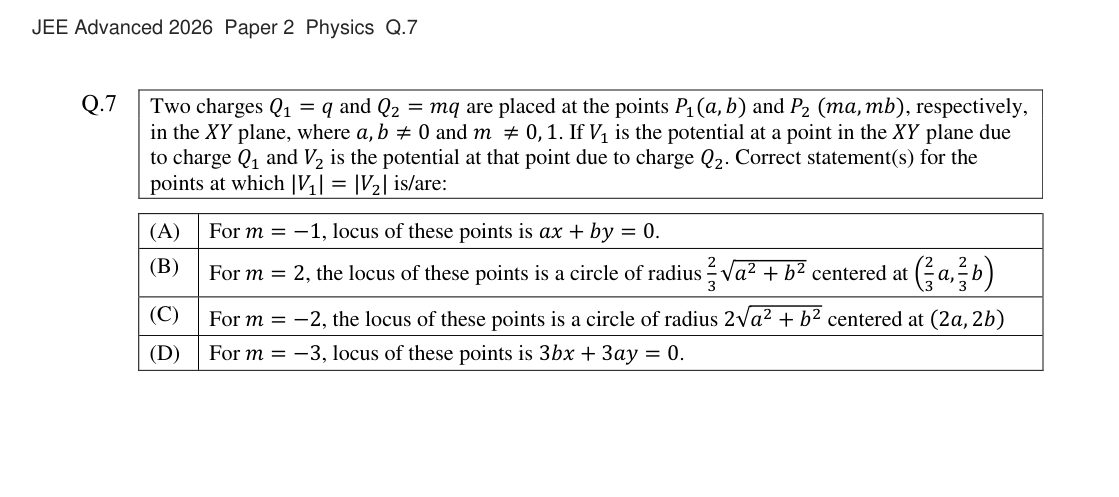
Model answers
Claude Fable 5.1
Anthropic
A, B, C
Claude Fable 5.1 reasoning
Since |V1|=|V2| requires r2 = |m|r1, I'm setting up the equation relating the two distance conditions and expanding the squared terms to find the relationship between coordinates. Simplifying gives (1+m)(x²+y²) = 2m(ax+by) for m≠1. Checking each option: m=-1 gives the line ax+by=0 (A correct); m=2 gives a circle centered at (2a/3,2b/3) with radius (2/3)√(a²+b²) (B correct); m=-2 gives a circle centered at (2a,2b) with radius 2√(a²+b²) (C correct); m=-3 gives another circle, not a line, so D is wrong. Final answer: A, B, C. Condition |V₁| = |V₂| gives r₂ = |m| r₁, i.e. (x−ma)² + (y−mb)² = m²[(x−a)² + (y−b)²] ⟹ (1+m)(x²+y²) = 2m(ax+by). - m = −1: ax + by = 0 ✓ (A) - m = 2: x²+y² − (4/3)(ax+by) = 0 → centre (2a/3, 2b/3), radius (2/3)√(a²+b²) ✓ (B) - m = −2: x²+y² = 4(ax+by) → centre (2a, 2b), radius 2√(a²+b²) ✓ (C) - m = −3: x²+y² = 3(ax+by), a circle, not a line ✗ (D)
GPT 6 Astra
OpenAI
A, B, C
GPT 6 Astra reasoning
No written reasoning was returned for this item.
GPT 5.5
OpenAI
A, B, C
GPT 5.5 reasoning
**Solving the equation** I'm looking at an equation that starts with (1 - m^2)(x^2 + y^2) + [-2m + 2m^2](ax + by) = 0. That leads to (1 - m^2)(R^2) + 2m(m - 1)S = 0, with S = ax + by. I think it might factor as (1 - m)[(1 + m)R^2 - 2mS]. After some checking, I confirm this is valid since m is not equal to 1, which simplifies down nicely.
Claude Sonnet 5
Anthropic
A, B, C
Claude Sonnet 5 reasoning
I need equal magnitude potentials, so the distance from the point to P2 must equal |m| times its distance to P1 — this defines an Apollonius circle (or a line when |m|=1). Setting up coordinates (x,y) and squaring the condition r2² = m²r1², I expand both sides and subtract, canceling the m²x² and m²y² terms against matching pieces, which leaves (1-m²)(x²+y²) plus linear terms in x and y with coefficients involving m, a, b — I'm now factoring this into a standard circle equation. Dividing through by (m-1) for m≠1 gives (m+1)(x²+y²) = 2m(ax+by). Checking m=-1 separately confirms it collapses exactly to ax+by=0, matching option (A), while for other m values I get the general circle equation x²+y² - [2m/(m+1)](ax+by) = 0. Testing m=2 gives center (2a/3, 2b/3) with radius (2/3)√(a²+b²), matching option (B). Then checking m=-2, the ratio m/(m+1) simplifies to 2, giving center (2a, 2b). For m=-3, the ratio becomes 3/2, producing a circle centered at (3a/2, 3b/2) with radius (3/2)√(a²+b²) rather than a line — so option D's claim of a line 3bx+3ay=0 is incorrect. So A, B, and C are correct while D is wrong. Looking at this problem, I need to find the locus where |V1| = |V2|, meaning: $$\frac{k|q|}{r_1} = \frac{k|mq|}{r_2} \implies r_2 = |m| r_1 \implies r_2^2 = m^2 r_1^2$$ With r₁² = (x-a)² + (y-b)² and r₂² = (x-ma)² + (y-mb)², expanding and simplifying (for m ≠ 1): $$(m+1)(x^2+y^2) = 2m(ax+by)$$ **Case m = -1:** Equation reduces to 2m(ax+by) = 0, giving **ax + by = 0** ✓ matches (A) **Case m ≠ -1:** Dividing by (m+1): $$x^2+y^2 - \frac{2m}{m+1}(ax+by) = 0$$ This is a circle with center $\left(\frac{m}{m+1}a, \frac{m}{m+1}b\right)$ and radius $\left|\frac{m}{m+1}\right|\sqrt{a^2+b^2}$ **Case m = 2:** m/(m+1) = 2/3 → center (2a/3, 2b/3), radius (2/3)√(a²+b²) ✓ matches (B) **Case m = -2:** m/(m+1) = -2/-1 = 2 → center (2a, 2b), radius 2√(a²+b²) ✓ matches (C) **Case m = -3:** m/(m+1) = -3/-2 = 3/2 → center (3a/2, 3b/2), radius (3/2)√(a²+b²) This is a **circle**, not a line as claimed in (D). So (D) is **incorrect**. ```json