
2026 · Paper 2 · Physics
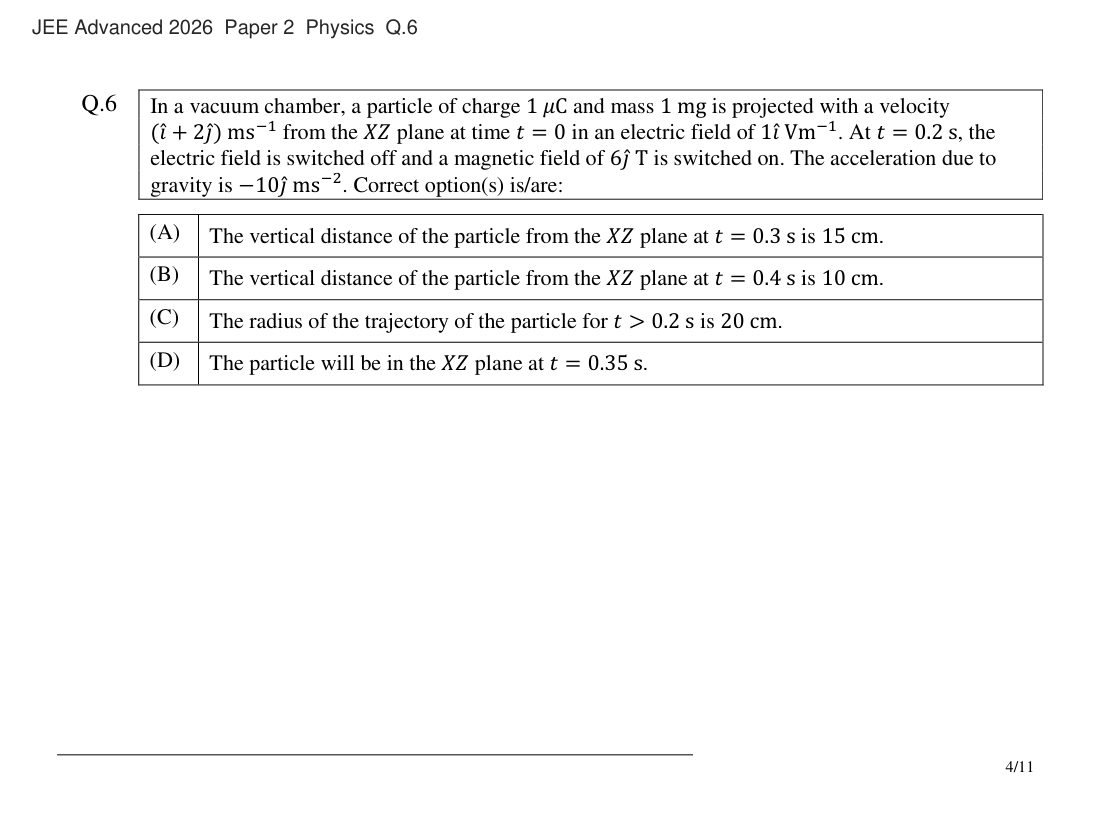
Question 6
The printed question, the official key, and each model’s JSON answer plus the reasoning it wrote.
Q06
Official A, C
Model answers
Claude Fable 5.1
Anthropic
A, C
Claude Fable 5.1 reasoning
With q/m = 1 C/kg, the field gives acceleration 1 m/s² in x, gravity gives -10 m/s² in y. Over 0.2 s, I'm computing v_x = 1.2 m/s and starting v_y = 2 - 10(0.2). At t=0.2s, position ends up y=0.2m, x=0.22m, v_y=0. Then E switches off and B=6j turns on, with velocity purely horizontal (perpendicular to B) so the horizontal motion becomes circular in the XZ plane with radius r=mv/(qB)=1.2/6=0.2m=20cm, while gravity still causes free fall along y since it's parallel to B. Checking the vertical motion y(t)=0.2-5(t-0.2)²: at t=0.3s, y=15cm (matches option A); at t=0.4s, y=0 (so option B's claim is wrong); the radius 20cm confirms option C; and at t=0.35s y≠0 so option D is incorrect since the particle only reaches the XZ plane at t=0.4s. So the correct answers are A and C. **Setting up:** q/m = (10⁻⁶ C)/(10⁻⁶ kg) = 1 C/kg. **Phase 1 (0 ≤ t ≤ 0.2 s):** a = (qE/m) î + g = 1 î − 10 ĵ m/s² At t = 0.2 s: - v_x = 1 + 0.2 = 1.2 m/s, v_y = 2 − 2 = 0 - y = 2(0.2) − 5(0.2)² = 0.20 m **Phase 2 (t > 0.2 s):** B = 6 ĵ T, velocity 1.2 î is perpendicular to B, so the particle moves in a circle in the horizontal (XZ-type) plane with r = mv/(qB) = 1.2/6 = 0.2 m = 20 cm → (C) correct. Gravity (along −ĵ, parallel to B) is unaffected by the magnetic force, so vertically the particle falls freely from rest from height 0.2 m: y(t) = 0.2 − 5(t − 0.2)² - t = 0.3 s: y = 0.2 − 0.05 = 0.15 m = 15 cm → (A) correct - t = 0.4 s: y = 0.2 − 0.2 = 0 → (B) incorrect (distance is 0, and it's in the XZ plane at 0.4 s, not 0.35 s) - t = 0.35 s: y = 0.2 − 0.1125 = 8.75 cm ≠ 0 → (D) incorrect
GPT 6 Astra
OpenAI
A, C
GPT 6 Astra reasoning
No written reasoning was returned for this item.
GPT 5.5
OpenAI
A, C
GPT 5.5 reasoning
**Analyzing physics problem** I need to be careful as I tackle this problem about a particle in a vacuum chamber. The particle has specific charge and mass properties, and it's projected from the XZ plane with a given velocity. The electric field and its later switch-off will affect its trajectory. I must confirm the meaning of "from XZ plane" in terms of initial vertical position, and I'm going to calculate the effects on the particle's motion, checking the provided options for their accuracy. **Calculating particle motion** Gravity is affecting the particle at -10 m/s² for the first 0.2 seconds. After that, the electric field turns off, and a magnetic field kicks in at 6 T. The Lorentz force affects the x-z components but not y, meaning the motion in the y direction is solely due to gravity. I can calculate the vertical position over time, finding that it drops to 15 cm at 0.3 seconds and zero at 0.4 seconds. Thus, options A is true, while B, C, and D need further analysis. **Calculating trajectory radius** I’m looking at the trajectory's radius for t > 0.2 and suspect it relates to the circular path in a plane perpendicular to the magnetic field. To compute that, I'll find the perpendicular speed at t = 0.2, where I calculate various velocity components. Notably, the angular frequency and the radius based on the perpendicular speed gives me the radius. I'll need to confirm the vertical distance as well, particularly how it changes over time due to gravity. **Preparing final JSON** I’m calculating values at specific points, where at 0.4 the value is zero and at 0.3 it's 0.15 m. However, at 0.35, I get a value of 0.0875, which isn’t zero. My answers are A and C. I want to finalize this as a JSON object, ensuring it’s formatted properly before the last channel submission. I think the format should include an array with the letters ["A", "C"], along with another key for "unanswered" set to false.
Claude Sonnet 5
Anthropic
A, C
Claude Sonnet 5 reasoning
I'm working through the first phase: with charge 1 μC and mass 1 mg, the electric field of 1 V/m along x gives an acceleration of 1 m/s² in that direction, alongside gravity pulling down at 10 m/s². Starting from velocity (1,2,0) at origin, I compute at t=0.2s the velocity becomes (1.2, 0, 0) and position reaches (0.22, 0.2, 0) — so the particle rises 20 cm before the y-velocity zeroes out. Now moving into phase 2, the E field switches off and a magnetic field of 6j T switches on, while gravity continues acting throughout since it's given as a constant condition, so I need to account for both the magnetic force qv×B and gravity in this new phase. I compute the cross product v×B given B=6j, finding it depends only on vx and vz components since B is purely along y — this gives a force that curves the motion in the xz-plane while gravity still pulls along y. Since (v×B)_y is always zero, the magnetic force never touches the y-component of velocity, so vertical motion stays governed purely by constant gravitational acceleration of -10 m/s², independent of the circular motion happening in the xz-plane. Using y(t)=0.2-5(t-0.2)² for t>0.2s, at t=0.3s I get y=0.15m matching option A, but at t=0.4s I get y=0m exactly, which contradicts option B's claim of 10cm at that time. Solving 0.2-5τ²=0 gives τ=0.2, meaning the particle crosses the XZ plane at t=0.4s, not 0.35s as option D claims—since y decreases monotonically from its peak with no reversal, this crossing time should be unique. This makes me suspect option B is also wrong, since it claims a vertical distance of 10cm at t=0.4s when I'm computing y=0 at that exact moment. Let me reconsider whether gravity acts continuously throughout the motion or only during a specific phase, since that assumption directly changes these calculations. Reasoning it through, gravity should apply constantly as a stated physical fact, unlike the E and B fields which are explicitly switched on/off. So during phase 1 (0 to 0.2s), vy starts at 2 and decreases at rate 10, reaching vy=0 at t=0.2s with y=20cm. In phase 2, only gravity affects the y-motion since the magnetic field along y can't produce a y-component of force, so y(τ) = 0.2 - 5τ² with initial vy=0. Checking this against the answer options: y=15cm occurs at τ=0.1 (t=0.3s), matching option A. And y=0 occurs at τ=0.2 (t=0.4s), meaning the particle enters the XZ plane at t=0.4s — this contradicts option B's claim of t=0.4 with a 10cm distance, and also rules out option D's t=0.35s. Now I need to examine the x-z motion for t>0.2s, which is governed purely by the magnetic force since the E field is off and gravity doesn't affect x or z. I compute v×B with B along y: this gives F_x = -6qv_z and F_z = 6qv_x, showing the x-z motion depends only on v_x and v_z, completely decoupled from v_y — so the x-z plane motion is circular, independent of the vertical motion. At t=0.2s, vx=1.2, vz=0, giving speed 1.2 m/s in the x-z plane, constant thereafter due to circular motion. I compute the radius as R = mv/(qB) = 0.2m = 20cm, matching option C. I also find the period T = 2πm/(qB) ≈ 1.047s for this circular motion. Since vy=0 at t=0.2s, y decreases monotonically from 0.2m to 0 by t=0.4s, giving only one crossing at t=0.4s — this contradicts D's claim of 0.35s. Checking at t=0.3s: y=0.2-5*(0.01)=0.15m=15cm, confirming option A. So the correct answers are A and C. Let me re-verify phase 1 kinematics: with acceleration a=(1,-10,0), velocity components are vx=1+t, vy=2-10t, and at t=0.2s, vx=1.2 and vy=0, matching earlier. Position y=2t-5t² gives y=0.2m at t=0.2s (20cm), confirming that value, and x(t)=t+0.5t² needs the same check for consistency. So both A and C hold up, while B and D don't, confirming the vertical distance interpretation as the y-displacement from the XZ plane — final answer is A and C. Looking at this problem, I need to analyze two phases of motion. **Phase 1 (0 to 0.2s):** E field (1î V/m) and gravity (-10ĵ) act. - a_x = qE/m = (10⁻⁶×1)/10⁻⁶ = 1 m/s² - a_y = -10 m/s² With initial velocity (1,2,0): - v_x(0.2) = 1+1(0.2) = 1.2 m/s - v_y(0.2) = 2-10(0.2) = 0 m/s - y(0.2) = 2(0.2) - 5(0.2)² = 0.4-0.2 = **0.2 m = 20 cm** **Phase 2 (t>0.2s):** B = 6ĵ T switched on, gravity continues, E off. Since B is along ĵ, the magnetic force (q**v**×**B**) has **zero y-component** — it only affects x,z motion. So y-motion is governed purely by gravity, decoupled from the magnetic circular motion. With v_y=0 at t=0.2s (τ = t-0.2): $$y(\tau) = 0.2 - 5\tau^2$$ - At t=0.3s (τ=0.1): y = 0.2 - 0.05 = **0.15 m = 15 cm** ✓ (matches A) - At t=0.4s (τ=0.2): y = 0.2 - 0.2 = **0 m** (not 10 cm, so B is false) - y=0 occurs when τ²=0.04, i.e., τ=0.2, so t=0.4s (not 0.35s, so D is false) **For x-z motion (circular motion):** The magnetic force depends only on v_x, v_z (independent of v_y), producing uniform circular motion with speed: $$v = \sqrt{v_x^2+v_z^2} = 1.2 \text{ m/s (constant)}$$ Radius: $$R = \frac{mv}{qB} = \frac{10^{-6}\times 1.2}{10^{-6}\times 6} = 0.2\text{ m} = 20\text{ cm}$$ ✓ (matches C) **Conclusion:** Options A and C are correct; B and D are false. ```json