
2026 · Paper 2 · Physics
Question 10
The printed question, the official key, and each model’s JSON answer plus the reasoning it wrote.
Q10
Official 1915
Model answers
Claude Fable 5.1
Anthropic
1915
Claude Fable 5.1 reasoning
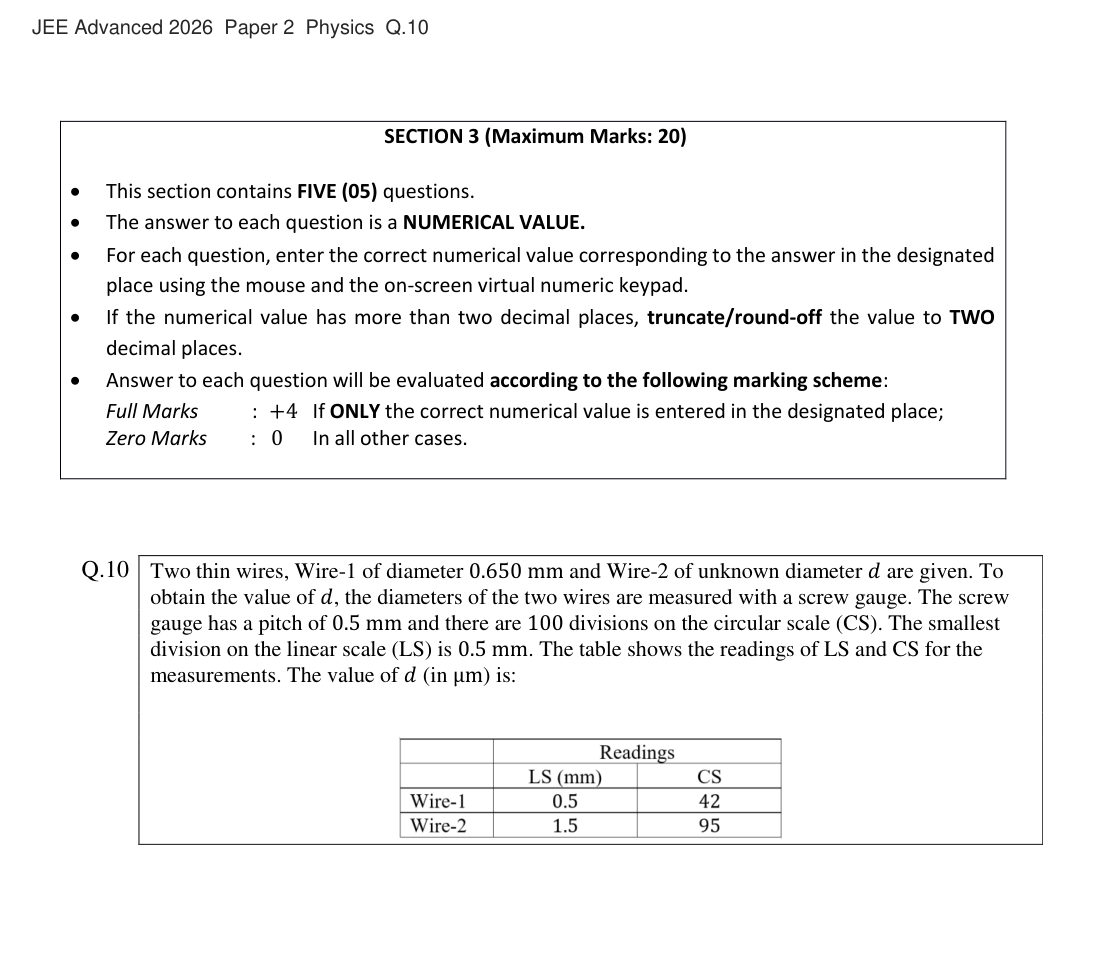
With a least count of 0.005 mm, I calculate wire-1's reading as 0.71 mm against an actual diameter of 0.650 mm, giving a zero error of 0.06 mm. Now I'm working out wire-2's reading using the same formula with its linear scale and circular scale values. **Least count** = pitch / number of CS divisions = 0.5 mm / 100 = 0.005 mm **Wire-1 reading:** LS + CS × LC = 0.5 + 42 × 0.005 = 0.5 + 0.210 = 0.710 mm True diameter = 0.650 mm, so **zero error** = 0.710 − 0.650 = +0.060 mm **Wire-2 reading:** 1.5 + 95 × 0.005 = 1.5 + 0.475 = 1.975 mm Corrected diameter: d = 1.975 − 0.060 = 1.915 mm = **1915 µm**
GPT 6 Astra
OpenAI
1915
GPT 6 Astra reasoning
**Calculating measurements** I need to compute some values starting with .005. First, I’ll add .5 and .21 to get .710. Then, I’ll compare that to .650 as .060. Next, moving on to the second calculation, I’ll add 1.5 and .475, which gives me 1.975. After that, I subtract .060 to arrive at 1.915 mm, which is equivalent to 1915 micrometers. This seems straightforward, so I'll present the final result in JSON format only.
GPT 5.5
OpenAI
1915
GPT 5.5 reasoning
**Calculating wire diameter** I need to solve a physics measurement question involving a screw gauge. The task involves finding the diameter of Wire-2 after measuring with the gauge. For Wire-1 with a known diameter of 0.650 mm, I calculate the measurements to determine the zero error and corrections needed. After evaluating readings and applying necessary adjustments, Wire-2's corrected measurement comes out to 1.915 mm, which converts to 1915 μm. I’ll ensure everything is clear before finalizing my answer. **Finalizing measurements for JSON** I’m working with the measurements from a screw gauge and making sure I get everything right. The least count is 0.005 mm, and I have to check my observations carefully. After determining the known error for Wire-1 and calculating the actual measurement for Wire-2, it lands at 1.915 mm. I’ll format my final answer as 1915, ensuring it's a single number in the JSON output. I’ll stick to the format without any extra text at the end.
Claude Sonnet 5
Anthropic
1915
Claude Sonnet 5 reasoning
Computing the least count as 0.005mm, I find wire-1's measured diameter is 0.71mm against an actual 0.650mm, giving a positive zero error of 0.06mm. Now I'm setting up wire-2's reading with a main scale value of 1.5mm to find its circular scale count. For wire-2: measured = 1.5+95*0.005 = 1.975mm, and correcting for the zero error gives 1.975-0.06 = 1.915mm, so the final answer is 1915 µm.